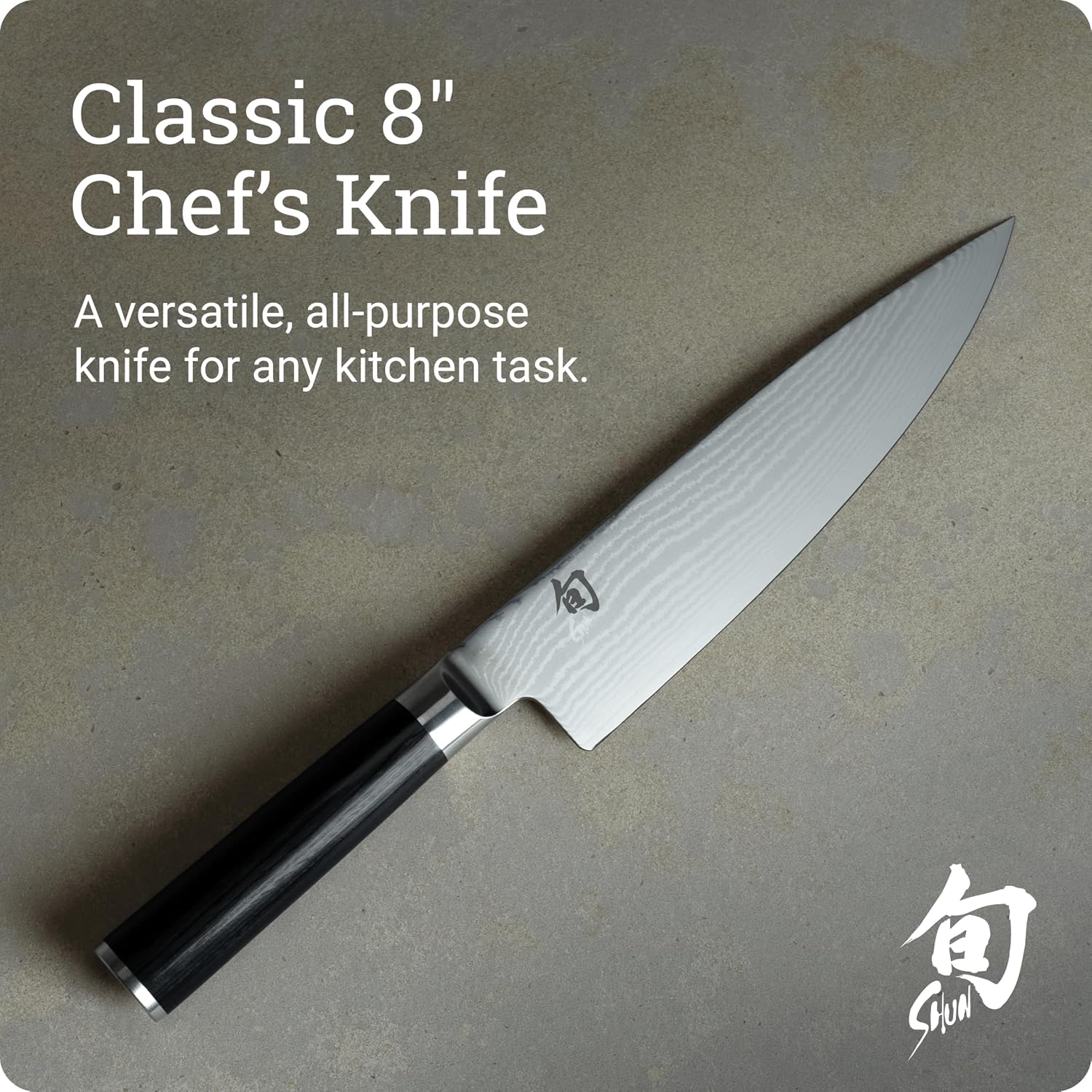
You’re standing in a kitchen-supply store or scrolling through a product page, and you’ve decided you want a Shun — a Japanese-style chef’s knife made by the Kai Corporation, a family-owned cutlery company based in Seki City, Japan’s traditional blade-making center. Shun is one of the most visible Japanese knife brands sold through American retailers, and for good reason: their knives are genuinely well-made, beautifully finished, and backed by a lifetime warranty. But Shun doesn’t make one knife. They make three distinct product families at three meaningfully different price points — and the gap between the entry tier and the top tier can run $150 or more on a single 8-inch chef’s knife. The question worth sitting with before you spend that money is a simple one: what, exactly, are you buying with that premium?
This article breaks down the three Shun tiers — Kanso, Classic, and Premier — with a focus on the steel upgrade that separates Classic and Premier from the entry line. If you already know what “hardness rating” and “edge angle” mean in a knife context, you’ll get the comparison-ready analysis you need. If you’re newer to Japanese knife specs, every term gets defined the first time it appears.
| EDITOR'S PICKShun Classic 8" Chef's Knife | Mid-tierShun Sora 8" Chef's Knife | Budget pick[Misen 8 Inch Chef Knife](https://www.amazon.com/dp/B08WRD2G7M?tag=greenflower20-20) | |
|---|---|---|---|
| Core Steel | VG-MAX | VG10 | AUS-10 |
| Handle Material | Pakkawood | Balanced Handle | — |
| Blade Cladding | Damascus Stainless Steel | 420J Stainless Steel | — |
| Price | $159.00 | $109.95 | $49.00 |
| See on Amazon → | See on Amazon → | See on Amazon → |
The Three Tiers at a Glance
Shun’s lineup as of mid-2026 organizes into three meaningful categories. Here’s the short version before we go deep:
| Series | Steel | Hardness (HRC) | Edge Angle | Street Price (8” chef’s) |
|---|---|---|---|---|
| Kanso | AUS10A | ~61 | 16° per side | ~$130–$150 |
| Classic | VG-MAX | ~61 | 16° per side | ~$175–$200 |
| Premier | VG-MAX | ~61 | 16° per side | ~$200–$230 |
Prices reflect major U.S. retailer listings, May 2026. Shun runs promotional discounts periodically; street price fluctuates ±15%.
The first thing that jumps out: all three tiers share the same published hardness rating. HRC (the Rockwell C scale) is the standard measure of how hard a steel is — harder steel can take a thinner, more acute edge and hold it longer, but it’s also more brittle and more prone to chipping if used roughly. At 61 HRC, Shun sits in the middle of the Japanese knife hardness range. Brands like Miyabi push to 63–66 HRC on some lines; European knives (Wüsthof, Henckels) typically run 56–58 HRC. So within the Shun family, hardness alone doesn’t explain the price differential.
What does explain it is steel alloy, handle construction, and finishing quality — and the differences matter differently depending on how you cook.
Kanso: What AUS10A Actually Gives You
Kanso is Shun’s most recent entry-level line, and “entry-level” here is doing some work — $130–$150 for a chef’s knife is still a serious purchase. The name means “simplicity” in Japanese, and the design philosophy follows: a single-piece AUS10A stainless steel blade, no exposed rivets, a rounded spine for comfortable pinch grip, and a deliberately plain handle in textured black PakkaWood (a resin-stabilized wood composite that handles moisture and heat better than raw wood).
AUS10A is a high-carbon stainless steel from Japan that contains roughly 1% carbon and 0.25% vanadium. The vanadium matters: it promotes fine carbide formation in the steel’s grain structure, which translates to a harder, more consistent edge that holds up better than standard stainless. Per Shun’s published specs, AUS10A achieves the same 61 HRC hardness as their VG-MAX steel.
So why does Classic cost $40–$60 more?
The honest answer from spec-sheet analysis: AUS10A is a slightly less complex alloy than VG-MAX. VG-MAX (a proprietary Shun/Kai steel) adds cobalt and slightly higher chromium content, which manufacturers claim improves corrosion resistance and edge toughness — the steel’s ability to flex slightly under stress rather than micro-chip. Fine Cooking’s feature on steel types in Japanese knives notes that cobalt in particular improves the steel’s grain refinement at high hardness, meaning a finer, more uniform edge is theoretically achievable and more durable under repeated stropping and sharpening cycles.
In practice: for a home cook sharpening two or three times a year and honing regularly, the real-world difference between AUS10A and VG-MAX is genuinely modest. Kanso earns its price for cooks who want a legitimate Japanese knife at the lowest entry point into the Shun family without sacrificing the brand’s lifetime sharpening service.
Classic: The VG-MAX Baseline and Why It Became the Default Recommendation
Shun Classic is the line most reviewers default to when recommending Shun broadly. Wirecutter’s chef’s knife guide has flagged Classic as a strong pick in the Japanese knife category, and it consistently appears in the Serious Eats roundup of best Japanese chef’s knives as a reliable, broadly available option.
The Classic’s spec sheet is worth reading carefully:
- Steel: VG-MAX core, clad in 34 layers per side (68 total) of stainless Damascus steel
- Hardness: 61 HRC
- Edge angle: 16° per side (versus the typical 20–22° on European knives)
- Handle: PakkaWood in ebony finish, D-shaped cross-section, designed for right-hand dominant users (left-handed versions are sold separately)
- Blade thickness at spine: approximately 2mm
The Damascus cladding — those 68 alternating layers of high and low-carbon steel — doesn’t meaningfully change cutting performance. Its function is visual (the wavy pattern) and protective (the softer outer layers cushion the hard VG-MAX core from lateral stress). It also reduces food-release friction slightly along the blade face, though owners report this effect is subtle and diminishes as the cladding is cleaned and polished.
The D-shaped handle is the Classic’s most debated feature. Owners who use a pinch grip — where thumb and forefinger pinch the blade just ahead of the bolster rather than wrapping around the handle — report the D-shape matters less than reviewers sometimes imply; your hand is mostly on the blade anyway. Owners who prefer a full handle grip feel the D-shape more directly, and it is a right-hand-biased design.
Cooks Illustrated’s equipment review notes that the Classic’s 16° edge holds up well through repeated sharpening cycles, but flags that the thin edge geometry requires more careful technique than a European knife — it dislikes board-scraping and twisting motions that thicker Western blades tolerate more easily.
If X, then Classic: You want the full Shun experience, you sharpen at least once a year (or use Shun’s free sharpening return service), you use a pinch grip or are willing to learn one, and you’re buying your primary chef’s knife rather than a secondary or specialty blade.
Premier: What the Upgrade Buys Beyond the Steel
Premier uses the same VG-MAX core as Classic and the same 68-layer Damascus cladding. The hardness rating is identical. The edge angle is identical. What Premier adds is:
-
A hammered finish (tsuchime) on the blade face — small dimples hand-hammered into the surface. The claimed function is air-pocket separation during cutting, reducing food adhesion. Owners consistently report the effect is real but subtle; starchy foods like potatoes or beets release more easily than on a polished Classic blade, but sliced proteins behave similarly on both.
-
A contoured walnut PakkaWood handle in a lighter color, with a more rounded, symmetrical profile. Critically: the Premier handle is ambidextrous, which matters if you’re left-handed or if you’re buying for someone whose handedness you don’t know.
-
Slightly more blade curvature on some Premier SKUs (model-dependent), which suits cooks who prefer a rocking cut motion to the forward-push slice that works best on flatter-profiled blades.
The price premium runs $25–$40 over Classic on comparable SKUs at major retailers. The Serious Eats knife team notes that the Premier’s ambidextrous handle and tsuchime finish make it the better buy for left-handed cooks specifically, and a reasonable upgrade for right-handed cooks who process large volumes of sticky produce.
If X, then Premier: You’re left-handed, or you frequently break down large batches of starchy root vegetables, or the walnut handle aesthetics matter for gifting or display. The steel is not the reason to buy Premier over Classic.
Where the Math Gets Honest
Here’s the comparison that’s worth making explicit:
Kanso → Classic ($40–$60 premium): You get VG-MAX instead of AUS10A — a marginally more complex alloy with cobalt content that theoretically improves long-run sharpening durability, plus Damascus cladding that reduces lateral stress on the core. For a cook sharpening frequently and planning to use the knife for 10+ years, the alloy difference may be meaningful at the inflection point where you’ve sharpened down through 20–30 cycles. For a once-a-year sharpener who will use Shun’s return service, the difference is largely theoretical.
Classic → Premier ($25–$40 premium): Same steel, same edge geometry, same performance. You’re buying handle symmetry, tsuchime finish, and aesthetic differentiation. That’s a legitimate purchase — premium kitchenware has always had an aesthetic dimension — but it’s not a performance purchase.
The cleaner decision frame:
- Cook who sharpens regularly, right-handed, performance-first: Kanso or Classic (Classic slightly edges ahead for long-run sharpening durability per published alloy specs)
- Left-handed cook, or buying as a gift without knowing handedness: Premier
- Entry point into Japanese knives, tightest budget, still want the Shun warranty: Kanso
- Building a set across Shun’s line: Classic as the chef’s knife anchor, then Kanso for specialty blades (utility, boning) where the steel difference matters less
One More Variable: Where Shun Sits in the Broader Market
For context: at the Classic’s $175–$200 price point, the competitive landscape also includes the MAC Professional Series (a perennial Wirecutter recommendation for value at similar HRC ratings), Miyabi’s Birchwood line at higher hardness, and MAC’s MTH-80, which Serious Eats’ equipment testing has repeatedly highlighted for its thin blade geometry and broad Western-cook compatibility.
Shun’s advantage in this competitive set isn’t primarily the steel — it’s the combination of wide U.S. retail availability (Williams Sonoma, Sur La Table, Amazon), a genuine lifetime warranty with a free sharpening return program, and a brand aesthetic that reads clearly as a premium gift. For the gifting market specifically, Shun Classic or Premier in a gift box is a complete, high-value, easily understood present in a way that a MAC or a Misono — both excellent knives — typically isn’t, because brand legibility matters when you’re giving to someone who may not be deep in knife research.
The bottom line: buy Kanso if budget is the primary constraint and you want the Shun warranty at entry price. Buy Classic if you want the full VG-MAX spec and the brand’s flagship experience. Buy Premier if you’re left-handed or gifting without knowing the recipient’s handedness. Don’t buy Premier over Classic chasing a performance upgrade — the specs don’t support it.