You’re standing in front of a knife display — or more likely scrolling through a product page at 11 p.m. — and you keep seeing two abbreviations: VG-10 and AUS-10. Both are Japanese stainless steels. Both show up in beautiful layered (Damascus-pattern) blades. Both are marketed with near-identical language about “superior edge retention” and “high-carbon performance.” The prices overlap between roughly $80 and $300, which makes the choice feel even murkier. If you’re a serious home cook or a culinary-professional-adjacent buyer who’s about to commit real money to a chef’s knife, “they both sound great” is not a useful answer. So let’s pull the spec sheets apart and figure out what’s actually different — and more importantly, what that difference means for how the knife performs in your kitchen, on your sharpening stone, over the next decade.
What the Hardness Number Actually Measures (and Why It’s Only Half the Story)
Both steels are rated on the Rockwell C scale (HRC) — a standardized hardness measurement that tells you how resistant the metal is to deformation under a specific load. Think of it as a proxy for how long an edge holds its geometry before it starts to roll or chip. Higher HRC generally means longer edge life between sharpenings, but it also means a more brittle blade that’s less forgiving of side-load stress — torquing the knife, prying, or landing on a glass cutting board.
By the numbers:
| Steel | Typical HRC Range | Carbon % | Vanadium | Cobalt |
|---|---|---|---|---|
| VG-10 | 60–62 | ~1.0% | ~0.2% | ~1.5% |
| AUS-10 | 58–61 | ~1.05% | ~0.25% | None |
The key differentiator is VG-10’s cobalt addition. Cobalt refines the grain structure of the steel, which allows the blade to hold a finer edge geometry without becoming brittle at that geometry. AUS-10 compensates with a slightly higher vanadium level, which aids wear resistance but does not replicate cobalt’s grain-refinement effect. This distinction is noted in Korin Japanese Trading’s published steel-types educational documentation, one of the clearest plain-language resources available in the professional knife trade.
What this means in practice: a well-ground VG-10 blade from a reputable manufacturer can hold a 15-degree bevel cleanly, while most AUS-10 knives are ground and marketed at 15–18 degrees because the steel is more tolerant of that slightly more robust geometry.
Where Each Steel Has a Structural Advantage
VG-10: The High-Ceiling Steel for Skilled Maintainers
The cobalt-stabilized grain structure of VG-10 means that experienced Japanese knifemakers can thin the blade behind the edge more aggressively. That geometry translates directly into a knife that cuts with noticeably less resistance through dense vegetables, proteins, and herbs. In Wirecutter’s “The Best Chef’s Knife” testing coverage, reviewers consistently flag this “laser-like” thinness behind the edge as the quality that separates premium VG-10 knives from mass-market alternatives.
The tradeoff: if you chip a VG-10 blade — drop it tip-first, let it contact a frozen product, or use it as a prying tool — the repair requires more time on a coarser stone. At-home sharpening on a basic pull-through device will degrade the geometry faster with VG-10 than it does with a softer, tougher steel. For cooks willing to maintain a proper whetstone progression, VG-10 is the right choice. For everyone else, the calculus shifts.
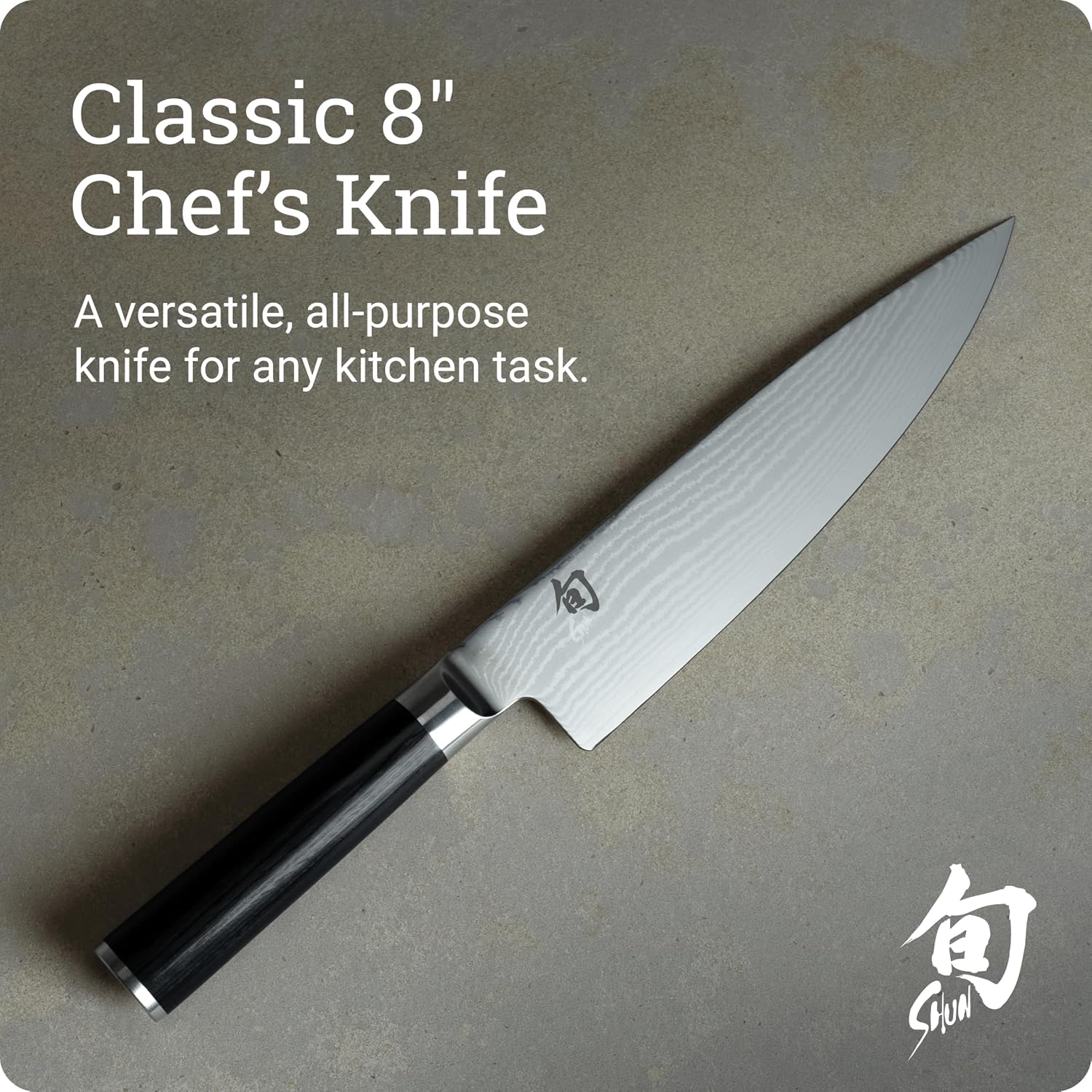
At the premium tier, Shun Classic and Miyabi Birchwood are the standard reference knives in VG-10 — both appear regularly in Serious Eats’ “The Best Chef’s Knives” and Wirecutter’s top picks, and both are widely available through specialty retail and direct brand channels.
Shun
$159.00
In stock on Amazon
Check price on AmazonAUS-10: The Forgiving Workhorse for High-Volume Use
Without cobalt, AUS-10 is tougher in the metallurgical sense — it tolerates lateral stress better and is less prone to micro-chipping under normal kitchen stress. For a cook who uses their chef’s knife as their primary workhorse — breaking down chickens, slicing through butternut squash stems, cutting on whatever board is clean — and sharpens on a ceramic honing rod or a basic whetstone once a month rather than once a week, AUS-10’s slightly lower hardness ceiling is genuinely an advantage.
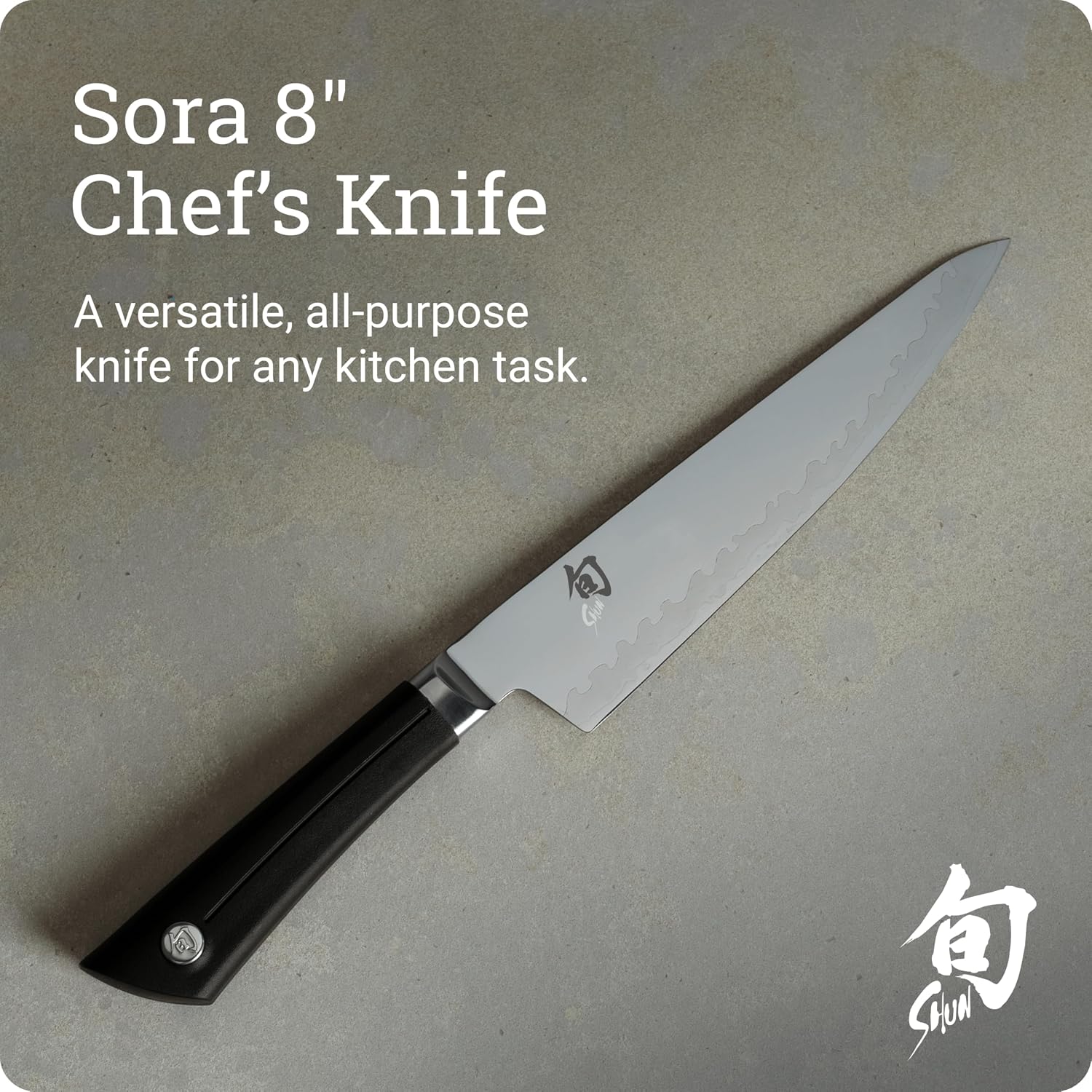
Cook’s Illustrated’s recurring chef’s knife equipment reviews note that mid-range knives using AUS-10 and similar steels earn strong durability marks from home cook reviewers precisely because the steel is forgiving of imperfect sharpening technique and angle inconsistency. Zelite Infinity’s Alpha-Royal series and Dalstrong’s Shogun series both lean on AUS-10 and are frequently cited as value-strong options in the $70–$130 range.
Shun
$109.95
In stock on Amazon
Check price on AmazonMonosteel vs. Laminated Construction: One More Layer of Difference
Most VG-10 blades you’ll encounter in the $150–$300 range are laminated — a VG-10 core sandwiched between softer stainless cladding, then given a Damascus finish by folding or acid-etching those outer layers. That cladding adds lateral toughness to what would otherwise be a brittle core. AUS-10 blades are frequently sold as monosteel or with minimal cladding, meaning the full blade cross-section carries the same hardness and toughness properties throughout.
For budget-conscious buyers entering the Japanese-steel category for the first time, a monosteel AUS-10 knife in the $80–$110 range offers a meaningful step up from basic stainless without the maintenance demands or price premium of laminated VG-10. Brands in this segment — including entry offerings from Zelite Infinity — appear in The Spruce Eats’ “Best Chef’s Knives” buyer’s roundups as reliable starting points for cooks building their first quality kit.

Misen
$49.00
In stock on Amazon
Check price on AmazonThe Damascus Pattern Question: Aesthetic vs. Performance
Let’s be direct about something: in most cases, the Damascus layered pattern you see on knives in this price range is an aesthetic finish, not a performance feature. The term “Damascus” historically referred to a specific folded-steel process that created meaningful structural variation through the blade. What you’re buying on the majority of $80–$250 knives today is either an acid-etched monosteel or a clad blade where the outer layers are decoratively patterned.
Neither Serious Eats’ knife guide nor Wirecutter’s chef’s knife testing has identified a performance difference attributable to the Damascus pattern itself — it does not affect edge retention, sharpenability, or balance. Food and Wine’s “The Best Chef’s Knives, Tested and Reviewed” makes the same point: the visual pattern communicates nothing reliable about steel quality or grind geometry.
This matters for your decision in a specific way: if you’re comparing a VG-10 Damascus knife against a VG-10 non-Damascus knife from the same maker at the same geometry, the Damascus version may cost 15–30% more for a finish that is purely decorative. You’re paying for beauty. That’s a legitimate choice — a 240mm gyuto with a flowing Damascus pattern is genuinely striking on a magnetic wall strip — but don’t let the visual premium confuse you into thinking you’re getting meaningfully different metallurgy.
The Decision Framework: Match the Steel to Your Actual Kitchen Life
If you sharpen on whetstones (400/1000/6000 progression or similar) and you’re comfortable maintaining a 15-degree bevel: Choose VG-10. The steel rewards skilled sharpening with an edge that will outperform AUS-10 over equivalent time between sessions. Shun Classic and Miyabi Birchwood are the standard reference points — both appear across Wirecutter and Serious Eats top picks and carry strong retail and warranty support.
If you sharpen on a honing rod and a pull-through, or you use your knife daily under conditions where chipping risk is real (catering, high-volume home cooking, shared kitchens): Choose AUS-10. The steel is more tolerant of imperfect sharpening angles and lateral stress, and you’ll spend less time recovering from micro-chips. Dalstrong’s Shogun series and Zelite Infinity’s Alpha-Royal series are the most frequently recommended options in this tier across aggregated home cook reviews.
If your primary concern is long-term cost-per-year value: The math slightly favors VG-10 at the premium tier — but only if you maintain it properly. A well-maintained $250 Shun or Miyabi sharpened on a quality whetstone every four to six weeks can deliver consistent performance for a decade or more. An AUS-10 knife at $100–$150 maintained on a pull-through sharpener will see more rapid geometry degradation under daily use without periodic professional resharpening. Cook’s Illustrated’s long-run equipment coverage notes that geometry degradation, not steel failure, is the primary reason home cooks replace knives — which is an argument for either spending up to VG-10 with proper maintenance, or budgeting for annual professional sharpening on your AUS-10 knife.
If this is a registry or gift purchase in the $150–$300 range: VG-10 is the correct call. It reads as a serious, premium choice, the Damascus finish photographs beautifully, and brands like Shun have the retail footprint to support returns and warranty service. The Shun Classic 8-inch appears on nearly every authoritative best-of list — from Serious Eats to Wirecutter to Food and Wine — because it consistently earns that placement in blind testing.
One More Spec You Should Check Before You Buy
Neither VG-10 nor AUS-10 tells you the full performance story without knowing the blade thickness at the spine and the grind geometry. Two knives in the same steel can perform completely differently if one is ground to a full flat grind (thin behind the edge, excellent for slicing) and the other carries a convex or hollow grind. Look for spine thickness at the heel of 2.0–2.5mm for a western-profile chef’s knife, or 1.5–2.0mm for a gyuto with more laser-style geometry. If the product listing omits this number, that’s a meaningful signal — manufacturers with refined grinds typically lead with the spec.
Food and Wine’s knife testing team and Saveur’s coverage of Japanese kitchen knives both make the same point: at the $80–$200 price point, geometry and grind do more work than steel grade alone. A VG-10 blade from a lesser manufacturer with a thick, obtuse grind will perform worse than a well-ground AUS-10 from a house that takes geometry seriously. Steel spec is the input; grind and heat treatment are what determine the output you feel on the cutting board.
The Bottom Line
VG-10 is the higher-ceiling steel — finer edge geometry, longer edge retention under skilled maintenance, the right choice if sharpening is a practice you already have or intend to build. AUS-10 is the more forgiving steel — better for high-volume use without ideal maintenance conditions, less punishing of imperfect sharpening, and genuinely competitive on durability for cooks who aren’t running a whetstone regularly.
The Damascus pattern is beautiful and tells you very little about performance. Check the spine thickness and grind before you commit. And if you’re choosing a gift or a registry anchor in the $150–$300 range, VG-10 from Shun or Miyabi is the recommendation that holds up across every authoritative source — Serious Eats, Wirecutter, Cook’s Illustrated, and Food and Wine — because it’s earned that placement through repeated testing, not marketing spend.