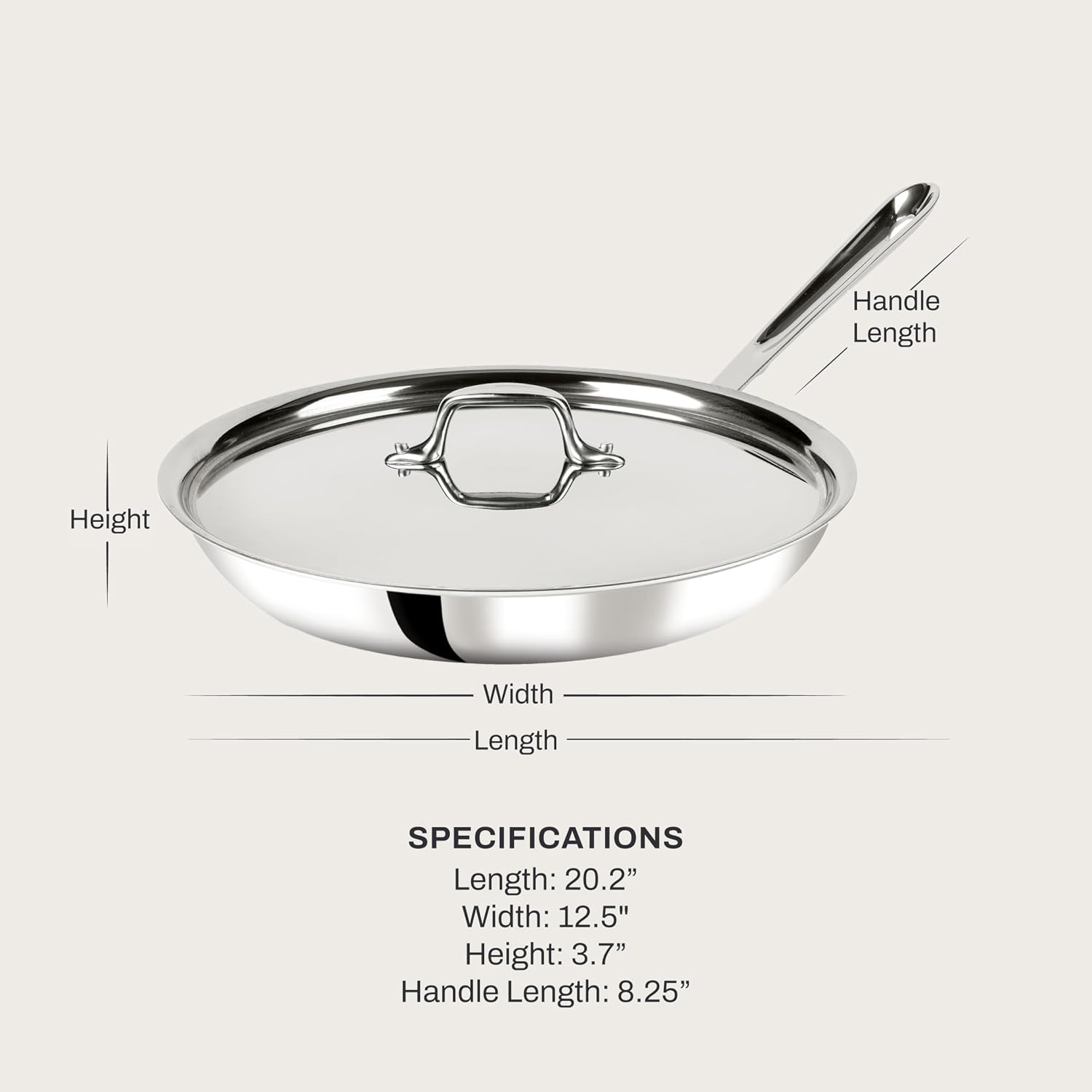
You’re standing in a kitchen store — or more likely scrolling a product page at midnight — staring at a wall of stainless steel skillets that look nearly identical. They’re all shiny. They all claim to heat evenly. And they range from $89 to $420 for what appears to be the same 12-inch pan. The difference, almost entirely, lives in the spec sheet: how many layers of metal the pan contains, how thick those layers are, and how the handle attaches. A tri-ply skillet — “tri” meaning three, “ply” meaning bonded layers — sandwiches a soft aluminum core between two layers of stainless steel. The aluminum conducts heat fast and evenly; the stainless gives you a durable, non-reactive cooking surface. That construction is why a good tri-ply pan sears a chicken thigh evenly from edge to center instead of burning the middle while the rim stays cool. This guide walks you through exactly what to look for on the spec sheet, where the meaningful differences are, and how to match those specs to your actual cooking priorities.
| EDITOR'S PICK[Cuisinart 12-Piece MultiClad Pr…](https://www.amazon.com/dp/B009JXPS6U?tag=greenflower20-20) | Mid-tier[All-Clad D3® Stainless Steel 12…](https://www.amazon.com/dp/B07HSKFGYQ?tag=greenflower20-20) | Budget pick[Tramontina Signature Tri-Ply Cl…](https://www.amazon.com/dp/B00JAP44MQ?tag=greenflower20-20) | |
|---|---|---|---|
| Piece Count | 12 | — | — |
| With Lid | — | ✓ | — |
| Size | — | 12" | 12" |
| Oven Safe | ✓ | ✓ | — |
| Dishwasher Safe | — | — | ✓ |
| Price | $199.96 | $119.95 | $35.35 |
| See on Amazon → | See on Amazon → | See on Amazon → |
Why Construction Thickness Is the Number That Actually Matters
Here’s the tradeoff nobody tells you upfront: a thicker pan heats more slowly but holds heat more steadily once it’s up to temperature. A thinner pan responds faster to burner adjustments. Neither is universally better — they reward different cooking styles.
The industry standard for entry-to-mid tri-ply is a total wall thickness around 2.4 to 2.6 mm. That’s the range you’ll find in the All-Clad D3 Stainless, which Wirecutter’s review by Lesley Stockton consistently cites as the benchmark for this category. At that thickness, you get fast preheat response, good searing performance, and enough thermal mass for most weeknight cooking tasks. Step up to 3.0 mm and above — territory occupied by Demeyere’s Atlantis line (though the Atlantis uses a different five-ply construction) and the heavier All-Clad D5 — and you’re buying more thermal inertia: slower to heat, dramatically more stable under load, better for deglazing without temperature shock.
The practical implication: if you cook on high heat and move fast, a 2.4–2.5 mm pan matches your workflow. If you’re managing delicate reductions, building fond patiently, or moving a pan between burner and oven repeatedly, the extra mass of a 3.0 mm+ construction earns its keep.
What the spec sheet often obscures is where that thickness applies. Some manufacturers publish the wall thickness at the sidewall but use a thicker disk base. Others — including All-Clad in the D3 — run fully clad construction, meaning the tri-ply sandwich extends up the entire sidewall, not just the bottom. This matters when you’re using the pan’s curved sides to toss vegetables or fold an omelette: a disk-base pan with thin stamped sidewalls will show hot-spotting on those walls during high-heat searing. Fully clad construction eliminates that problem. Fine Cooking’s overview of cookware construction describes the distinction clearly: disk-base pans are cheaper to manufacture and work fine for low-to-medium heat applications, but fully clad is the correct choice for anything that involves contact cooking on the sidewalls.
Reading the Layer Breakdown (And When More Layers Aren’t Better)
“Five-ply” and “seven-ply” sound more advanced than three-ply, and sometimes they are — but not always for the reasons marketed. The honest version:
What extra layers can add:
- A thicker or purer aluminum core (more thermal conductivity)
- A magnetic stainless steel exterior layer specifically tuned for induction compatibility
- A harder stainless interior grade (18/10 vs. 18/0) for better corrosion resistance
What extra layers often just add:
- Marketing surface area
- Weight without meaningful performance gain
The All-Clad D5 adds two additional stainless layers bracketing the aluminum core. The published rationale is reduced warping and more even heat distribution across the base. America’s Test Kitchen’s equipment review panel has noted that in practice, the D5’s performance advantage over the D3 is measurable but modest at standard home-cooking temperatures — the meaningful benefit appears at very high sustained heat, which is exactly the use case for a professional-adjacent cook running a supper club or catering operation where burners run hot for hours.
The Demeyere Proline skillet takes a different approach entirely: a 4.8 mm base achieved through a seven-layer construction, with pure aluminum at the core and a Silvinox-treated 18/10 interior. Serious Eats’ review by Sasha Marx notes that the Proline’s heat retention is exceptional and owners consistently report that it maintains temperature even when cold proteins hit the surface — the critical moment where thinner pans drop temperature sharply and interrupt the Maillard reaction (the browning process that creates flavor crust). That’s a real, spec-verifiable advantage. It’s also why the Proline retails around $185–$220 for a 10-inch versus $120–$140 for the All-Clad D3 equivalent.
By the Numbers
| Pan | Total Thickness | Construction | Approx. 12” Retail (2026) |
|---|---|---|---|
| All-Clad D3 Stainless | 2.6 mm | 3-ply, fully clad | $170–$200 |
| All-Clad D5 Stainless | 2.6 mm (5-ply) | 5-ply, fully clad | $220–$260 |
| Demeyere Proline | 4.8 mm base | 7-ply, fully clad | $200–$240 |
| Made In Blue Steel (for reference) | 3.0 mm | Single carbon steel | $109–$129 |
Retail pricing sourced from manufacturer and major retailer listings, May 2026. Pricing fluctuates; check current listings before purchasing.
Handle Design and Oven Compatibility: The Overlooked Specs
Handle construction is where otherwise-knowledgeable buyers stop reading the spec sheet. Two things to verify before you buy:
1. Oven-safe temperature rating. A fully stainless handle (no silicone overmolding, no riveted composite) is typically rated to 500°F or higher in the oven. The All-Clad D3’s stick handle is rated to 600°F. Pans with silicone grips or any polymer component drop that rating to 350–400°F, which eliminates them from finishing thick steaks or braised dishes in a hot oven. Saveur’s cookware buying guide specifically flags oven rating as a non-negotiable spec to check before purchase if you cook with a combined stovetop-to-oven method.
2. Handle angle and balance point. This is harder to spec-sheet and easier to understand from aggregated owner reviews. The All-Clad D3’s handle runs nearly straight, which many cooks find comfortable during long sautés but slightly awkward during the wrist-rolling motion of pan sauces. The Demeyere and Made In handles angle slightly upward from the pan body, which shifts the balance point forward and reduces wrist fatigue during one-handed maneuvering. Neither is correct — this is ergonomic preference — but it’s worth noting that owners in longer reviews consistently raise handle comfort as a factor in daily-use satisfaction.
3. Rivets vs. welded handles. Riveted handles (where metal bolts attach the handle to the pan body through the interior surface) are the traditional professional construction and extremely durable. The tradeoff is that food and fond collect around rivets, making cleanup slightly more involved. Demeyere’s Proline and several Hestan pans use welded handles with no interior protrusions, which owners consistently report as easier to clean and maintain a smooth cooking surface. From a pure durability standpoint, both approaches hold up over years of use when the metallurgy is correct; the rivet concern is largely about cleaning preference rather than structural failure.
Induction Compatibility: What “Induction Ready” Actually Requires
The spec sheet will usually state “induction compatible” or “induction ready,” but the meaningful question is what kind of induction burner you’re running. All induction cooking requires a magnetic exterior layer — and nearly all modern tri-ply stainless uses a magnetic 18/0 or ferritic stainless for the exterior — but the efficiency of induction coupling depends on how well the base makes contact with the cooktop.
A slightly warped base (common on cheaper construction after thermal cycling) reduces the contact surface and decreases induction efficiency — you’ll notice longer preheat times and uneven heating. Fully clad, heavier-gauge pans resist warping because the bonded layers constrain each other’s thermal expansion. This is one legitimate argument for spending up to a 3.0 mm+ construction if your primary cooking surface is induction: the additional thickness pays a durability dividend that maintains induction efficiency over years of use.
Fine Cooking’s material guide notes that induction power delivery is also affected by pan diameter relative to burner zone size. Running a 12-inch pan on an 8-inch induction zone will heat the center efficiently but leave the outer ring comparatively cool — a construction issue no amount of cladding can overcome. Match your pan diameter to your burner zone within an inch or two for best results.
The Decision Framework: If X, Then Y
You’ve read the specs. Here’s the direct version:
If you cook primarily on gas at medium-to-high heat and want fast response: The All-Clad D3 Stainless at 2.6 mm fully clad is the right specification. Reviewers at both Wirecutter and Serious Eats reach the same conclusion independently — it’s not the flashiest spec story but it executes core cooking tasks at a level that justifies the price over years of use. This is the pan the cost-per-year math consistently favors for a general-purpose kitchen workhorse.
If you’re running an induction setup, cooking proteins at high volume, or want maximum thermal stability: Step up to the Demeyere Proline or All-Clad D5 specification. The heavier construction, welded handle, and high-rated induction coupling matter more in that context. The $60–$80 premium over the D3 is real money, but it’s the right tradeoff if you’re at the stove four or five nights a week at professional pace.
If you’re buying for a registry or as a gift at the premium tier: The All-Clad D3 12-inch skillet is the clearest recommendation in this category — widely recognized, useful immediately, long-tenured, and spec-consistent with what recipients will find endorsed in every major equipment review. The Demeyere Proline skillet is the upgrade version of that same gift for a buyer who wants to clearly signal “serious kitchen” rather than “solid kitchen.”
If you’re comparing a 5-ply pan to a 3-ply pan at the same price point: Choose the 3-ply. Extra ply count at the same price almost always means thinner individual layers, not better construction. Published-spec comparisons support this: a 2.6 mm three-ply pan outperforms a 2.6 mm five-ply pan with thinner aluminum core layers, because the thermal conductivity advantage of aluminum depends on its thickness, not just its presence.
The spec sheet is honest if you know how to read it. Total thickness, construction type (fully clad versus disk base), oven rating, and handle design are the four numbers that will tell you more than any marketing paragraph. Everything else — brand heritage, box design, the color of the packaging — is noise. Match the specs to your cooking style, and you’ll buy right the first time.