You’re standing in front of three stainless steel cookware sets, each marketed as “tri-ply” — a term meaning the pots and pans are built from three bonded layers of metal, typically stainless steel on the outside, an aluminum core in the middle for heat distribution, and stainless steel on the cooking surface. The layered construction matters because aluminum spreads heat evenly while stainless steel provides a durable, non-reactive cooking surface. On paper, all three sets you’re comparing — Cuisinart MultiClad Pro, Tramontina Signature, and Made In Cookware — use a version of this same approach. In practice, the price gap between the entry-level option and the top tier runs several hundred dollars, and the construction differences are subtler than the marketing suggests. This article breaks down exactly where that money goes, which tradeoffs are real versus overstated, and how to decide which set belongs in your kitchen.
| EDITOR'S PICKTramontina Signature Tri-Ply Cl… | Mid-tierCuisinart 12-Piece MultiClad Pr… | Budget pickTramontina Signature Tri-Ply Cl… | |
|---|---|---|---|
| Pieces | 12 | 12 | 1 |
| Material | Tri-ply | Triple ply | Tri-ply clad |
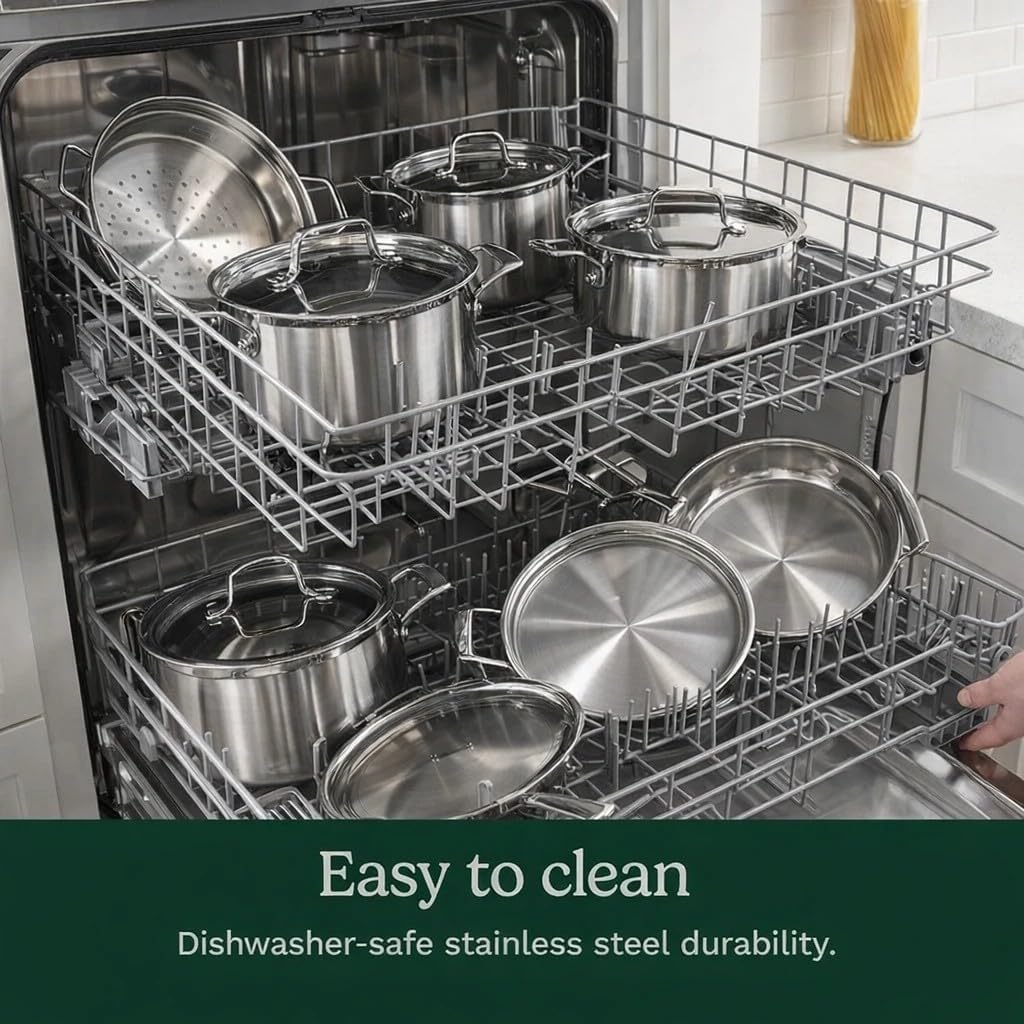
| Dishwasher-safe | ✓ | — | ✓ |
| NSF-certified | ✓ | — | ✓ |
| Made in | Brazil | — | Brazil |
| Price | $299.99 | $199.96 | $30.59 |
| See on Amazon → | See on Amazon → | See on Amazon → |
What You’re Actually Comparing: Construction, Not Just Brand
Before diving into individual sets, it’s worth anchoring on the one spec that separates a functional pan from a frustrating one: total wall thickness and how the cladding is applied.
Cuisinart MultiClad Pro

Tramontina
$30.59
In stock on Amazon
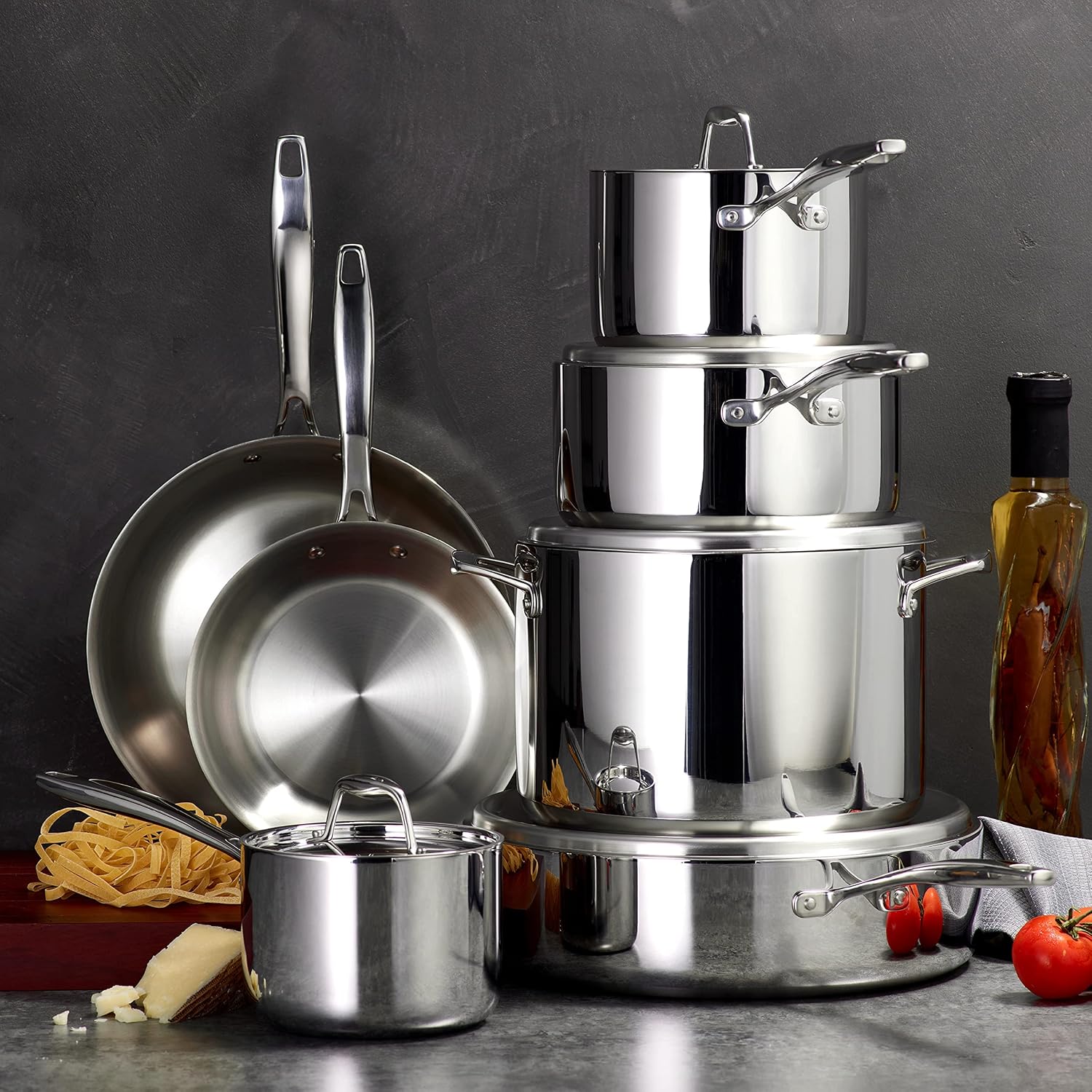
Check price on AmazonCuisinart MultiClad Pro uses a full-clad, three-layer construction — stainless / aluminum / stainless — running the full length of the pan wall, not just the base. Published specs put the total thickness at roughly 2.6mm. The handles are stay-cool stainless, the lids are tight-fitting stainless, and the line is induction-compatible. Wirecutter, in “The Best Stainless Steel Skillets,” and The Spruce Eats, in “Best Tri-Ply Stainless Steel Cookware Sets,” consistently flag it as the most accessible entry point into genuinely full-clad stainless, noting it outperforms disk-bottom pans — where only the base has the aluminum layer — in side-wall heat distribution for tasks like searing and reducing sauces.
A 12-piece set consistently prices in the $200–$250 range, making it the clear budget tier in this comparison. Cuisinart buyers frequently describe using the MultiClad Pro as a workhorse set alongside a smaller collection of premium pieces — a pattern that speaks to its genuine competence across everyday tasks rather than any shortcoming.
Tramontina
$30.59
In stock on Amazon
Check price on AmazonTramontina Signature
Cuisinart
$199.96
In stock on Amazon
Check price on AmazonTramontina Signature steps up in both feel and provenance. The line is NSF-certified — meaning it meets commercial foodservice sanitation standards — and manufactured in Brazil, a detail that reviewers consistently treat as a meaningful quality signal. Wall thickness on the Signature line runs slightly heavier than the Cuisinart, and the fit and finish of the riveted handles is noticeably more refined in owner accounts. Cook’s Illustrated, in “Rating Stainless Steel Cookware Sets,” notes that Tramontina’s construction quality punches above its price relative to comparable competitors in the same tier.
A comparable piece count to the Cuisinart set runs $300–$400 depending on retailer and configuration. The NSF certification and heavier gauge make it a natural choice for cooks who want a set they can abuse in a serious home kitchen — or who cook for larger households where the pans are in constant rotation.
Cuisinart
$199.96
In stock on Amazon
Check price on AmazonMade In Cookware
Tramontina
$299.99
In stock on Amazon
Check price on AmazonMade In is the outlier in this comparison. Where Cuisinart and Tramontina deliver true tri-ply (3 layers), Made In’s flagship stainless line uses 5-ply construction — five bonded layers including two aluminum layers sandwiching a stainless core, all clad in stainless inside and out. Published wall thickness is approximately 3mm. The brand positions itself as a direct-to-consumer alternative to All-Clad, and owner accounts consistently describe a noticeable step-up in sear evenness and thermal stability compared to entry-level stainless.
Building a comparable lineup in open stock or curated bundles runs $400–$600 or more. That premium is real, and whether it’s justified depends heavily on your cooking style and your primary heat source — a distinction addressed in detail below.
Tramontina
$299.99
In stock on Amazon
Check price on AmazonBy the Numbers: A Side-by-Side Construction Comparison
| Brand | Ply Count | Approx. Wall Thickness | NSF Certified | Induction Compatible | Price (12-pc equiv.) |
|---|---|---|---|---|---|
| Cuisinart MultiClad Pro | 3-ply | ~2.6mm | No | Yes | $200–$250 |
| Tramontina Signature | 3-ply | ~2.6–2.8mm | Yes | Yes | $300–$400 |
| Made In Cookware | 5-ply | ~3.0mm | No | Yes | $400–$600+ |
Where the Price Gaps Are Real — and Where They Aren’t
The spread across these three sets is meaningful, but the performance delta depends entirely on which tasks you’re running.
Tasks where all three perform comparably: Deglazing, making pan sauces, boiling pasta, sautéing aromatics, braising on the stovetop. These tasks don’t stress the thermal differences between 2.6mm and 3.0mm walls or between 3-ply and 5-ply construction in ways most home cooks on a gas range will notice.
Tasks where the gap opens up: High-heat searing of proteins, where even heat distribution across the full pan surface becomes more critical; induction cooking, where thicker construction and higher-quality magnetic stainless translates to more consistent electromagnetic response; and long sautés where you’re monitoring fond development, where the extra mass in Made In’s 5-ply walls provides more thermal stability after a cold protein hits the surface.
Serious Eats, in “The Best Stainless Steel Cookware Sets,” highlights this thermal recovery point specifically: a heavier pan with more total mass holds its surface temperature better when a large, cold piece of protein contacts it — which directly affects how even and dark a sear you can build without moving the food repeatedly.
The Preheating Protocol That Fixes Most Stainless Steel Problems
A recurring complaint across all three brands in owner reviews is early sticking — and in nearly every case, it disappears once the cook locks in proper preheating. “Preheat properly” is advice that appears everywhere and explains nothing, so here is what it actually means, step by step.
The water-drop test:
- Place the pan on the burner over medium heat. Do not add oil yet.
- Wait 2–3 minutes. Flick two or three drops of water into the pan.
- If the water sizzles and evaporates immediately, the pan is not hot enough. If it explodes into steam aggressively, it’s too hot.
- The pan is ready when the water drops bead up, skitter across the surface, and then evaporate. This is the Leidenfrost effect — the pan’s surface is hot enough to vaporize a thin layer of water under the drop, letting it slide freely.
- Now add your fat, let it heat for 20–30 seconds until it shimmers, then add your protein.
Serious Eats’ technique coverage explains the Leidenfrost point as the threshold at which proteins are less likely to bond to the metal surface before releasing — which is why adding food to a cool stainless pan (even with oil) is the primary cause of the sticking that frustrates new owners. No reviewers across the Cuisinart, Tramontina, or Made In lines report warping or delamination at the heat levels this protocol involves.
5-Ply vs. 3-Ply on a Home Gas Range: Does It Actually Matter?
Made In’s construction story centers on its 5-ply cladding, and owners consistently describe better sear quality and heat evenness compared to previous stainless pans. But on a home gas range, the difference between 3-ply and 5-ply is less dramatic than it would be on induction or electric.
Gas burners create a ring of heat rather than a flat, uniform surface, and the additional thermal mass of a 5-ply pan does provide more buffering — it absorbs temperature spikes from the outer burner ring more effectively and distributes that heat more evenly toward the pan center. The Spruce Eats, in “Best Tri-Ply Stainless Steel Cookware Sets,” notes this advantage becomes particularly visible when searing a thick steak or a full chicken thigh, where a large cold protein hits the pan and drops its surface temperature sharply. A heavier, thicker pan recovers faster.
On induction specifically, the advantage of 5-ply construction and premium-grade magnetic stainless is more pronounced. The electromagnetic response is more consistent, and the pan’s mass helps regulate the rapid cycling that induction elements can produce in budget units.
The honest decision rule: If you’re on gas and cooking for two to four people, 3-ply from Tramontina or Cuisinart will handle 90% of home cooking without you feeling shortchanged. If you’re on induction, cooking larger volumes, or genuinely care about sear quality as a craft outcome, Made In’s 5-ply construction earns its price premium.
Set vs. Open Stock: Where the Value Math Lands
All three brands offer both full sets and individual pieces, and this is worth thinking through before committing.
The case for buying a set: Sets consistently offer better per-piece pricing than open stock — typically 20–30% savings per piece when you aggregate across what a full set contains. For a first stainless purchase, where you’re equipping from scratch, the set math usually wins.
The case for open stock: If you’re supplementing an existing kitchen, you likely need one 10-inch skillet and a 3-quart saucier, not twelve pieces. Buying open stock means you pay more per piece but don’t accumulate pieces you won’t use.
Food & Wine, in “Best Cookware Sets of 2025,” notes that most serious home cooks use three to five core pieces for 80% of their cooking — a 10-inch and 12-inch skillet, a 3- to 4-quart saucepan, and a stockpot. If that describes your habits, building open stock from Tramontina or Made In for just those pieces often makes more sense than buying a 12-piece set with two small saucepans you’ll store and ignore.
Cook’s Illustrated, in “Rating Stainless Steel Cookware Sets,” reinforces this point: the per-piece value calculation only favors sets when you’ll actually use the majority of what’s included. An honest inventory of your cooking frequency and household size should drive that decision more than the per-piece discount alone.
Frequently Asked Questions
Is Cuisinart MultiClad Pro genuinely close to All-Clad, or is that comparison only valid for certain tasks?
Across aggregated reviews, the Cuisinart handles most home cooking tasks — sautéing, sauce work, braising, boiling — comparably to All-Clad. The gap opens on high-heat searing and induction performance, where All-Clad’s tighter construction tolerances and heavier gauge show up. Cook’s Illustrated testing historically ranks the Cuisinart as the best value in its price tier. The “close enough” verdict is credible for everyday cooking; it’s less credible if sear quality is your primary benchmark.
What is the correct preheating method for stainless steel — and how do you know the pan is ready?
See the water-drop walkthrough above. The pan is ready when water drops bead and skitter rather than immediately evaporating. This is the Leidenfrost point, and it’s the single most reliable indicator across all three brands in this comparison.
Can you cook scrambled eggs on tri-ply stainless without them sticking?
Yes — the technique requires proper preheating to the Leidenfrost point, enough butter to coat the surface fully, and keeping the heat at medium-low rather than medium. The key variable is heat management, not pan quality. All three sets in this comparison handle eggs with the right approach.
Does 5-ply construction meaningfully outperform 3-ply on a home gas range, or mainly on induction?
Both, but the delta is more pronounced on induction. On gas, 5-ply’s advantage is real but modest — better thermal recovery when large cold proteins hit the pan, more even heat across the pan surface. On induction, the thicker construction and premium magnetic stainless layer in Made In’s line delivers noticeably more consistent performance.
Is buying a full set better value than building open stock for these brands?
For a first purchase or a full kitchen setup, sets offer 20–30% better per-piece value. For supplementing an existing kitchen, open stock lets you buy exactly what you’ll use. The honest answer depends on where you’re starting from — and how many small saucepans you’re willing to store.