
You’re standing in front of two cookware brands that everyone in the serious home-cook conversation keeps naming — Tramontina and Made In — and you’re trying to figure out whether the price difference between them is real or just marketing. Both sell what’s called tri-ply clad cookware: pans built from three bonded layers of metal (typically stainless steel on the outside, aluminum in the middle for heat conduction, and stainless on the cooking surface). That sandwich construction is what separates these pans from cheaper single-layer options — the aluminum core carries heat quickly and evenly, so you don’t get scorching at the center while the edges lag behind. The question isn’t whether tri-ply works. It does. The question is whether Made In’s higher price tag buys you meaningfully better performance than Tramontina’s budget-friendly line — or whether Tramontina is quietly one of the best-kept secrets in the cookware aisle. This article breaks that down at three price points, with the math spelled out and a clear decision rule at the end.
What “Tri-Ply” Actually Means for Performance (and Where the Brands Diverge)
Tri-ply is a construction method, not a quality guarantee. Two pans can both be tri-ply and still perform very differently depending on total thickness, the gauge of that aluminum core, and how far the cladding extends up the sidewalls.
Tramontina’s Tri-Ply Clad line — the Brazilian-made, NSF-certified line sold at Costco and through major retailers, not the entry-tier Primaware — is built to roughly 2.6mm total thickness. The cladding runs fully up the sides, which matters for sautéing and reducing sauces. Published specs confirm it is induction-compatible, oven-safe to 500°F, and dishwasher-safe, though hand-washing is always the better call for longevity. Cook’s Illustrated, in its equipment review “The Best Inexpensive Skillet,” has consistently placed the Tramontina Tri-Ply Clad skillet among its top-rated affordable options, noting even heat distribution and comfortable handle geometry as standout qualities.
Made In’s Stainless Clad line publishes a slightly thicker overall construction — around 2.8–3.0mm depending on the piece — and uses a five-ply build on some SKUs (two layers of stainless, two of aluminum, one of stainless at the cooking surface), which the brand markets as enhanced heat retention and reduced warping risk. Serious Eats, in its roundup “The Best Stainless Steel Skillets,” highlights Made In’s responsive heat and well-balanced weight as standout characteristics, particularly for high-heat searing applications.
The honest gap: Made In’s specs are incrementally better on paper — a touch thicker, a touch more aluminum in the stack on five-ply pieces. Whether that increment is perceptible at a home burner is a genuinely open debate. Reviewers at both Food & Wine, in “The Best Stainless Steel Cookware, Tested by Our Editors,” and The Spruce Eats, in “Tramontina Tri-Ply Clad Cookware Review,” note that Tramontina closes the gap substantially for most everyday cooking tasks.
The Three Price Points: Where Your Money Actually Goes
Here’s where the comparison gets concrete. Three common purchase scenarios, mapped to the value story at each tier.
H3: Price Point 1 — The Entry Skillet
A 10-inch Tramontina Tri-Ply Clad skillet retails around $30–$45 at Costco or through major online retailers, occasionally dipping lower on seasonal promotions. Made In’s comparable 10-inch Stainless Clad skillet carries a $99 list price, though the brand runs periodic sales that bring it closer to $79–$89.
| Spec | Tramontina Tri-Ply Clad 10” | Made In Stainless Clad 10” |
|---|---|---|
| Approx. retail (2026) | $30–$45 | $79–$99 |
| Total thickness | ~2.6mm | ~2.8mm |
| Ply count | 3 | 5 |
| Induction compatible | Yes | Yes |
| Oven-safe temp | 500°F | 800°F (handle rated separately) |
The oven-safe ceiling is the most practically meaningful spec difference at this tier. If you regularly finish proteins in a 450°F-plus oven, Made In’s 800°F rating is genuine headroom. If your oven work stays under 450°F — which covers most home cooks — Tramontina’s 500°F limit is a non-issue.
Wirecutter, in “The Best Cookware Sets,” has historically positioned Tramontina as the value pick precisely because the performance-per-dollar ratio at this tier is hard to beat. For a practitioner who needs a workhorse skillet for a second kitchen, a supper-club setup, or a gift for someone just building their kit, Tramontina at this price point is difficult to argue against.
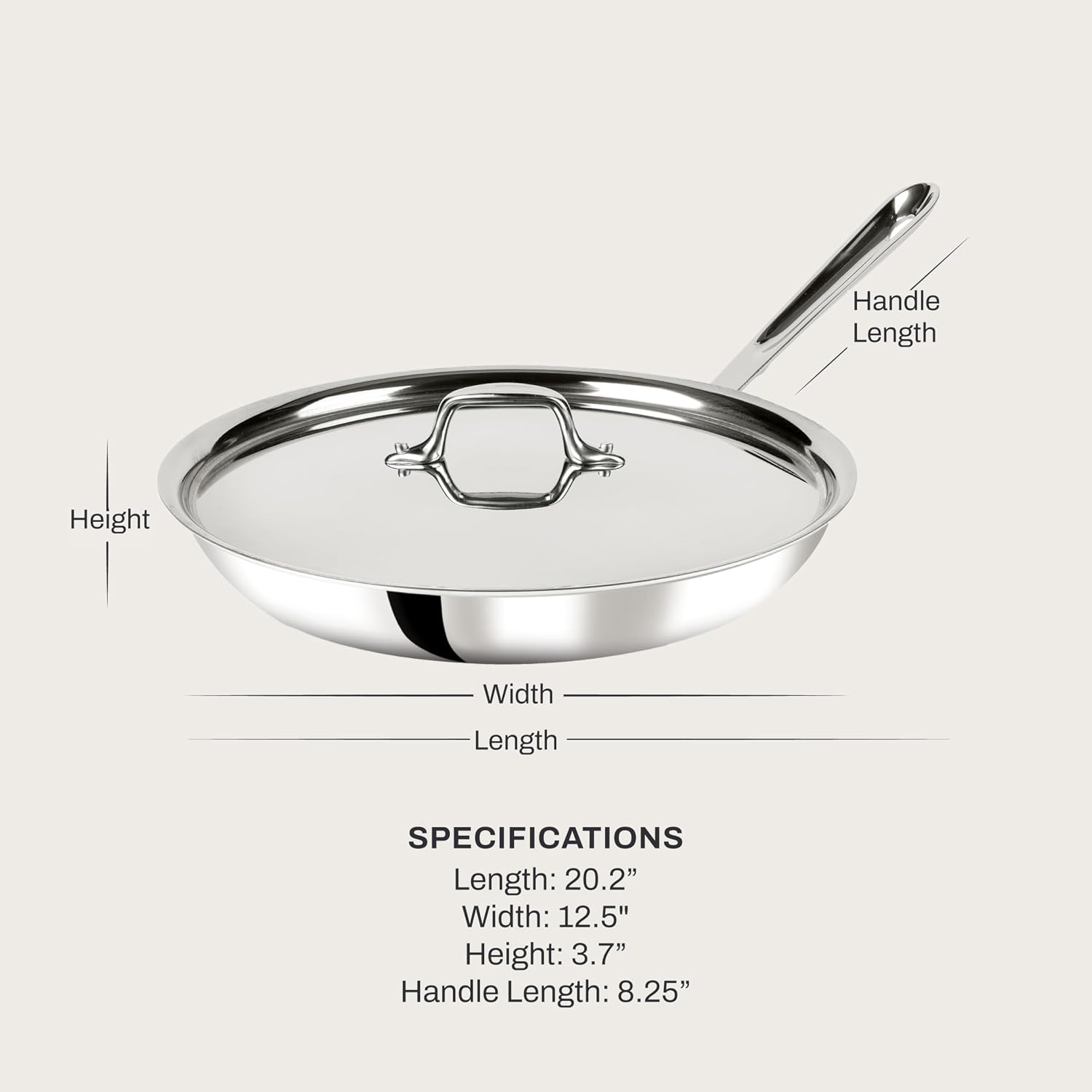
[PRODUCT:Tramontina Tri-Ply Clad 12-Inch Skillet:amazon:mid]

Tramontina
$30.59
In stock on Amazon
Check price on AmazonH3: Price Point 2 — The Core Set
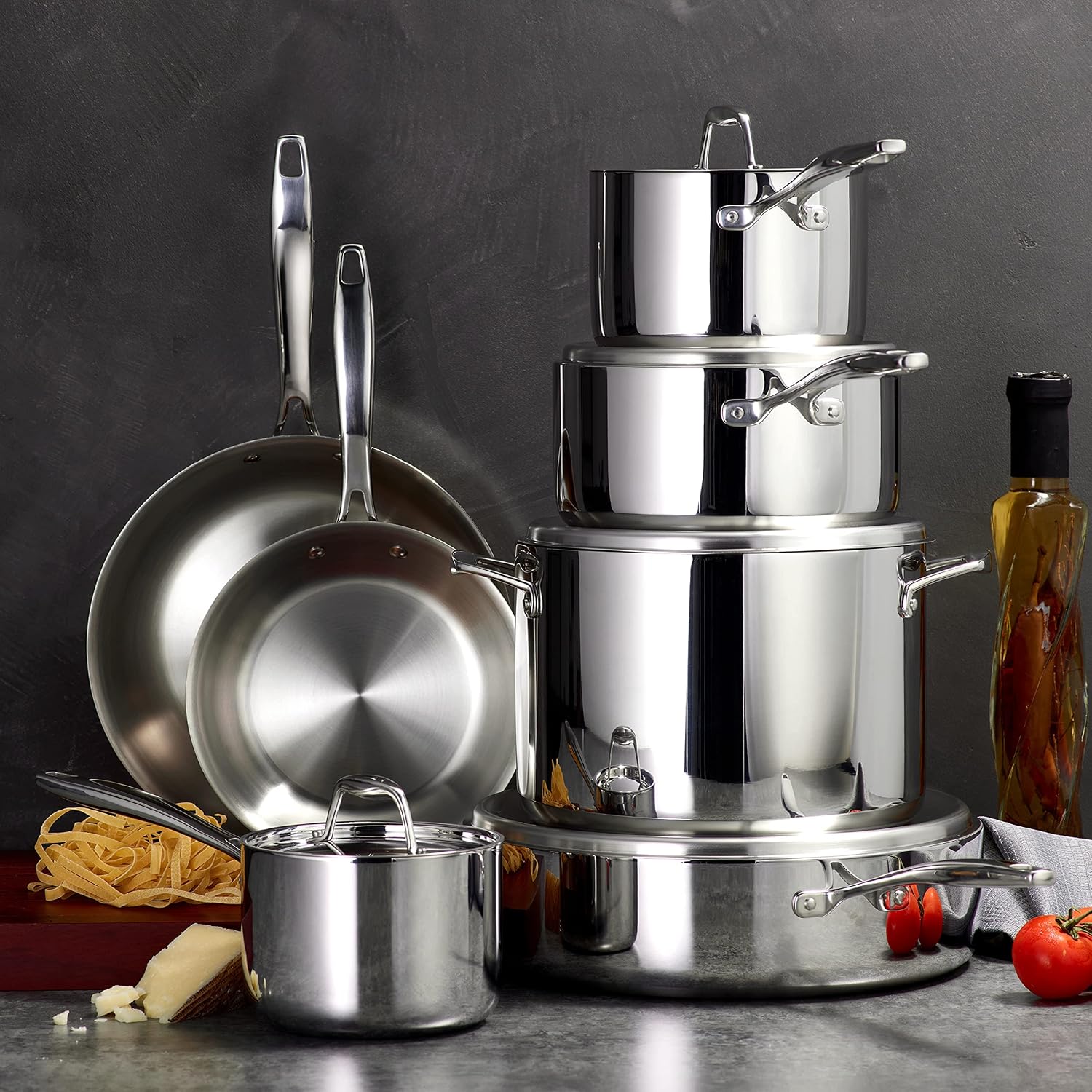
A Tramontina Tri-Ply Clad 10-piece set lands in the $150–$200 range. Made In sells pieces individually and does not package traditional sets, but assembling a comparable eight-to-ten piece collection — two skillets, a saucier, a saucepan, a stockpot — puts you at $400–$500 at list price.
| Spec | Tramontina 10-Piece Set | Made In Comparable Collection |
|---|---|---|
| Approx. retail (2026) | $150–$200 | $400–$500 |
| Ply count | 3 | 5 (select pieces) |
| Sold as set | Yes | Build-your-own |
| Cost per year (15-yr est.) | ~$11.67–$13.33 | ~$26.67–$33.33 |
This is where the cost-per-year math becomes worth running. Assume both brands last 15 years of consistent use — a conservative estimate for either, given proper care:
- Tramontina 10-piece at $175 → ~$11.67/year
- Made In comparable collection at $450 → ~$30/year
The roughly $18-per-year gap has to be justified by performance. For most practitioners, the honest answer is: it depends on what you’re cooking and how you push the pans. Owners who run high-heat sears regularly, or who push pans hard through catering volume, report that Made In’s slightly heavier construction pays dividends in flatness retention over time. For the home cook doing four dinners a week, aggregated owner experience suggests Tramontina holds its shape and surface finish comparably well through years of use. Food & Wine, in “The Best Stainless Steel Cookware, Tested by Our Editors,” notes that the direct-to-consumer cookware segment has become notably more promotional as brands compete for market share, which means the effective price gap between Tramontina and Made In, when both are purchased at optimal timing, is narrower in practice than the list prices suggest.
[PRODUCT:Tramontina Tri-Ply Clad 10-Piece Cookware Set:amazon:mid]
All-Clad
$119.95
In stock on Amazon
Check price on AmazonH3: Price Point 3 — The Flagship Sauté Pan or Saucier
At the individual flagship-piece level — a 4-quart sauté pan, a 3.5-quart saucier — the brands converge on a more interesting question: is this a workhorse tool or a statement tool?
Tramontina’s sauté pan in this size runs $55–$80. Made In’s equivalent lands at $129–$149. For the practitioner who rotates through stock reduction, braises, and sauce work, the sauté pan is arguably the highest-use piece in the batterie.
| Spec | Tramontina Sauté Pan (~4 qt) | Made In Sauté Pan (~4 qt) |
|---|---|---|
| Approx. retail (2026) | $55–$80 | $129–$149 |
| Ply count | 3 | 5 |
| Thermal mass advantage | Moderate | Higher |
| Best for | Everyday sautéing, moderate reductions | Precision sauce work, high-heat volume |
This is where Made In’s five-ply construction starts to matter more practically. The extra thermal mass means slower temperature swings, which translates to more stable reductions and less reactive behavior when you add cold protein to a hot pan. The Spruce Eats, in “Tramontina Tri-Ply Clad Cookware Review,” specifically praises Tramontina’s even heating but notes that more experienced cooks may perceive a meaningful edge in heat stability with heavier-gauge alternatives at higher price tiers. That assessment maps directly to what the five-ply stack is actually doing.
For a single flagship piece that will be your primary working vessel for a decade or more, the per-year cost difference shrinks to near-irrelevance, and Made In earns its premium most clearly here. Serious Eats, in “The Best Stainless Steel Skillets,” underscores this point by recommending heavier-gauge pans specifically for practitioners who want consistent searing results without babysitting burner temperature.
[PRODUCT:Made In Stainless Clad 10-Inch Skillet:amazon:premium]
Tramontina
$299.99
In stock on Amazon
Check price on AmazonThe Retailer Landscape and Pricing Volatility in 2026
One underappreciated dynamic in this comparison: Tramontina’s pricing is more volatile but skews lower; Made In’s pricing is more controlled but the brand runs meaningful direct sales.
Tramontina’s Tri-Ply Clad line appears at Costco (often in bundles), Sam’s Club, and major online retailers. Because it moves through wholesale and big-box channels, prices fluctuate meaningfully — the 10-piece set that sits at $175 in January sometimes drops to $140–$150 around major retail events or in late spring. If you are not in a hurry, watching the price curve on this line pays off measurably.
Made In sells primarily direct-to-consumer through its own site, with occasional retail placements. This means less third-party price variance, but the brand’s own promotional calendar — particularly around spring and fall — tends to produce 20–25% off windows. Practitioners equipping a supper-club kitchen or a professional-adjacent setup who want Made In’s specs but not the full list price should plan purchases around those windows rather than buying at list.
Wirecutter, in “The Best Cookware Sets,” makes the practical point that timing a cookware purchase to a major promotional window can deliver meaningful savings on premium lines — a consideration that applies directly to Made In’s direct-sales calendar. For buyers comparing both brands, the right move is to track Made In’s sale windows and Tramontina’s big-box promotions simultaneously before committing.
Handle Feel, Aesthetics, and the “Feels Premium” Factor
This is worth naming directly because it influences real purchasing decisions even when buyers do not fully acknowledge it: Made In’s handles feel more substantial in hand, with a longer, slightly heavier profile that reviewers consistently describe as having a professional-kitchen character. Tramontina’s handles are comfortable and well-balanced but carry a slightly lighter, more consumer-market aesthetic.
Cook’s Illustrated, in “The Best Inexpensive Skillet,” notes that handle geometry and balance are among the most subjective but practically significant factors in daily pan usability — a point that applies directly here. Tramontina’s handle scores well on balance and grip, but Made In’s longer handle provides a measurable leverage advantage when maneuvering a loaded sauté pan.
If you are hosting supper clubs or working in view of guests, the visual and tactile premium of Made In’s line reads clearly at a glance. That is not a trivial consideration — the “this is what a serious cook uses” signal has genuine value in those contexts, and it is worth pricing in alongside the performance specs. For pure performance-to-price without the optics consideration, Tramontina’s aesthetics are completely respectable at its price tier. But if the pan will be visible and handled by guests or clients, Made In’s presentation advantage is real.
The Decision Rule: If X, Then Y
Here is where this lands, stated plainly.
If you are building or expanding a core batterie and want to maximize coverage per dollar — and your cooking stays under 450°F in the oven — buy Tramontina Tri-Ply Clad. Use the savings to invest in a carbon-steel or cast-iron piece for high-heat work, or toward a better knife. The performance gap at typical home-cook temperatures does not justify doubling your outlay.
If you are equipping a supper-club kitchen, catering setup, or guest-facing cook space where the pan is visible, where you are pushing high heat regularly, or where you want the incremental heat-stability advantage for precision sauce work — Made In is the correct tool, particularly if you time your purchase to a direct-sale window and bring the effective cost down toward $80–$90 per skillet.
If you are buying a single flagship sauté pan or saucier that will be your primary working piece for years — this is the one SKU where Made In earns its premium most clearly, regardless of the rest of your setup. The thermal mass advantage in a sauce pan pays dividends faster than in a skillet, and the per-year cost difference on a single piece is small enough to be irrelevant over a decade of daily use.
The practitioners who end up most satisfied are almost always the ones who mix and match deliberately: Tramontina skillets for volume and backup, Made In or comparable premium pieces for the one or two vessels they live in every day. That is the actual pro-kitchen logic applied at home scale — and it is a smarter allocation than any single-brand loyalty.