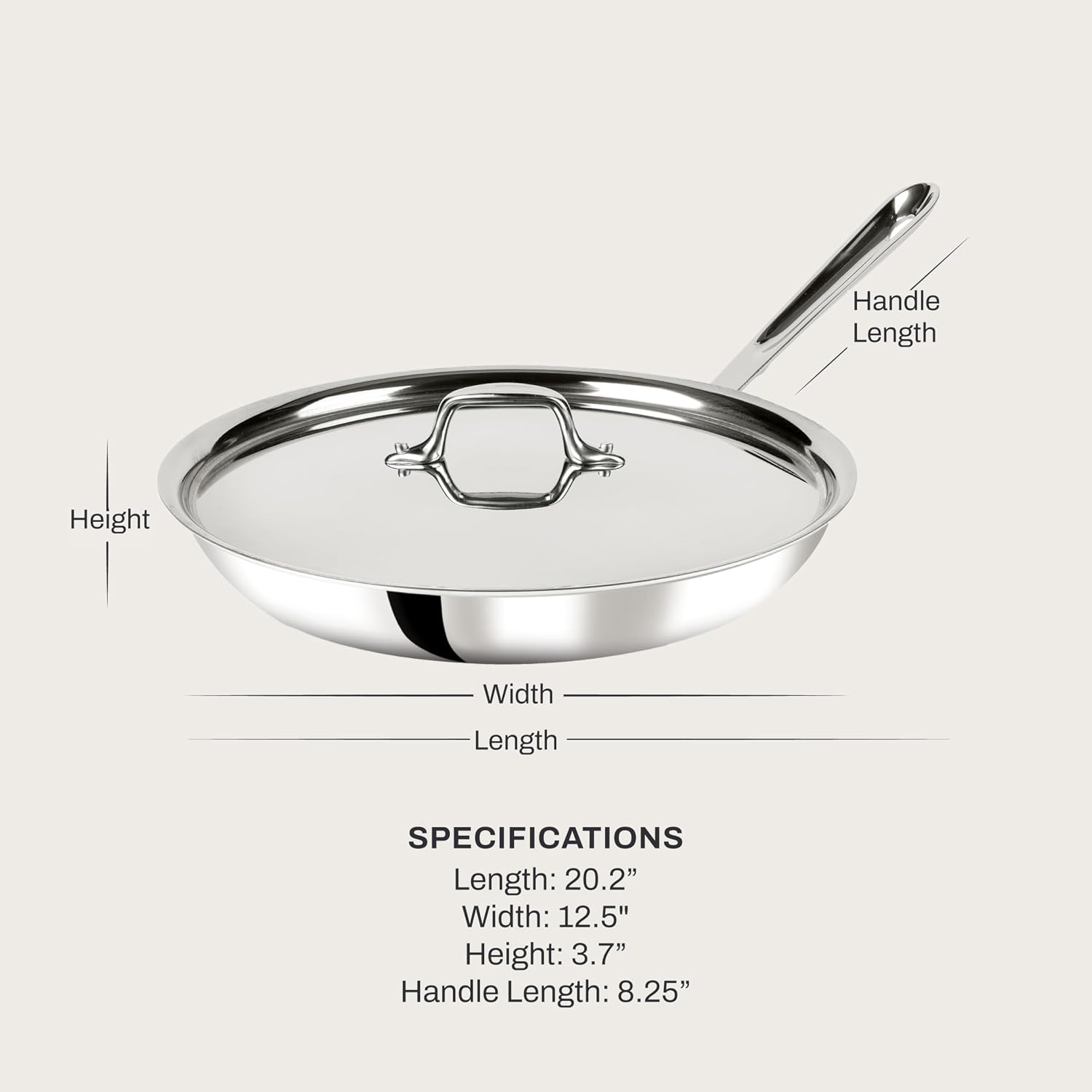
You’ve just watched a chicken breast weld itself to a brand-new stainless steel pan, and now you’re wondering whether the $200 you spent on that skillet was a mistake. You’re not alone — and the pan almost certainly isn’t the problem. Stainless steel is a broad term for cookware made from a steel alloy that resists rust and doesn’t react with acidic foods. Unlike nonstick pans (which have a slippery polymer coating) or cast iron (which builds up a layer of polymerized oil over time), stainless steel has no intrinsic release properties at all. That bare surface is what makes it so durable and so versatile — it can go from stovetop to oven to broiler without a second thought, and it will outlast most other pans in your kitchen by decades. But it demands one specific technique before it cooperates. This guide will show you exactly what that technique is, walk through the real tradeoffs between three of the most widely owned stainless lines — All-Clad D3, Made In, and Tramontina — and give you a clear decision framework for where your money makes the most sense.
The Actual Problem: Preheating, Not the Pan
The sticking failure almost every new stainless cook experiences traces back to a single root cause: the pan wasn’t hot enough before fat was added. Serious Eats’ overview of stainless steel skillets explains the underlying physics clearly — stainless steel is porous at a microscopic level, and when proteins or starches contact a cold or insufficiently heated surface, they bond to those pores before the exterior of the food sets. Once the food’s surface cooks through, those bonds release naturally. Skip the preheat, and you’re fighting chemistry.
The practical fix is straightforward. Cook’s Illustrated’ research on stainless steel cookware identifies the working window as roughly 210–375°F at the pan surface — hot enough to create an immediate sear but below the smoke point of most cooking fats. Here’s how that maps to actual stove behavior:
By the numbers:
- Low-medium heat, 3–4 minutes preheat: ~200–240°F — right for eggs, delicate fish
- Medium heat, 3–4 minutes preheat: ~280–320°F — right for sautéed vegetables, chicken thighs
- Medium-high, 2–3 minutes preheat: ~350–400°F — right for a hard sear on steak
The water-drop test gives you a reliable read without a thermometer. Add a few drops of water to the pan: if they skitter and bead into a single rolling ball, you’re in the sweet spot — this is the Leidenfrost effect, where a thin vapor layer forms beneath the water and keeps it from boiling off immediately. If the drops flash and evaporate instantly, the pan is too hot. If they just sit and simmer, it needs more time.
Fat goes in after the pan is preheated, not before. Swirl it to coat, give it 20–30 seconds, and then add your food. That’s it. Fine Cooking’s guide to stainless steel notes that once cooks internalize this sequence, the complaints about sticking essentially disappear — and many report surprising themselves by preferring stainless over nonstick for everyday work within a few weeks.
Construction Differences That Actually Matter
Once technique clicks, the next conversation is about which stainless pan is worth owning — and here construction genuinely separates the field. The key spec is ply count and core material: stainless steel alone is a poor heat conductor, so quality pans sandwich a more conductive core (usually aluminum, sometimes copper) between stainless layers.
3-ply (tri-ply) clad means two layers of stainless with an aluminum core running through the full body of the pan, not just the base. All-Clad D3 and Tramontina’s Tri-Ply Clad line are both built this way. The aluminum core distributes heat evenly from base to rim, which is why a tri-ply pan performs so differently from a cheap disc-bottom stainless pan (where the conductive layer only covers the base, leaving the sides as heat-dead zones).
5-ply clad adds layers — typically two outer stainless layers, two aluminum layers, and a stainless or aluminum core in the middle. Made In’s stainless line is 5-ply. In theory, more aluminum means more thermal mass and slightly more even heat distribution; in practice, Wirecutter’s review of stainless steel skillets notes that the real-world cooking difference between 3-ply and 5-ply is subtle for most home applications, but the additional mass does translate to more stable temperatures when cooking proteins — less dramatic temperature recovery time after a cold piece of meat hits the pan.
All-Clad D3 has a 2.6mm total thickness and a long track record that owners and reviewers consistently cite as the reliability benchmark. The Spruce Eats’ guide to stainless cookware puts it at the top of its long-run durability consideration specifically because of All-Clad’s bonding process, which resists delamination over decades of thermal cycling. Reviewers across aggregated purchasing data keep returning to two themes: the pans are lighter than expected, and once technique clicks, they become the most-reached-for pan in the kitchen.
Made In’s 5-ply skillet runs slightly thicker at 3.0mm total and is direct-to-consumer. Owners who previously struggled with cheaper stainless pans — thin disc-bottom models that create hot spots and scorch edges — consistently report that the even heat distribution of Made In’s construction gave them their first genuinely successful stainless experience. Wirecutter’s testing notes its handle design as ergonomically comfortable for extended use. The premium over Tramontina is real; the question is whether 5-ply matters to your specific cooking.
Tramontina Tri-Ply Clad occupies a category of its own. Reviewers who also own All-Clad d5 explicitly describe buying Tramontina sets because the price of a single All-Clad stockpot exceeded the cost of an entire Tramontina 12-piece — and they report genuine satisfaction with the tradeoff. One long-run reviewer documented scrambled eggs releasing cleanly from a Tramontina skillet without a spatula assist, cooked on low-medium heat with butter, which is the technique-dependent benchmark most stainless skeptics consider impossible. Tramontina’s total thickness runs around 2.5mm on most pieces, slightly thinner than All-Clad D3, which shows up as marginally faster heat response (a positive for quick sautés) and slightly less thermal buffer (a mild negative when searing large proteins).
The Honest Tradeoffs: Where to Spend and Where to Save
Here’s where the decision framework gets concrete.
If you’re building your first serious stainless kit and you have a limited budget: Tramontina Tri-Ply Clad gives you the material and construction fundamentals — full-clad bonding, induction compatibility, oven-safe to 400°F — at a price point that makes a complete set viable without compromising on the piece that matters most to daily cooking (the 10- or 12-inch skillet). The savings on secondary pieces like stockpots and saucepans are genuine and hard to argue against. You are not buying an inferior product; you’re buying a product with thinner spec margins and less brand cachet.
If you’re adding one centrepiece pan to a mixed kit: All-Clad D3’s 10- or 12-inch skillet is still the default recommendation for most serious home cooks precisely because its long-run review record is so consistent. Owners across thousands of aggregated reviews come back to the same story: bought it 10 years ago, it looks nearly the same, still the most-used pan. That’s cost-per-year math that makes the upfront price easier to absorb.
If you cook proteins at high volume or host regularly: Made In’s 5-ply is worth serious consideration. The extra thermal mass genuinely shows up when you’re cooking multiple chicken thighs or pork chops back to back — the pan holds temperature more stably between additions, which means a more consistent sear across the batch rather than the first piece searing hard and the last piece steaming. Private chefs and supper-club hosts in long-run ownership reviews consistently identify this as the practical differentiator, not marketing language.
On All-Clad lids: lids are sold separately for most All-Clad pieces, and reviewers consistently note sticker shock. The honest answer is that a universal stainless or tempered-glass lid from a restaurant supply source at a fraction of the price fits All-Clad skillets and saucepans without meaningful performance loss. If budget is a constraint, the pan is where the quality investment lives — not the lid.
Frequently Asked Questions
Why do eggs still stick even after I oil the pan? The oil went in before the pan was fully preheated. Cold oil on a warming pan heats unevenly, and proteins bond to the surface before the fat creates a barrier. Preheat the pan first (water-drop test), then add fat, then add eggs. Cook’s Illustrated’s stainless research points to pan temperature — not fat quantity — as the primary variable.
What heat setting should I use for stainless steel daily cooking? Medium heat covers most situations: sautéed vegetables, pan sauces, reheating. Use low-medium for eggs and delicate fish. Reserve medium-high for initial sears on proteins, and cut back to medium once you add liquid. Fine Cooking’s guide to stainless notes that most home cooks chronically overheat their pans, which accelerates sticking rather than preventing it.
Is Made In 5-ply worth the premium over Tramontina 3-ply? It depends on use case. For most daily cooking — sautés, sauces, eggs — owners across both lines report functionally similar results once technique is dialed in. The 5-ply advantage shows up most clearly in high-volume protein cooking where thermal recovery matters. If that’s your primary use case, the premium is defensible. If you’re building a full set across multiple piece sizes, the Tramontina savings on secondary pieces are hard to ignore.
Can these pans go in the dishwasher safely long-term? Technically yes — stainless steel itself is dishwasher-safe, and none of the three brands void warranties over dishwasher use. Practically, Wirecutter and The Spruce Eats both note that repeated dishwasher cycling dulls the interior surface finish and can cause mineral spotting over time. Hand washing with warm water and a small amount of Bar Keepers Friend (a mild oxalic-acid powder) every few weeks takes two minutes and keeps the surface performing like new.
How do I clean burnt food off stainless without scratching? Deglaze while the pan is still warm — add water or another liquid, and most residue lifts immediately. For stuck-on deposits, simmer water in the pan for two minutes, then use a wooden spoon to scrape. Barkeeper’s Friend applied with a soft cloth handles discoloration and mineral deposits. Avoid steel wool or abrasive scrubbers, which leave micro-scratches that give food more surface area to bond to on future cooks.
Does the All-Clad lid justify the price over buying the pan alone? For most cooks, no. The lid’s role is to trap steam and control moisture — a function any properly fitting lid performs. Reviewers and culinary professionals who own All-Clad consistently recommend spending the budget differential on a second pan or a quality splatter screen rather than a brand-matched lid. The pan is where All-Clad’s quality story lives.
The pattern across every long-run stainless owner community is remarkably consistent: frustration early, a technique adjustment, and then a quiet conversion. The pan that used to stick becomes the pan they reach for first. That inflection point — where stainless stops being difficult and starts being reliable — is purely about preheating, not about which brand you own or how much you paid. Get the technique right, and every pan in this category will reward you for it.