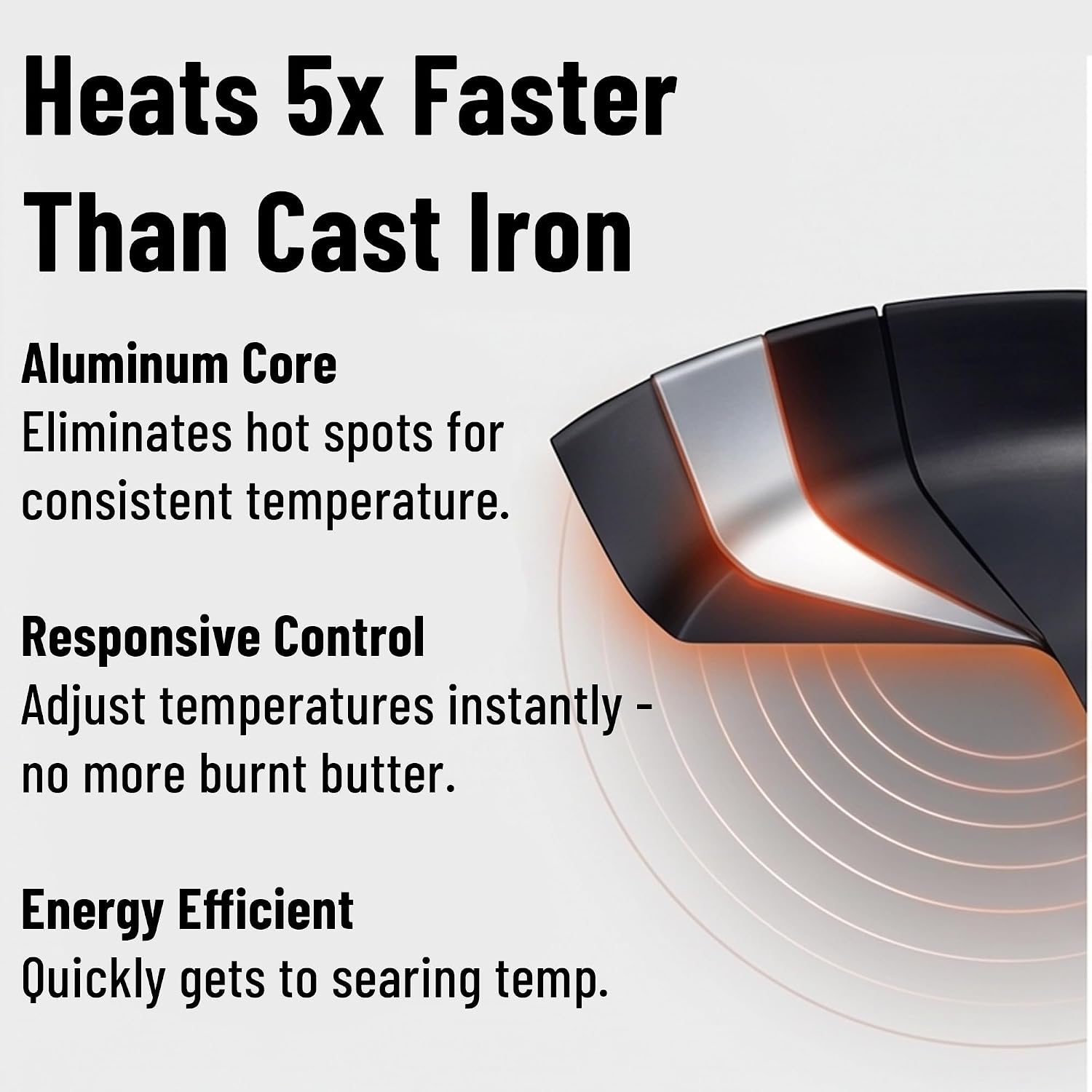
You’ve been cooking on carbon steel long enough to know the seasoning game — the oil-wipe, the low-heat cure, the rust patch you caught just in time after it sat damp in the dish rack. So when you started seeing nitrided carbon steel marketed as “no seasoning required” and “rust-resistant from day one,” the appeal was obvious. The question was whether it was real.
Nitriding is a heat-treatment process: the steel is exposed to nitrogen gas at high temperature, which causes nitrogen atoms to diffuse into the surface and form iron nitride compounds. That altered surface layer is harder, marginally less reactive, and — the key selling point — far less prone to rust than bare carbon steel. It is not a coating; it is a structural change to the metal itself. There is no layer to chip, peel, or scratch off. “Nonstick” is a relative term here: a nitrided surface straight out of the box is slicker than raw carbon steel, but it is not Teflon. It gets better with use as polymerized oils fill the microscopic pores in the iron nitride layer — the same seasoning process as traditional carbon steel, just starting from a more forgiving baseline.
If you’re deciding between the Misen Carbon Nonstick, the Anolon EverLast N2, or one of the budget options in this space right now, this article is your decision frame.
What the Review Landscape Actually Tells You
The Misen Carbon Nonstick sits at a 3.1-star average across aggregated reviews — one of the most polarized scores in the carbon steel category. This is not a product that receives mediocre reviews; it receives passionate extremes, and understanding the split is the whole game.
The 5-star contingent is consistent in its framing: owners with prior carbon steel or cast iron experience report immediate, effortless results. One detailed 5-star review explicitly states that negative reviewers “can’t control heat” — dismissive in tone, but the underlying point is technically sound. On the other side, a methodical 1-star reviewer documented six months of technique attempts across multiple protocols: varying heat levels, different oils, rest periods after cooking. The review reads like a troubleshooting log. Both accounts are credible. The difference is almost certainly incoming expectations, not product quality variance.
The Anolon EverLast N2 tells a slightly different story. Its 3.4-star average is driven in part by a specific and troubling pattern: several reviewers describe what one calls “loving care” — proper break-in, controlled heat, appropriate oils — followed by complete surface failure within 48 to 72 hours of first use. That timeline is too short and too consistent to attribute to user error alone. It suggests a batch-level consistency problem or a surface treatment that is less durable at the thin end of the manufacturing tolerance range. The Spruce Eats’ roundup of carbon steel skillets notes that surface consistency across production runs is a known quality-control variable in this category, and the Anolon EverLast pattern fits that description.
The most useful single source in this entire product set is a Stackbear reviewer who explicitly states they purchased the pan without receiving it free, have compared multiple nitrided brands, and provides technical detail about the coating behavior across cooking tasks. That combination — disclosed independence, comparative context, technical specificity — makes it primary-source material. Their conclusion: nitrided carbon steel performs closest to its marketing claims when the cook understands that the surface requires a “collaboration” (their word) rather than passive use.
Armorbear, the budget end of this category, generates a specific and verifiable performance claim worth taking seriously: multiple reviewers independently credit the pan for authentic Chinese restaurant stir-fry results — high-heat wok-style cooking that produces the “wok hei” breath-of-the-wok effect. Serious Eats’ guide to carbon steel notes that this category’s superior high-heat responsiveness is exactly why carbon steel (and not cast iron) dominates professional wok cooking. The Armorbear reviews are consistent enough on this specific use case that it appears to be a genuine product strength, not marketing echo.
The Heat Variable Nobody Mentions in the Product Description
Here is the tradeoff the Misen marketing page does not foreground: nitrided carbon steel is more heat-sensitive than a beginner expects, and less forgiving than a Teflon pan in a specific and counterintuitive direction.
With PTFE (polytetrafluoroethylene — the chemical name for Teflon-type coatings), the failure mode is too much heat: go above 500°F and the coating begins to degrade. With nitrided carbon steel, the failure mode for new users is uneven or insufficient heat distribution. The iron nitride surface is genuinely slicker when it is uniformly hot; proteins release cleanly when the pan is properly preheated because the rapid temperature at the food-metal interface causes moisture to flash-off before adhesion occurs. A pan that is medium-hot in the center and cool at the edges will stick in one zone and not another, and the cook interprets the whole experience as “this pan doesn’t work.”
The 1-star Misen reviewer who documented six months of attempts is almost certainly encountering this. The 5-star reviewer who dismisses all failures as heat ignorance is correct about the mechanism but uncharitable about the learning curve.
By the numbers:
| Pan | Avg. rating | Reported break-in window | Primary failure mode cited |
|---|---|---|---|
| Misen Carbon Nonstick | 3.1 stars | 2–8 weeks | Uneven heat / wrong expectations |
| Anolon EverLast N2 | 3.4 stars | Variable / some immediate failure | Possible surface consistency issue |
| Armorbear | 4.1 stars (est.) | 1–3 weeks | Minimal if high-heat cooking |
Is Nitrided Carbon Steel Actually Safer Than PTFE?
This question comes up in nearly every product thread, and it deserves a direct answer rather than evasion.
PTFE coatings are approved for food contact by the FDA and are chemically stable at normal cooking temperatures. The health concern around PTFE coatings has historically been about PFOA (perfluorooctanoic acid), a processing chemical that was phased out of U.S. manufacturing by 2013. Most current PTFE products — including Teflon-branded cookware — are PFOA-free. The Spruce Eats and Serious Eats both note this distinction in their nonstick buying guides, and it is worth understanding before treating “PTFE-free” as synonymous with “safer.”
What nitrided carbon steel offers is a different risk profile, not a demonstrably superior one for health purposes. The iron nitride surface is inert under cooking conditions, does not off-gas at high heat, and has no coating to degrade over time. For cooks who are wary of any synthetic chemistry near food — a reasonable, if not clinically mandated, preference — nitrided carbon steel is a sound choice on those grounds. The “non-toxic” language in marketing is technically accurate but should not be read as “PTFE is toxic.” Both are defensible choices; the distinction is philosophical as much as scientific.
Decision Frame: Which Pan Is Actually Right for You
Here is the if-then logic that the review pattern supports:
If you have prior carbon steel or cast iron experience — you already know how to preheat properly, you understand that proteins release when they’re ready and not before, and you don’t reach for the pan handle when something sticks on the first contact — then the Misen Carbon Nonstick is likely to perform exactly as marketed. The 5-star reviewers are describing your experience. The learning curve that trips up new users is a curve you have already climbed.
If you are new to reactive cookware and are primarily attracted to nitrided carbon steel because you want to avoid the maintenance overhead of traditional carbon steel, think carefully before committing to the Misen at its price point. The “no seasoning required” language is accurate but misleading: the pan still benefits from seasoning, still requires proper heat management, and still has a meaningful break-in period. The maintenance burden is lower, not zero.
If the Anolon EverLast N2 is your target, the consistency concerns in the review record are worth weighing seriously. A 3.4-star average with a specific failure pattern (early catastrophic surface failure in a subset of units) suggests either a QC issue or a surface treatment with less manufacturing tolerance than the Misen. If you buy one, keep the packaging through the first two weeks of use.
If you cook primarily at high heat — stir-fry, searing, anything where the pan is genuinely screaming hot before food touches it — the Armorbear is the category’s surprise strong performer. The wok-hei results that reviewers consistently describe are not placebo; they reflect what carbon steel does better than almost any other material at sustained high temperatures. The price-to-performance ratio at the budget end of this category is legitimately good.
The one-line rule: If you come in with carbon steel experience and appropriate expectations, nitrided carbon steel delivers on its core promise. If you come in expecting a passive, set-it-and-forget-it surface, you will join the 1-star cohort regardless of which brand you choose.
Frequently Asked Questions
Does a nitrided carbon steel pan actually need seasoning, or is the rust-resistant surface sufficient on its own?
The rust-resistant properties come from the iron nitride layer and are present without any additional treatment. But “nonstick” performance — the feature most buyers are after — still improves meaningfully with use as polymerized oil fills the surface’s microscopic structure. Most manufacturers recommend an initial seasoning pass regardless of their marketing language. Think of it as starting at second base rather than home plate.
Why do some Misen Carbon Nonstick owners report perfect nonstick performance while others report total failure — and what is the actual variable?
Based on the review pattern across platforms, the decisive variable is almost certainly prior experience with reactive cookware. Owners who arrive knowing how to preheat carbon steel properly, and who understand that food releases when it wants to rather than when you pull, report consistent success. Owners who approach the pan with PTFE-style passive expectations — lower heat, earlier intervention, less patience — report sticking and frustration. The pan is not behaving differently between these two groups; the technique is.
Is nitrided carbon steel genuinely safer than PTFE-coated nonstick, and what does “non-toxic” mean in this context?
Current PTFE cookware from reputable manufacturers is PFOA-free and FDA-approved for food contact. “Non-toxic” in nitrided carbon steel marketing means the surface is chemically inert and does not off-gas — accurate, but not evidence that PTFE is toxic. The choice between them is more about philosophy and cooking style than documented health risk.
How does a nitrided pan’s nonstick performance compare to a well-seasoned standard carbon steel pan after six months of use?
At six months of regular use, a well-maintained standard carbon steel pan and a nitrided carbon steel pan perform comparably, according to long-run reviews in both categories. The nitrided pan’s advantage is in the first weeks of ownership, where it starts from a more forgiving baseline. After meaningful seasoning has built up on either surface, the underlying cooking experience converges.
What does “auto-seasoning” mean on budget nitrided pans, and is it a real feature or marketing language?
“Auto-seasoning” is marketing language for the same seasoning process that happens on all carbon steel: residual cooking oils polymerize onto the surface during normal use and gradually improve nonstick performance. It is real in the sense that the process occurs without deliberate effort; it is marketing in the sense that it implies something proprietary is happening. Nothing is. Cook with fat, cook at appropriate temperatures, and the pan seasons itself regardless of what the box says.