Nakiri Knife Reality Check: What Daily Vegetable Prep Reveals
You’re breaking down vegetables for a Wednesday prep session — a butternut squash, a pile of cabbage, a few bunches of scallions — and your chef’s knife is doing the job, technically. But you keep noticing the accordion effect: thin cabbage slices that stay connected at the bottom because your blade curved away before the cut finished. Maybe you’ve heard about nakiri knives (nah-kee-ree: Japanese vegetable knives with a flat, rectangular blade and a blunt tip) and wondered if one would actually change anything, or whether it’s another specialty tool that sits in a block looking purposeful. This article is for the cook genuinely considering a nakiri — specifically the PAUDIN 7-Inch Nakiri and the HOSHANHO Nakiri — and wants a realistic comparison grounded in what owners actually report, not marketing copy. We’ll cover blade geometry, steel behavior, handle durability, and the single question that determines whether a nakiri earns its spot: will it replace your chef’s knife, or supplement it?
What the Blade Geometry Is Actually Doing
A nakiri’s defining feature is its flat edge profile — unlike a Western chef’s knife, which has a pronounced belly curve designed for rocking cuts, a nakiri’s edge runs nearly parallel to the cutting board along most of its length. This geometry forces a technique change: you’re push-cutting (pressing straight down through the ingredient) rather than rocking the heel-to-tip. That distinction matters more than most buyers anticipate.
Serious Eats, in their roundup “The Best Nakiri Knives, Tested and Reviewed,” notes that the flat profile is specifically engineered to maximize board contact on each stroke — which is what eliminates the accordion effect on leafy vegetables and thin-sliced rounds. The blade doesn’t arc away from the ingredient before the cut completes; it goes through clean. For high-volume vegetable prep, that’s a meaningful efficiency gain, not a marginal one.
PAUDIN 7-Inch Nakiri: Versatility Under Pressure
Where the geometry conversation gets interesting is with dense produce. PAUDIN owners consistently highlight the knife’s ability to split large, hard vegetables — one reviewer describes halving a large butternut squash upright with “relative ease” using a slight rocking motion. That detail is worth pausing on: a slight rocking motion on a flat-profile blade. It suggests the grind geometry on the PAUDIN is forgiving enough to allow modified technique when the ingredient demands it, rather than locking you into strict push-cuts. That’s a real-world advantage for a home cook doing mixed prep rather than a single-ingredient station.
HOSHANHO
$33.24
In stock on Amazon
Check price on AmazonHOSHANHO Nakiri: Precision and Balance
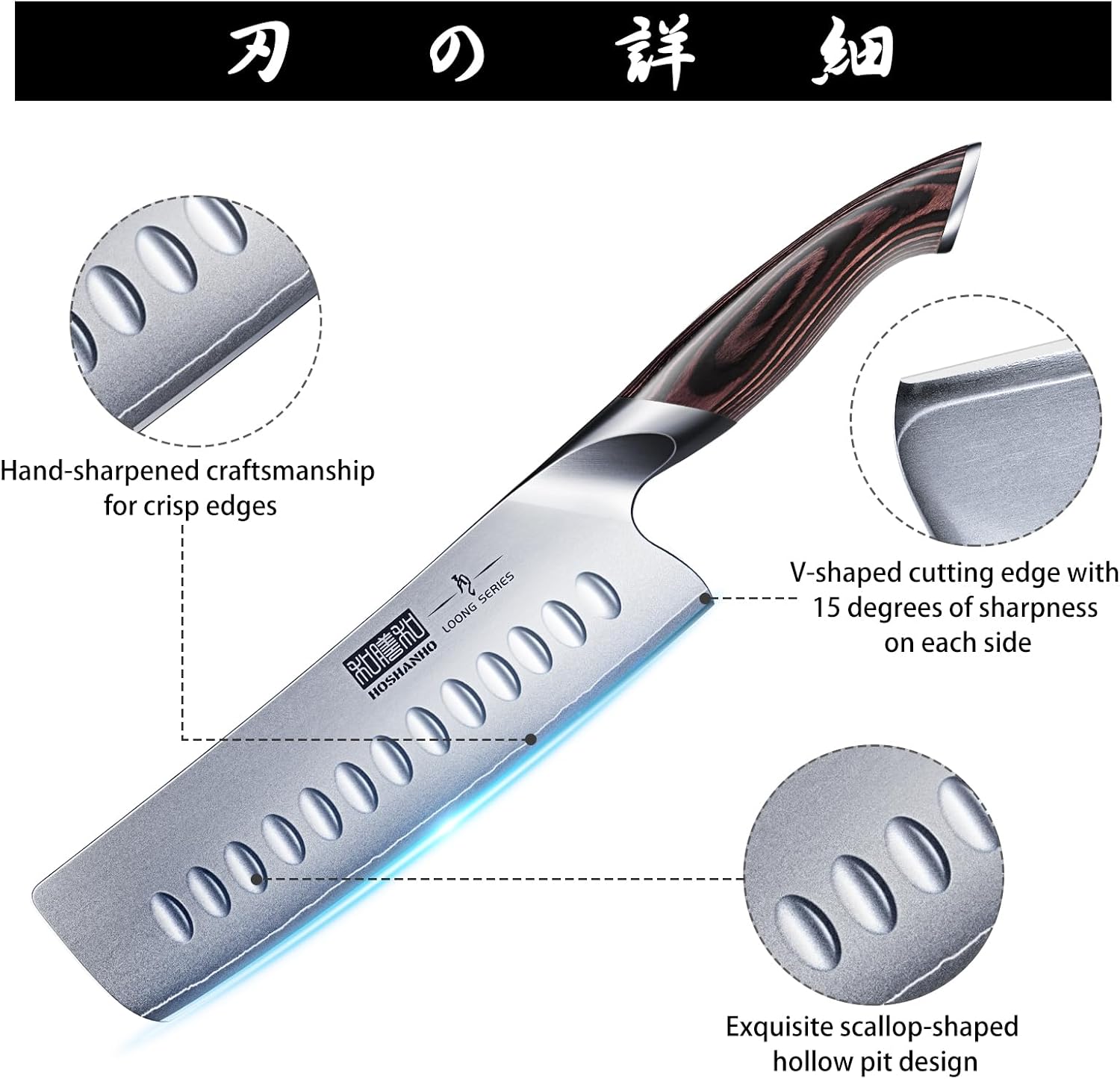
The HOSHANHO, by contrast, generates owner feedback that emphasizes precision and balance over brute versatility. Reviewers describe it as feeling like an extension of the hand rather than a tool being wielded — language that shows up consistently when a blade’s weight distribution is well-engineered. The tradeoff: precision-optimized geometry tends to reward correct technique more than it forgives sloppy form. If you’re still calibrating your push-cut, the HOSHANHO will tell you.
Viking
$599.96
In stock on Amazon
Check price on AmazonHow the Two Profiles Compare in Mixed Prep
For a cook whose week includes both delicate chiffonade and dense root vegetables, these geometry differences have real consequences. The PAUDIN’s more forgiving grind handles the transition between ingredient types with less technique adjustment; the HOSHANHO rewards the cook who has already internalized the push-cut and wants a blade that responds with precision. Neither geometry is wrong — they’re optimized for different prep profiles, and the honest question is which one matches yours.
Viking
$599.96
In stock on Amazon
Check price on AmazonSteel Designations: What “High-Carbon Stainless” Actually Means Here
This is where a lot of budget-nakiri conversation goes sideways, so let’s be precise.
Both the PAUDIN and HOSHANHO are built from high-carbon stainless steel alloys — not fully reactive carbon steel. The distinction matters. Fully reactive carbon steel patinas, can rust if left wet, and requires deliberate maintenance. High-carbon stainless is a hybrid: the elevated carbon content (typically above 0.6%) improves hardness and edge retention relative to standard stainless, while chromium content (above 13%) provides meaningful corrosion resistance.
Cook’s Illustrated, in their ongoing coverage of knife steel types and selection, notes that the trade-off in high-carbon stainless is that neither property is maximized — you don’t get the full reactive edge of carbon steel, and you don’t get the bulletproof rust resistance of low-carbon stainless. What you get is a workable middle ground that suits most home kitchens: better edge retention than standard stainless, significantly less maintenance anxiety than reactive carbon steel.
The published spec on HOSHANHO’s nakiri indicates use of 9CR18MOV steel — a high-carbon stainless with chromium, molybdenum, and vanadium additions that improve hardness ceiling and edge stability. Owners consistently describe the edge as razor sharp right out of the box and, crucially, note it holds that sharpness over repeated use — which suggests the hardness rating (often cited around 58–60 HRC for this alloy) is genuine rather than a factory-only phenomenon. Notably, neither PAUDIN nor HOSHANHO reviews surface rust complaints at scale, which is the clearest signal that these are performing as corrosion-resistant alloys should.
PAUDIN’s published materials reference a similar high-carbon stainless composition. The practical takeaway: for daily vegetable prep without obsessive post-use drying, both knives are appropriate. Neither requires the oiling ritual associated with reactive carbon steel.
Handle Durability and the Pakkawood Question
Pakkawood — resin-impregnated laminated wood — is the standard handle material in this price tier, and it gets a bad reputation it doesn’t entirely deserve. The resin impregnation is specifically designed to address what makes natural wood handles problematic: moisture absorption, warping, and bacteria retention. Food & Wine, in their piece “Japanese Knives Explained,” notes that pakkawood has become the practical choice for knives that will see daily use and real washing, because it behaves more like a stable composite than a wood grain.
The credible caveat from PAUDIN’s review pool is a reported hairline split in handle material on arrival — not from use, but as a manufacturing defect. That distinction is important. Structural failures from regular use would indicate a material problem; pre-shipment defects indicate a QC inconsistency. The more meaningful signal is what happened next: PAUDIN responded immediately with a replacement. For a knife at this price point, that responsiveness is a genuine differentiator. A buyer who hits a QC issue and gets a no-friction replacement is ultimately in a better position than someone who bought up into a brand with worse service response.
HOSHANHO handle reviews don’t surface comparable complaints, which could mean tighter QC, a different lamination process, or simply a smaller review sample. Neither handle is dishwasher-safe in any meaningful sense — hand washing and periodic air drying is the correct maintenance protocol for both.
By the Numbers
| Feature | PAUDIN 7-Inch Nakiri | HOSHANHO Nakiri |
|---|---|---|
| Published steel | High-carbon stainless | 9CR18MOV stainless |
| Approximate HRC | ~56–58 | ~58–60 |
| Handle material | Pakkawood | Pakkawood |
| Notable owner feedback | Hard-produce versatility, strong QC response | Balance, out-of-box edge retention |
| Rust reports in reviews | Minimal | Minimal |
HOSHANHO
$33.24
In stock on Amazon
Check price on AmazonThe Decision Frame: Supplement or Replace?
Here’s the honest version of the chef’s-knife-versus-nakiri question: a nakiri will not replace a chef’s knife. It will not break down a whole chicken, mince fresh herbs effectively, or handle the curved geometry of an onion with the same fluid motion a chef’s knife allows. What it will do, executed correctly, is outperform a chef’s knife on high-volume, flat-surface vegetable prep — specifically thin-slicing, chiffonade, and push-cutting dense roots and squash where the flat profile’s board contact is a direct advantage.
Wirecutter, in their guide “The Best Chef’s Knife,” frames the generalist-versus-specialist question clearly: a chef’s knife is the generalist tool, and any specialist blade earns its place by being meaningfully better at a specific task — not marginally better at most tasks. If your prep workflow is vegetable-heavy — you’re doing mise en place for a supper club, running a CSA-box meal prep routine, or working through weekly produce in volume — a nakiri justifies the addition. If you cook proteins three nights a week and vegetables are supporting players, your chef’s knife does not have a gap the nakiri fills.
If X, then Y:
- If vegetable prep represents more than 40% of your weekly knife time → the nakiri earns its slot; the PAUDIN offers more versatility for mixed dense-and-delicate produce.
- If you prioritize edge longevity and precise technique over hard-produce versatility → the HOSHANHO’s balance and published steel spec make it the stronger pick.
- If you’re adding this to a knife block that already includes a quality chef’s knife → either works; buy on the strength of the handle feel you prefer, since both steel types will serve you well.
Frequently Asked Questions
What is the difference between push-cutting and rocking with a nakiri, and does blade geometry force you to change technique?
Push-cutting means driving the blade straight down through the ingredient in a single stroke, with the flat edge maintaining full contact with the board. Rocking uses the curved belly of a chef’s knife to roll the blade forward through the cut. A nakiri’s flat profile is optimized for push-cutting — the geometry doesn’t support a true rock the way a Western blade does. That said, PAUDIN owners report that a slight modified rock is possible for hard produce like squash. The technique shift is real but not steep; most cooks adapt within a single prep session.
Will a nakiri replace a chef’s knife for everyday prep, or is it a specialist tool?
Specialist, not replacement. A nakiri excels at vegetable prep — thin slicing, julienne, chiffonade — but won’t handle proteins, curved produce like onions, or fine herb mincing as fluidly as a chef’s knife. It belongs alongside your chef’s knife, not instead of it.
How do you store a nakiri safely — block, magnetic strip, or blade guard?
All three work. A magnetic strip is preferred for a blade with a thin grind, because block storage causes repeated edge contact on wood each time you insert and remove the knife. A blade guard is the minimum for drawer storage. Avoid loose drawer storage entirely — it damages the edge and creates a safety hazard.
Does the pakkawood handle on budget nakiris hold up to daily washing and moisture?
Pakkawood is resin-impregnated and significantly more moisture-stable than natural wood. Hand washing and air drying is the correct protocol; dishwasher use will degrade any wood-composite handle over time regardless of resin content. With proper care, pakkawood handles on both the PAUDIN and HOSHANHO should perform without warping or cracking under normal use.
Is high-carbon stainless steel on a nakiri prone to rust if left wet, and how should you maintain it?
High-carbon stainless is not fully rust-proof, but it is substantially more corrosion-resistant than reactive carbon steel. Leaving either knife wet overnight is inadvisable; a quick hand-dry after washing is sufficient maintenance. Neither PAUDIN nor HOSHANHO reviews surface rust complaints at volume, which aligns with what the steel designations would predict. No oiling ritual is required — that is a reactive carbon steel practice, not applicable here.