You’re staring at a Japanese knife listing and the spec sheet reads something like “VG10 core, 67-layer Damascus cladding, 60 HRC, 15° bevel.” If you’ve been in the knife world long enough to know those terms exist but not quite long enough to know which ones actually move the needle, you’re in exactly the right place. Steel grade — the alloy recipe the blade is made from — is the single most-cited spec in Japanese knife marketing. It’s also, according to aggregated owner reviews and editorial analysis from outlets like Serious Eats and Wirecutter, one of the least predictive factors in day-to-day satisfaction. What predicts satisfaction? Technique, care habits, and honest expectation-setting about how a Japanese knife behaves differently from the heavier German-style blades most cooks started with. This guide breaks down the four grades you’ll encounter most — VG10, VG-MAX, 9Cr18MoV, and AUS-10 — so you can read a spec sheet confidently, understand the real tradeoffs, and stop second-guessing the purchase you already know you want to make.
| EDITOR'S PICKShun Classic 8" Chef's Knife | Mid-tierShun Sora 8" Chef's Knife | Budget pick[Misen 8 Inch Chef Knife](https://www.amazon.com/dp/B08WRD2G7M?tag=greenflower20-20) | |
|---|---|---|---|
| Core Steel | VG-MAX | VG10 | AUS-10 |
| Blade Cladding | Damascus Stainless | 420J Stainless | — |
| Handle Material | Pakkawood | — | — |
| Knife Style | — | Gyuto | — |
| Price | $159.00 | $109.95 | $49.00 |
| See on Amazon → | See on Amazon → | See on Amazon → |
What the Steel Grade Is Actually Telling You
A steel grade is shorthand for an alloy formula — a specific ratio of iron, carbon, chromium, and trace elements like molybdenum, vanadium, and cobalt. Each element plays a role:
- Carbon raises hardness, which allows a finer edge and longer edge retention, but also makes steel more brittle and more susceptible to chipping under lateral stress.
- Chromium (typically 13–18% in stainless or semi-stainless Japanese steels) builds corrosion resistance. More chromium = less rust risk, but too much can soften the steel.
- Vanadium and molybdenum refine grain structure and improve wear resistance — the knife holds its edge under repeated use rather than just sharpening to a fine point that quickly rolls.
- Cobalt (present in VG10 and VG-MAX) acts as a binder that lets the steel achieve higher hardness without sacrificing too much toughness.
The hardness number you’ll see on spec sheets — HRC, which stands for Rockwell Hardness Scale, C scale — is the output of all those ingredient decisions plus the heat treatment applied during manufacturing. Japanese knives typically run 58–67 HRC, versus 56–58 HRC for most European blades. Higher HRC means a harder steel that takes and holds a sharper edge, but also a steel that’s less forgiving if you torque the blade sideways or land it on a hard bone.
The practical takeaway: steel grade sets the ceiling; heat treatment and geometry determine whether you reach it.
The Four Grades, Side by Side
VG10 — The Reference Standard
VG10 (manufactured by Takefu Special Steel in Japan) has been the dominant premium stainless steel in Japanese consumer knives for roughly two decades. Its composition includes approximately 1% carbon, 15% chromium, 1% molybdenum, 0.2% vanadium, and 1.5% cobalt. Spec sheets from major manufacturers put finished VG10 blades at 60–61 HRC.
In practice, reviewers at Serious Eats and Cook’s Illustrated consistently describe VG10 knives as the benchmark against which other Japanese stainless grades are measured — easy to sharpen on whetstones from 1,000 to 6,000 grit, capable of taking a very acute edge, and resistant enough to chromium content to handle normal kitchen moisture without babying. The tradeoff is brittleness relative to softer German steels: VG10 chips rather than rolls when stressed, so technique matters. Owners who transitioned from European knives and researched the switch consistently report that the thinness and lightness of VG10 blades — not the steel spec itself — was the deciding factor in their experience.
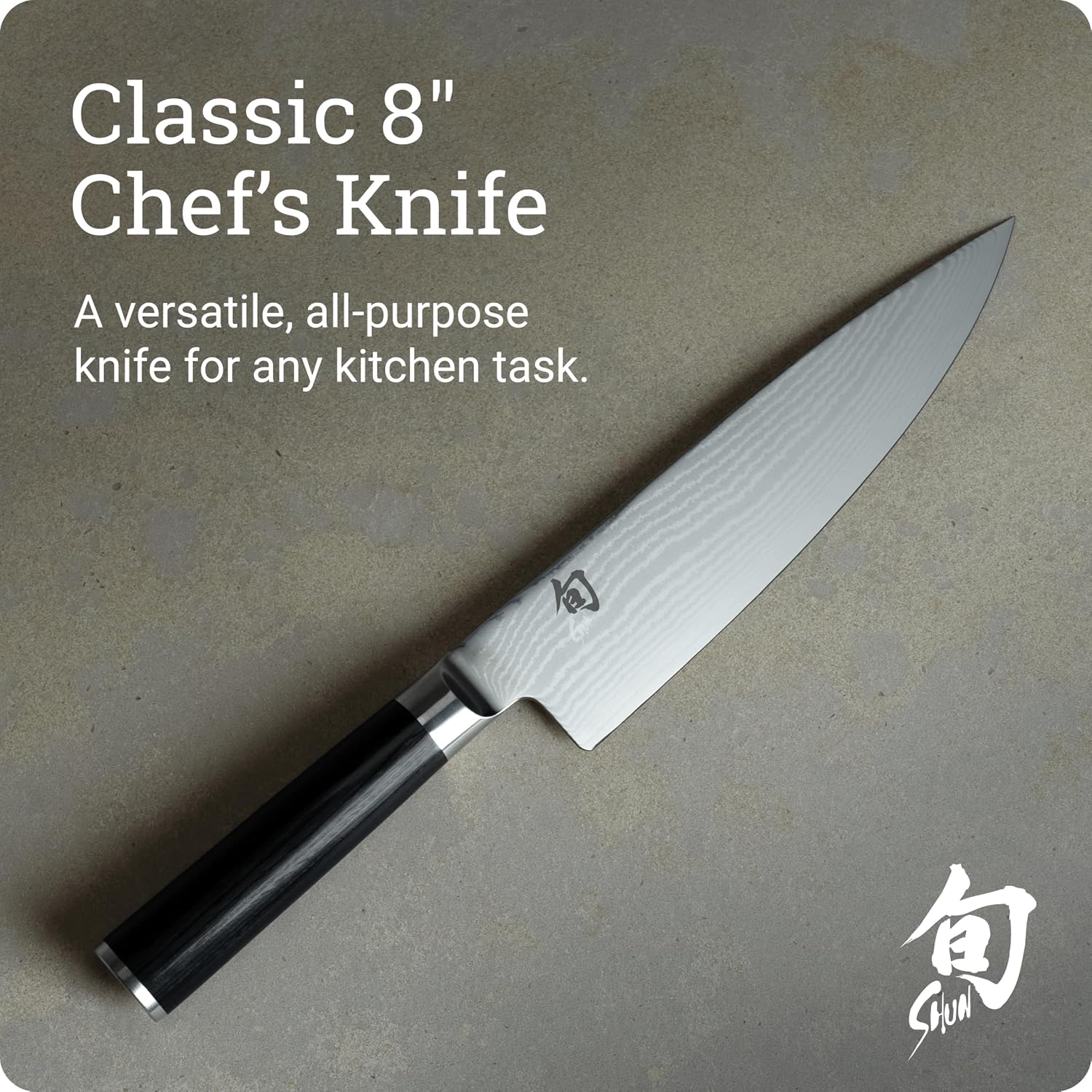
Shun Classic is the most widely reviewed VG10 knife in the North American market. Owner accounts across aggregated reviews emphasize the knife’s thinness as a strength and flag its delicacy — meaning the need to avoid lateral force, hard bones, and frozen food — as a serious consideration rather than a product flaw.
VG-MAX — VG10’s Proprietary Evolution
VG-MAX is Shun’s exclusive steel, developed with Takefu. The published formula adds more carbon (~1.05%), more chromium (~15.5%), more vanadium (~0.3%), and more cobalt (~2.5%) relative to standard VG10. The intent, per Shun’s published materials, is finer grain structure — which allows a more acute, more consistent edge geometry — and slightly improved wear resistance.
In real-world owner accounts, the VG10-versus-VG-MAX difference is subtle enough that professional reviewers at Fine Cooking and Wirecutter generally describe it as meaningful on the margin rather than a categorical upgrade. One long-reviewed Shun Premier account from a reviewer with two decades of professional cooking background describes it with genuine authority and flags its delicacy as a real consideration — not a complaint, but an honest assessment that this steel rewards technique. The delta between VG10 and VG-MAX matters most to cooks who sharpen meticulously and push to very acute edge angles (10–12° per side). For most home cooks sharpening to 15°, the grain refinement difference is difficult to perceive in daily use.
By the numbers — VG10 vs. VG-MAX vs. AUS-10 vs. 9Cr18MoV:
| Grade | Typical HRC | Chromium % | Notable Additive | Sharpenability |
|---|---|---|---|---|
| VG10 | 60–61 | ~15% | Cobalt, vanadium | Moderate-easy |
| VG-MAX | 61–62 | ~15.5% | More Co + V | Moderate-easy |
| AUS-10 | 60–62 | ~13.5% | Vanadium | Easy-moderate |
| 9Cr18MoV | 58–60 | ~18% | Molybdenum | Easy |
AUS-10 — The Value-Tier Overperformer
AUS-10 is a Japanese stainless steel (produced by Aichi Steel) with roughly 1% carbon, 13–14.5% chromium, and vanadium for grain refinement. Its hardness ceiling — 60–62 HRC depending on heat treatment — sits competitively with VG10. The lower chromium content relative to 9Cr18MoV means slightly less corrosion resistance, but still well within stainless territory for normal kitchen use.
The story owners and culinary-professional-adjacent reviewers tell about AUS-10 is one of recalibrated expectations. Misen’s AUS-10 gyuto has been reviewed extensively by buyers with restaurant management backgrounds who report surprise at the sharpness and edge retention relative to price. The repeated framing is “everyday carry” — a knife you use without ceremony, sharpen regularly, and don’t worry about. That positioning distinguishes AUS-10 entries from the more intentionally handled Shun lineup, and it’s an honest distinction rather than a marketing one. AUS-10’s slightly lower chromium content means it’s slightly more forgiving to sharpen (the steel is marginally less abrasion-resistant at the surface), which makes it a natural recommendation for cooks who sharpen their own knives on whetstones and want faster feedback from the stone.
9Cr18MoV — High Chromium, Entry-to-Mid Positioning
9Cr18MoV is a Chinese-produced stainless steel (the naming convention encodes its composition: 0.9% carbon, 18% chromium, molybdenum and vanadium). The 18% chromium content is notably high — higher than VG10 or AUS-10 — which is why manufacturers market these knives aggressively on rust resistance. The tradeoff is that high chromium slightly inhibits maximum hardness; finished 9Cr18MoV blades typically top out at 58–60 HRC, a step below the VG10 tier.
In practice, this means 9Cr18MoV knives are easier to sharpen (the steel is less wear-resistant at the surface and comes off the stone quickly), hold a serviceable edge for general prep work, but won’t reach the acute geometry or long intervals between sharpenings that VG10 and AUS-10 allow. For a home cook who doesn’t sharpen often and wants a low-maintenance Japanese-style blade, 9Cr18MoV is a rational choice. For someone investing in sharpening skill, the ceiling is lower than the other three grades.
What Actually Predicts Owner Satisfaction
Aggregated review patterns from Serious Eats, Wirecutter, and Cook’s Illustrated point to the same three variables, consistently, regardless of steel grade:
1. Edge angle and geometry. Japanese knives are typically ground to 15–16° per side (some to 10–12°), versus 20–22° for most European blades. The acute angle is what creates the effortless slicing feel owners describe — not the steel grade. That same acute angle is also why the knife chips when you twist it in a hard vegetable: geometry, not material failure.
2. Heat treatment. Two knives from the same steel can perform meaningfully differently based on the quench-and-temper process. This is why the Mitsumoto Sakari’s deep-cryo treatment — a post-quench cryogenic treatment that refines carbide structure — earns explicit attention in owner reviews as a signal of intentional manufacturing quality, even though the steel grade itself isn’t exotic. Reviewers treat it as a mark that the maker understood the material rather than just sourced it. Similarly, the 67-layer Damascus cladding on knives like the Shun Premier is discussed by knowledgeable reviewers as a heat treatment signal, not an aesthetic one — the layering process reflects forge-welding discipline that correlates with careful core treatment. One reviewer with a katana-collecting background made this point explicitly: the Damascus layers are evidence of process, not a performance spec in themselves.
3. Care habits. High-carbon or semi-stainless Japanese steels — all four grades above qualify — reward hand washing, immediate drying, and storage that doesn’t let blades contact each other. Owners who treat their knives like they’d treat a carbon-steel pan (wipe, dry, store) report zero rust issues across years of use. Owners who run them through dishwashers report degraded edges and occasional spotting within months.
Frequently Asked Questions
What is the real difference between VG10 and VG-MAX steel in a kitchen knife? VG-MAX is a proprietary refinement of VG10 developed by Shun and Takefu, with slightly more carbon, chromium, vanadium, and cobalt. The result, per published specs and owner accounts, is marginally finer grain structure and a slightly more acute achievable edge. In daily use, most home cooks — including experienced ones — report the difference as subtle. It matters most if you’re sharpening to 10–12° and maintaining that edge meticulously.
Does the number of Damascus layers affect how sharp or durable a knife is? No — and reviewers with metallurgical or collector backgrounds are consistent on this point. The Damascus cladding (the patterned outer layers visible on blades like the Shun Premier) doesn’t touch the cutting edge; the performance comes from the core steel. The layer count is a manufacturing process indicator, not a hardness or sharpness spec. What those layers do signal, according to credible owner accounts, is that the maker is running a disciplined forge-welding process — which tends to correlate with careful heat treatment of the core.
How do I prevent rust on a Japanese high-carbon steel knife? Hand wash in warm water, wipe dry immediately after use, and store the blade without contact against other metal surfaces (a magnetic strip, blade guard, or knife roll works well). Even higher-chromium grades like 9Cr18MoV can develop surface spotting if left wet. The care habit is straightforward; what trips owners up is the assumption that “stainless” means “impervious.” All four grades here are semi-stainless at best under kitchen conditions.
Is a Shun knife too delicate for daily home cooking? Not if you adjust your technique. The consistent message from longtime Shun owners — including a reviewer with two decades of professional cooking — is that the knife’s delicacy is a real consideration, not a marketing caveat. Avoid: twisting the blade in dense vegetables, rocking on bones, lateral force, the dishwasher. Respect: push-cut on a wood or plastic board, hand wash, store properly. Cooks who make that adjustment report years of excellent performance.
What edge angle do Japanese knives use and why does it matter? Most Japanese knives are ground to 15–16° per side (some premium lines to 10–12°), versus 20–22° for European-style blades. The shallower angle creates a more acute, thinner edge that slices with less resistance — the sensation owners describe as the knife “falling through” food. The tradeoff is reduced edge stability: an acute edge chips rather than rolls under lateral stress. Fine Cooking’s guide on Japanese knife geometry covers this in depth and is the most accessible treatment of the concept in print.
How does AUS-10 steel compare to VG10 for someone who sharpens their own knives? AUS-10’s slightly lower chromium content (13–14.5% versus VG10’s ~15%) means the surface is marginally less abrasion-resistant, which translates to faster, more responsive feedback on a whetstone. For cooks developing sharpening skill, AUS-10 gives clearer tactile confirmation of the burr forming and releasing. VG10 is slightly more resistant at the surface, which rewards technique but can frustrate beginners. Both steels respond well to the same 1,000-to-6,000 grit progression; AUS-10 just moves a bit faster.
The decision rule, plainly stated: If you want the benchmark stainless Japanese experience and are buying from an established Japanese manufacturer, VG10 is the reference — and any upgrade to VG-MAX is a marginal refinement worth paying for only if you sharpen to acute angles consistently. If you want an everyday-use knife you’ll sharpen regularly and handle without ceremony, AUS-10 at the Misen price tier offers legitimate performance. If rust resistance is your primary concern and you sharpen less frequently, 9Cr18MoV’s 18% chromium buys you real-world forgiveness. In every case, your edge angle, board surface, and care habits will shape the experience more than the steel stamp on the blade.