You’re standing in front of a knife block at a kitchen-supply store — or scrolling a page of options on a specialty retailer’s site — and the terminology is coming at you fast. Gyuto, nakiri, santoku, hagane, kasumi, VG-10. The blades all look vaguely similar. The prices range from $80 to $600 for a single knife. And if you’ve spent any time in a Western cooking context, you’re probably wondering: how different can these really be from a good German chef’s knife?
Quite different, as it turns out — and the differences are worth understanding before you spend a dollar. Japanese knives (wa-bōchō, or “Japanese-style kitchen knives”) are generally thinner, harder, and ground at a more acute edge angle than their European counterparts. That combination produces extraordinary sharpness and precision, but it also means they’re less forgiving of lateral stress, bone-contact, and the kind of rough-and-tumble kitchen habits that a Wiesenberger or Victorinox happily absorbs. This guide is about three specific shapes — the gyuto, nakiri, and santoku — and how to build a kit around them without accumulating “phantom pieces”: knives you bought because they seemed essential but haven’t touched in six months.
What Each Shape Actually Does
Before you buy anything, you need an honest map of what these three knives cover — and where they overlap.
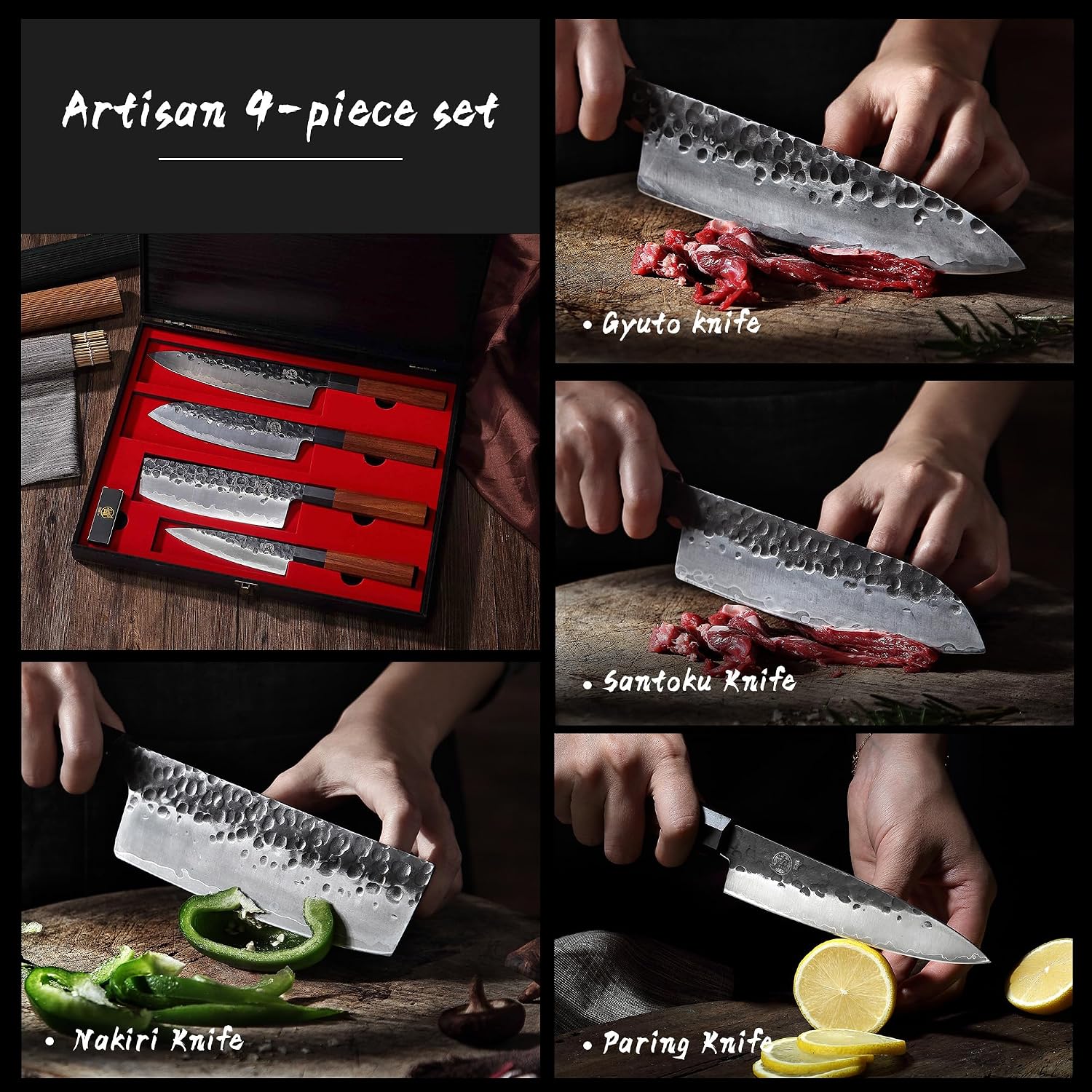
Gyuto (牛刀, literally “beef sword”) is the Japanese answer to the Western chef’s knife. Blade lengths typically run 210mm to 270mm (about 8–10.5 inches). It has a curved belly that allows rocking cuts, a pointed tip useful for detail work, and enough length to break down larger proteins. If you only buy one Japanese knife, this is the one. Serious Eats’ knife coverage consistently positions the gyuto as the most versatile single blade in a Japanese kit — usable for proteins, alliums, and most rough vegetable prep.
Nakiri (菜切り, “vegetable cutter”) is a rectangular, flat-profiled blade, typically 165–180mm long. The flat edge is not a design limitation — it’s the entire point. Because the blade contacts the cutting board along its full length with each stroke, you get clean, straight-down cuts through dense vegetables (carrots, beets, winter squash) without the push-forward motion a rocking blade requires. There’s no tip to speak of, which is a real tradeoff if you need to do any protein work. But for a cook who processes a lot of produce — especially one cooking Japanese, Korean, or plant-forward cuisine — reviewers across aggregated sources consistently describe the nakiri as transformative once you’ve worked with one.
Santoku (三徳, “three virtues” — meat, fish, vegetables) is often pitched as a do-everything knife, and in a modest home kitchen it largely is. Blade length is typically 165–180mm. The profile is flatter than a gyuto but not as flat as a nakiri, with a “sheep’s foot” tip that drops straight down rather than curving to a point. Cook’s Illustrated’s comparative coverage notes that Western cooks who prefer a chopping motion over a rocking motion often find the santoku more intuitive than a gyuto, since the flatter profile accommodates straight-down cuts more naturally.
The Overlap Problem
Here’s where phantom pieces get born: the gyuto and santoku overlap significantly for a home cook doing moderate-volume prep. If your cutting style is primarily push-cut and chop (rather than rock-and-roll), a santoku may cover 80% of what a gyuto does in your specific workflow. Buying both early is usually redundant unless you’re working at volume or cooking across multiple protein-forward menus in a single service.
The nakiri, by contrast, has almost no functional overlap with either — it genuinely does something different. If you process large quantities of vegetables regularly, it earns its drawer space. If your vegetable prep is incidental, it doesn’t.
The practical decision frame: Start with a gyuto. Add a nakiri if and when vegetable prep becomes a meaningful bottleneck. Only buy a santoku if your cutting style genuinely suits it better than a gyuto — or if you’re outfitting a secondary cook in your household who finds a shorter, lighter blade more comfortable.
Steel and Construction: The Numbers That Matter
By the Numbers
| Spec | Budget tier | Mid tier | Aspirational tier |
|---|---|---|---|
| Blade steel hardness (HRC) | 58–60 | 60–62 | 62–67+ |
| Edge bevel angle (per side) | 15–18° | 12–15° | 10–13° |
| Typical gyuto price (210mm) | $80–$150 | $150–$300 | $300–$600+ |
| Sharpening interval (typical home use) | Every 2–4 months | Every 3–6 months | Every 4–8 months |
Japanese knives are typically made from steels harder than their German counterparts — measured on the Rockwell C scale (HRC). That hardness allows the blade to be ground thinner and hold a more acute edge. The tradeoff: harder steel is more brittle. An HRC 66 blade will outperform an HRC 58 blade on a cutting board, but tap it against a cast-iron rim or use it to split a chicken leg and you’ll see why brittleness matters.
Korin’s published knife-buying guide describes two broad steel categories worth knowing:
Stainless steel (including VG-10, SG2/R2, and AUS-10) resists corrosion and is forgiving of imperfect drying habits. Most entry-to-mid knives use stainless. VG-10 is the benchmark at the $150–$300 tier — Wirecutter’s chef’s knife coverage consistently lists VG-10 blades as strong recommendations for cooks who want Japanese performance without high-maintenance carbon care.
Carbon steel (White Steel No. 1 and No. 2, Blue Steel, and their variants) develops a patina over time, can be sharpened to a more refined edge than most stainless alloys, and is the material choice for serious practitioners willing to dry and oil their blades after every use. It reacts to acidic foods and will stain or rust without attention. The performance ceiling is higher; the maintenance burden is real.
For a practitioner still building their sharpening practice, start with stainless. The difference between a well-sharpened VG-10 gyuto and a neglected carbon blade is not in the steel’s favor.
Handle Construction
Japanese knives come in two handle configurations:
Wa-handle (traditional Japanese octagonal or D-shaped handle, typically magnolia, ho wood, or pakkawood): lighter, promotes a pinch grip, is replaceable if it warps. Reviewers who’ve used both styles frequently note that wa-handles feel more natural for extended prep sessions.
Yo-handle (Western-style riveted handle, similar to European knives): heavier, more familiar to Western-trained cooks, typically not replaceable. If you’re coming from German or French knives and want a lower learning curve, yo-handle reduces one variable while you adapt to the blade geometry.
Specific Knives Worth Researching at Each Tier
Entry-level ($80–$180):
The Tojiro DP Gyuto (210mm or 240mm) is the most frequently cited entry-point in this category. Serious Eats’ knife coverage has highlighted it repeatedly as a best-buy for cooks transitioning from Western-style blades — VG-10 core with stainless cladding, yo-handle, sold at a price that makes it a low-regret first purchase. Owners across aggregated reviews consistently describe the out-of-box edge as competitive with knives at twice the price.
For a nakiri at this tier, the Yoshihiro VG-10 Nakiri (165mm) comes up often in practitioner-adjacent forums and appears in Korin’s introductory nakiri recommendations as a sensible starting point.
Mid-tier ($200–$350):
The MAC Professional Series Gyuto (MTH-80, 8-inch) occupies an interesting position — it’s a yo-handle knife with a slightly Western profile, making it genuinely approachable for cooks transitioning from German knives, while the blade geometry and steel (MAC’s proprietary alloy, rated around HRC 59–61) delivers noticeably better performance than European stainless. Fine Cooking’s santoku and gyuto coverage has cited the MAC MTH-80 as a strong recommendation for cooks who find pure-Japanese geometry intimidating.
The Shun Classic Santoku (6.5-inch) consistently appears in mid-tier santoku discussions. VG-10 core, ebony PakkaWood handle, well-supported for sharpening and warranty. The Shun brand is widely distributed, which matters for warranty service access.
Aspirational tier ($300–$600+):
The Korin Kagayaki CarboNext Gyuto (240mm) is frequently cited in professional-adjacent purchasing discussions. The CarboNext steel formula is semi-stainless, occupying a deliberate middle ground between reactive carbon and fully stainless — easier maintenance than traditional carbon, sharper potential edge than VG-10. Korin’s own published materials position it as the entry point to serious carbon-adjacent performance.
For a nakiri at this tier, the Masamoto KS Series and knives from Sakai Takayuki in White Steel No. 2 come up in practitioner discussions — reactive carbon, requiring full maintenance discipline, but the performance ceiling reviewers describe is qualitatively different from stainless at equivalent angles.
Sharpening Is Not Optional — Plan for It Before You Buy
This is where a lot of practitioners stumble: they invest in a $250 gyuto and then sharpen it on a ceramic honing rod designed for German steel, at the wrong angle, and wonder why the performance degraded so fast.
Japanese knives are sharpened on whetstones (also called water stones), not pull-through sharpeners or electric belt systems. The geometry is different enough that the latter two options will degrade an expensive blade’s edge faster than neglect would.
The minimum viable sharpening setup for a Japanese knife kit:
- A combination whetstone (1000/6000 grit is the standard starting point). King and Shapton are the most-cited brands in this category at the $40–$80 price point.
- An angle guide if you’re new to freehand sharpening — until you can hold 12–15° consistently by feel, a guide prevents you from inadvertently re-profiling the edge.
- A strop (leather, loaded with compound) for maintenance between sharpening sessions.
Serious Eats’ knife-sharpening coverage consistently makes this point: a $100 knife that’s properly maintained will outperform a $400 knife that hasn’t been sharpened in a year. Budget for the sharpening kit before you upgrade the blade.
The Decision Rule
If you’re building your first Japanese knife kit with a clear head and a defined budget, the framework is simple:
- If your budget is $150–$200 total: One gyuto (Tojiro DP, 210mm). Full stop. Learn to sharpen it. Add a nakiri in twelve months if the gap shows up.
- If your budget is $300–$450: A mid-tier gyuto (MAC MTH-80 or equivalent) plus a combination whetstone. The sharpening investment is not optional at this tier.
- If your budget is $500–$800: A Korin-tier gyuto in semi-stainless or carbon, a quality nakiri in the same steel family, and a full sharpening kit. At this spend level, maintenance skill is the actual differentiator — the knives will only perform to their potential if you can keep them sharp.
In every scenario: buy the gyuto first. Add the nakiri when you feel the absence of it in your workflow. Buy the santoku only if it genuinely fits your technique better than the gyuto does — not because it came in a set.
The best Japanese knife kit isn’t the most complete one. It’s the one where every blade in the drawer has a job.