You’re standing at a cookware crossroads that trips up even experienced home cooks: you’ve decided carbon steel is the right pan for the job — lighter than cast iron, faster to heat, capable of a screaming-hot sear and a delicate omelet in the same morning — and de Buyer keeps rising to the top of every list you read. Then you land on their site and realize they sell two different carbon steel lines: the Mineral B and the Blue Carbon Steel (sometimes called “Blue Steel”). Both are made in France. Both are carbon steel, meaning they’re a high-iron alloy that develops a natural nonstick surface (called a seasoning — layers of polymerized oil baked into the metal) over time. But they’re not the same pan, and the spec differences have real cooking consequences. This article breaks down exactly what separates them, shows you the numbers that matter, and closes with a plain decision rule so you can stop overthinking and order.
What the Spec Sheet Is Actually Telling You
De Buyer publishes clear material data for both lines, and the gap between them is legible once you know what to look for.
Mineral B pans ship with a beeswax coating already applied to the surface. That coating serves two purposes: it protects the bare steel during shipping and storage, and it gives you a head start on your first seasoning layer. You burn it off (or scrub it off, depending on your preferred break-in method) before your first cook. The steel itself is 99% iron with trace carbon — standard AFNOR-grade carbon steel. De Buyer’s published product documentation lists the Mineral B 11-inch skillet at approximately 2.5–3 mm of steel thickness depending on the SKU, with the pan weighing in around 1.4–1.6 kg (roughly 3.1–3.5 lbs) at that diameter.
Blue Carbon Steel (the “Blue” refers to the blue oxide finish applied during manufacturing — a controlled heat-oxidation process that creates a thin, dark protective layer on the raw steel) ships without the beeswax layer. The oxide finish itself provides some short-term rust protection, but it is not a seasoning. You’re starting from a cleaner baseline, which some cooks prefer because there’s no wax to remove. De Buyer’s own product pages for the Blue Steel line put most restaurant-targeted SKUs at 1.5–2 mm thickness — meaningfully thinner than the Mineral B equivalent.
That thickness difference is the axis everything else rotates around.
Head-to-Head: Three Comparisons That Actually Matter
H3: Heat Retention and Searing Performance
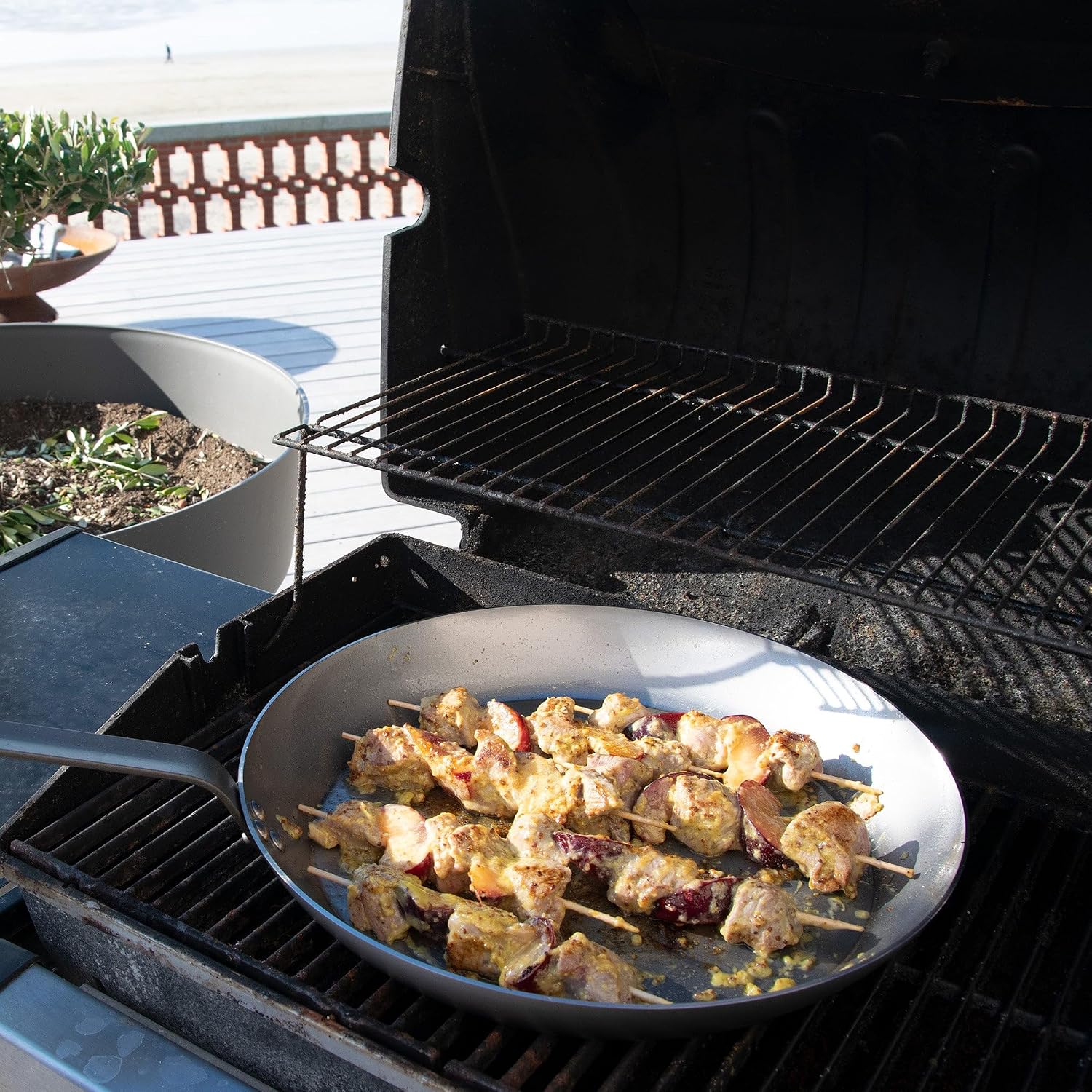
Thicker steel holds heat longer and recovers more slowly after a cold protein hits the surface. When you lay a cold chicken thigh into a hot Mineral B, the pan’s thermal mass absorbs the chill without cratering dramatically. The tradeoff: it takes longer to heat up from cold, and when you crank the burner down, the pan doesn’t cool as quickly.
For searing proteins, roasting vegetables, or anything that benefits from sustained, even heat, this stability is exactly what you want. Serious Eats, in their carbon steel skillet roundup, describes the Mineral B as performing almost like a lightweight cast iron once it’s up to temperature — stable, forgiving of small burner adjustments, and slow to punish distraction. The Blue Carbon Steel’s thinner gauge doesn’t sustain that thermal buffer the same way; a thick pork chop will drop pan temperature more noticeably, which can slow the Maillard reaction if the burner doesn’t compensate quickly.
For searing and high-retention cooking: the Mineral B’s thicker gauge is the stronger tool.
Mauviel
$120.00
In stock on Amazon
Check price on AmazonH3: Responsiveness and Egg Work
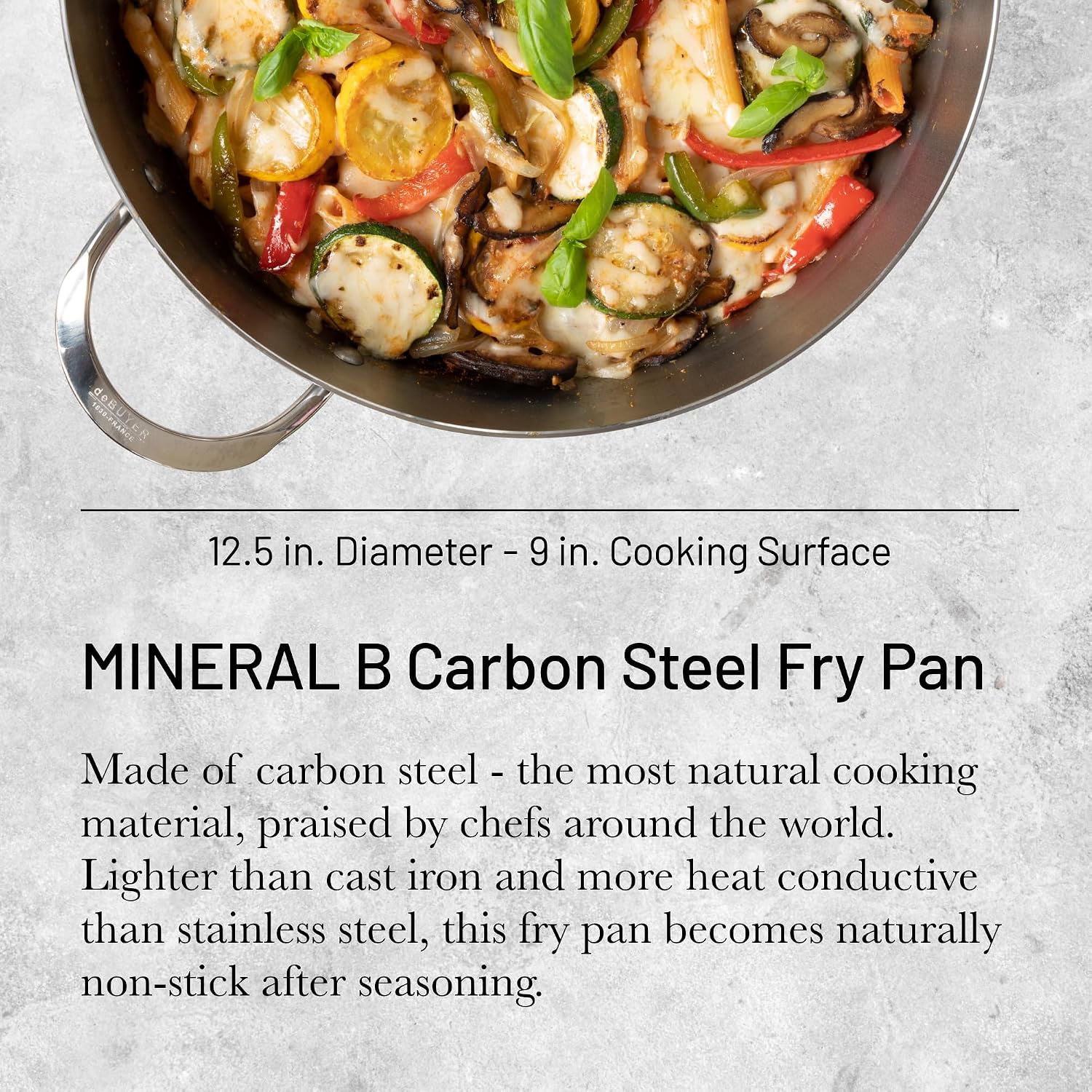
Thinner steel is more responsive. It heats faster, cools faster, and transmits burner changes almost immediately. This is why the Blue line is the standard in professional restaurant kitchens — line cooks working a French top or a high-BTU gas range need a pan that adjusts in real time. When you’re making a French omelet, sautéing greens, or reducing a pan sauce that needs precision temperature control, responsiveness beats thermal mass.
Cook’s Illustrated, in their carbon steel pan buying guide, notes that thinner-gauge pans are particularly well-suited to egg work and sautéed vegetables precisely because of this live-feedback characteristic. The Spruce Eats’ 2025 carbon steel roundup reinforces the same distinction: they characterize thinner restaurant-gauge steel as better suited to cooks who are actively managing heat moment to moment rather than setting a burner and stepping back.
Fine Cooking’s overview of carbon steel versus cast iron frames it usefully: thicker carbon steel closes the gap with cast iron in terms of heat retention, while thinner steel positions itself closer to stainless in terms of responsiveness — a meaningfully different tool, even from the same material category.
For egg work, sautés, and real-time heat management: the Blue Carbon Steel’s thinner gauge is the stronger tool.
de
$109.99
In stock on Amazon
Check price on AmazonH3: Weight, Handling, and Multi-Pan Value
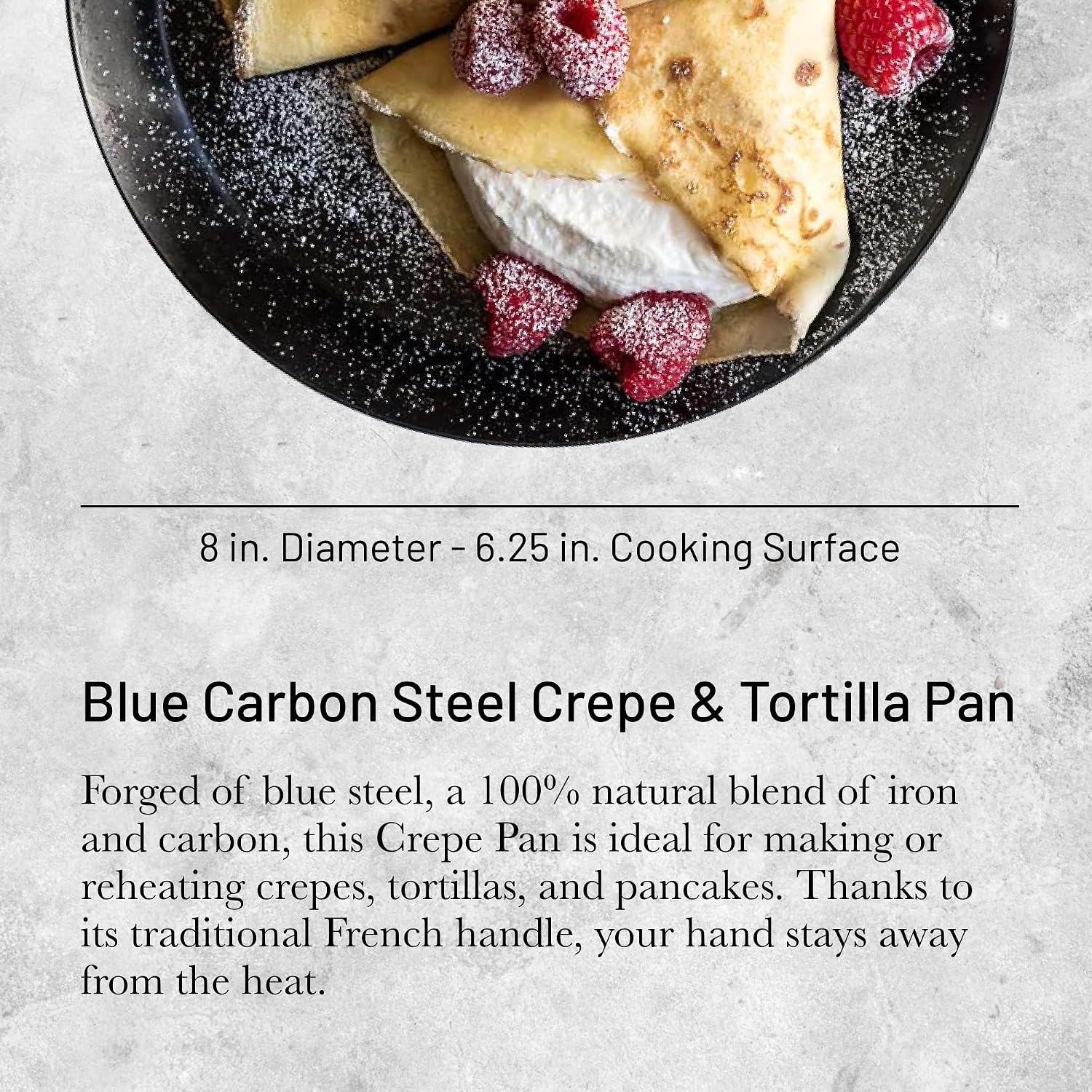
At comparable diameters, the Mineral B runs approximately 3.1–3.5 lbs; the Blue Carbon Steel comes in around 2.2–2.6 lbs. That weight difference is inconsequential for a home cook making a single omelet, but it becomes a real factor across a full service in a catering or supper club context where you’re tossing and lifting repeatedly over several hours.
The Blue line’s lighter weight and lower per-unit retail cost (typically $45–$85 for 10–12-inch skillets versus $65–$120 for the Mineral B at comparable sizes, based on de Buyer’s published pricing and US retailer listings as of mid-2026) make it a more defensible fleet purchase when you’re buying four or more pans. Professional supply houses frequently stock the Blue Steel line in bulk SKUs with quantity pricing — worth investigating for any multi-pan setup.
For the serious home cook buying a single pan to use for years, however, the Mineral B’s price premium is genuinely small relative to total cost of ownership. A properly maintained carbon steel pan lasts decades; the cost-per-year math favors buying the thicker, more versatile option once.
For multi-pan catering or professional volume use: the Blue Carbon Steel’s weight and price advantages add up. For single-pan home investment: the Mineral B’s durability premium is worth it.
de
$35.00
In stock on Amazon
Check price on AmazonThe Seasoning Ramp: Does the Beeswax Actually Help?
This comes up constantly in review threads and cookware forums, and the answer is nuanced.
The Mineral B’s beeswax coating is not a seasoning. It will not substitute for the layers of polymerized oil you’ll build through cooking. What it does is give the pan minor surface protection and, according to de Buyer’s own product documentation, can contribute to a seasoning foundation if you heat the pan through on a high burner rather than scrubbing it off entirely. Serious Eats’ carbon steel guide recommends burning off the majority of the wax on a high burner before proceeding to a standard high-smoke-point oil seasoning protocol — the residue isn’t harmful, but it can create an uneven base if you skip this step.
The Blue Steel’s oxide finish is different in character — it’s a factory-applied, heat-controlled oxidation that passivates the steel surface and provides more meaningful short-term rust resistance than bare steel, but it’s still not a cooking surface. You’re starting fresh, which means your first few cooks are more variable regardless of care.
For a cook building out a carbon steel collection, this distinction matters less than it sounds at purchase time. Both pans will fully season after 8–12 cooking sessions with high-smoke-point oils and high-heat protein cooks. The beeswax head start on the Mineral B is a minor convenience, not a meaningful performance advantage six months in.
Induction, Oven, and Compatibility Notes
Both lines are induction-compatible — carbon steel is magnetic, so this is inherent to the material, not a feature either line adds. Both are oven-safe without meaningful temperature limits. One practical caveat worth noting: the Mineral B’s riveted steel handle becomes uncomfortably hot above 400°F without a silicone sleeve, which matters for longer oven finishes where you need to grab the pan mid-cook.
Neither pan is dishwasher-safe. Neither should hold acidic foods (tomatoes, wine reductions, citrus) for extended periods before the seasoning is fully mature — that’s a 3–4 month seasoning-build caveat, not a permanent limitation. Once the seasoning is established, brief contact with acid during active cooking is generally fine; it’s prolonged sitting that erodes an immature surface.
Both pans should be dried immediately after washing and stored with a thin oil layer if they’ll sit unused for more than a week or two. That maintenance discipline is identical across both lines.
The Decision Rule
Buy the Mineral B if: your cooking is mostly at home — searing proteins, roasting vegetables, egg work across different heat intensities, the occasional braise finish. The extra thickness makes it more forgiving across a wider range of techniques, and it’s the pan that Serious Eats, The Spruce Eats, and Cook’s Illustrated converge on as the right entry into de Buyer’s carbon steel lineup for home cooks. The beeswax break-in is a minor inconvenience, not a barrier.
Buy the Blue Carbon Steel if: you’re running high-volume cooking at professional pace — fast sautés, responsive egg technique, omelet-station speed — or you’re building out a multi-pan catering kit where weight and per-unit cost matter. It’s the pan that restaurant kitchens reach for precisely because burner responsiveness is the priority.
If you’re still undecided: the Mineral B handles the Blue Steel’s use cases acceptably; the Blue Steel struggles to replicate the Mineral B’s heat retention on thick proteins. Defaulting to the Mineral B gives you the wider functional range for a home kitchen context.
Both pans, maintained correctly, will outlive every nonstick pan you’ve ever owned. Buy one, season it properly, cook through the awkward early weeks where eggs stick and everything feels like a mistake, and stop second-guessing it. The spec differences are real — but both are excellent pans, and the best carbon steel pan is the one that’s already hot on your burner.
Spec data cited from de Buyer’s published product documentation. Performance characterizations reflect editorial coverage in Serious Eats’ carbon steel skillet roundup, Cook’s Illustrated’s carbon steel pan buying guide, The Spruce Eats’ 2025 carbon steel pans review, and Fine Cooking’s carbon steel versus cast iron overview.