You’re standing in front of a 12-piece cookware set listing — the kind that shows a glamorous stack of gleaming pans and announces, in bold, that you’re getting twelve pieces for the price of what feels like two or three bought individually. It looks like the smart buy. But flip through the item list carefully and you’ll spot two lids counted as separate pieces, a steamer insert you’ll use once, and a saucepan so small it’s really only useful for warming a can of soup. The “12-piece” set just became a 6-piece set with expensive padding. That padding has a name in the buying community: phantom pieces — items counted in the headline number that deliver little or no practical value for the way most home cooks actually cook.
This guide is about auditing a set before you commit. You’ll learn which pieces are load-bearing (meaning you’ll reach for them multiple times a week), which are fillers, how to run a cost-per-useful-piece comparison across competing sets, and what the published specs — things like clad construction, thickness, and pan weight — actually tell you about long-term performance. By the end, you’ll have a clear decision framework: a set is worth it if and only if the useful-piece count justifies the price at the per-piece level.
What “Piece Count” Actually Measures (and What It Doesn’t)
The piece count on a cookware set listing is a marketing number, not a utility number. Manufacturers count lids, steamer inserts, bonus utensil sets, and even trivets — anything physically in the box — toward the headline figure. The practice is widespread and, as Wirecutter’s cookware set reviews note across multiple cycles, one of the most consistent sources of buyer confusion in the category.
Here’s the audit move: strip the count down to cooking vessels only — pots and pans that sit on a burner and transfer heat to food. Everything else is a support item. Lids matter, but they don’t cook anything on their own; count them separately. A steamer basket is a nice bonus, not a core pan.
The core vessel list for a serious home cook typically looks like this:
- 8-inch skillet (eggs, single portions, quick sautés)
- 10- or 12-inch skillet (the workhorse — most cooks use this daily)
- 2-quart saucepan (sauces, grains, reheating)
- 3- or 4-quart saucepan (soups, blanching, pasta water for two)
- 6- or 8-quart stockpot (big pasta nights, stocks, batch cooking)
- 3- or 4-quart sauté pan or wide skillet with straight sides (braises, pan sauces with volume)
That’s six vessels. A set that lists twelve pieces but only contains five or six of those six core vessels — and fills the rest with lids, a small butter warmer, and a steamer — is a five- or six-piece useful set wearing a twelve-piece price tag.
Running the Cost-Per-Useful-Piece Math
Once you’ve identified the actual vessel count, the comparison becomes arithmetic. Here’s the framework:
Set price ÷ core vessel count = cost per useful piece
Do this for every set you’re evaluating, then cross-reference what it would cost to buy those same vessel sizes individually in the same line.
By the Numbers: A Representative Audit
| Set Listing | Headline Pieces | Core Vessels | Set Price | Cost per Useful Piece | Open-Stock Equivalent |
|---|---|---|---|---|---|
| Brand A 10-piece stainless | 10 | 5 | $450 | $90 | ~$520 |
| Brand B 12-piece stainless | 12 | 6 | $580 | ~$97 | ~$640 |
| Brand C 7-piece stainless | 7 | 6 | $520 | ~$87 | ~$610 |
The 12-piece set looks like the most generous value, but at 6 vessels for $580, it’s actually priced comparably to the smaller-headline 7-piece set — and slightly worse than Brand A on a per-vessel basis. The lesson isn’t that one of these hypothetical sets wins; the lesson is that you can’t evaluate value from the headline number alone.
Serious Eats’ stainless set roundups consistently make the same point: a well-configured 7- or 8-piece set often outperforms a 12-piece set on actual utility per dollar, because the lower-piece-count sets tend to be configured by brands that prioritize function over perceived volume.
Reading the Spec Sheet: What Thickness, Weight, and Construction Actually Tell You
If you’re spending $300–$700 on a set, you deserve to understand the spec sheet — not just accept the marketing copy. Three specs drive most of the real-world performance difference between sets at this price tier.
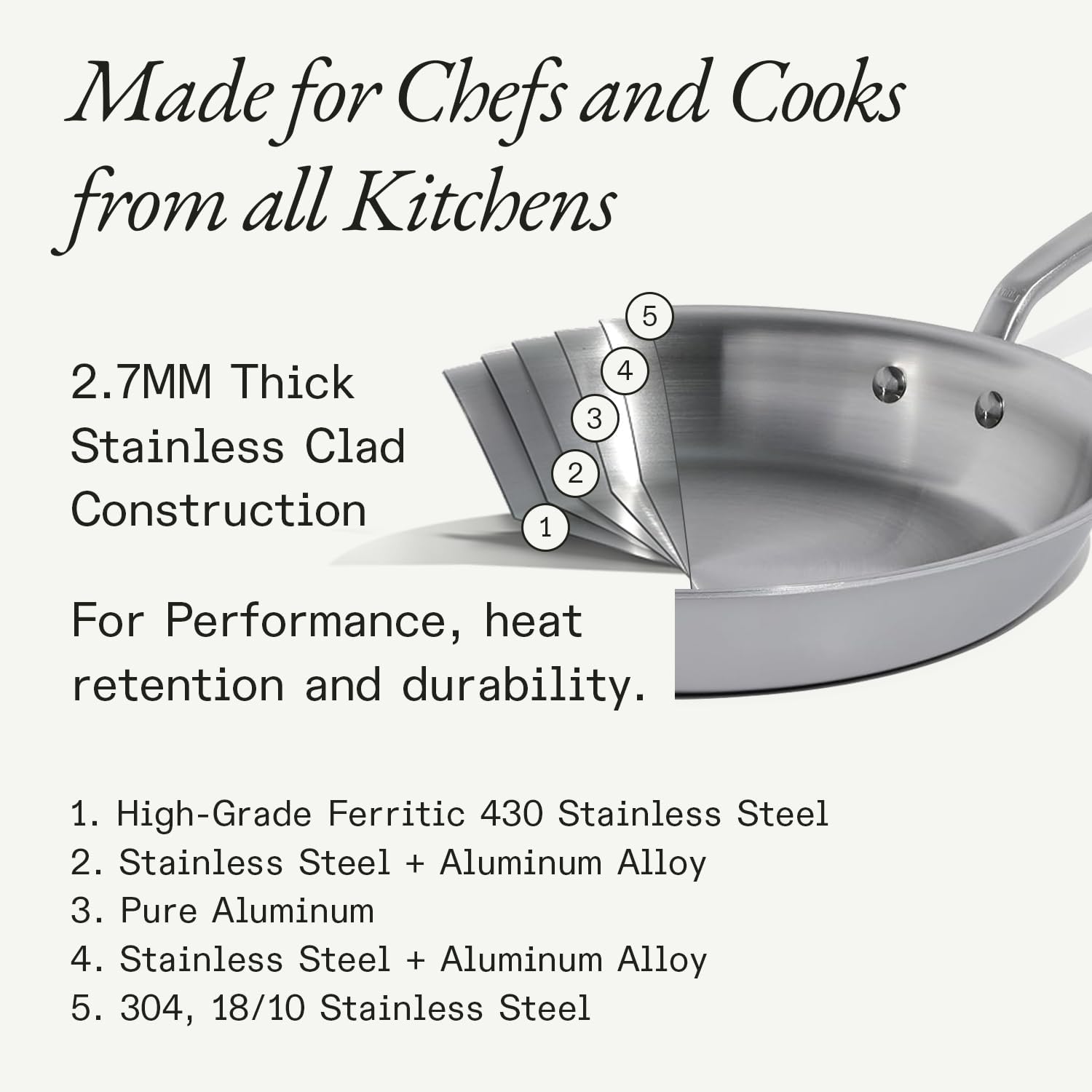
1. Total wall thickness (measured in millimeters) Clad cookware — the dominant construction type in serious home-cook sets — bonds multiple metal layers together across the entire pan wall, not just the base. Tri-ply (three layers: typically stainless-aluminum-stainless) is the entry-level standard. Five-ply adds additional layers for more even heat distribution and marginally more mass. Published specs from brands like All-Clad, Demeyere, and Cuisinart put total wall thickness typically in the 2.6mm–3.0mm range for tri-ply and up to 3.4mm for five-ply configurations.
Thicker walls mean more thermal mass — the pan holds heat more steadily when cold food hits it, which matters for searing and for maintaining a consistent simmer. Cook’s Illustrated’s equipment testing methodology specifically calls out thickness as a primary differentiator in heat evenness scores across stainless clad sets.
2. Pan weight Published weights on product listings are a proxy for build quality. A 12-inch skillet in a serious stainless clad set typically runs 2.8–3.5 lbs. Suspiciously light skillets (under 2.3 lbs at 12 inches) often indicate thinner gauge construction or a base-only clad design rather than full-wall cladding. The Spruce Eats’ cookware set roundups flag weight as one of the first spec signals reviewers use to screen out underbuilt sets.
3. Full-clad vs. impact-bonded (base-only clad) Full-clad means the aluminum core runs the full height of the pan wall. Impact-bonded means the multi-layer sandwich is applied only to the base, with a single-layer stainless sidewall. For sauces and anything where liquid climbs the wall — reductions, pan sauces, scrambled eggs — full-clad performs more evenly because the sidewalls also conduct heat. Impact-bonded is not a dealbreaker at lower price points, but it’s worth knowing which you’re buying. Fine Cooking’s cookware materials guide describes this distinction in detail and notes it’s rarely called out clearly in set listings.
The Five Audit Questions to Ask Before You Click Buy
These are the practical questions to run through any set listing before committing. Think of this as your due-diligence checklist.
1. What is the actual vessel count? List every item in the set and mark which ones are cooking vessels (they sit on a burner, they hold food). Lids, steamer inserts, bonus tools — note them separately. If the vessel count is fewer than five, the set needs to clear a higher per-vessel value bar to justify the purchase.
2. Does the size range match how I cook? A set heavy on small saucepans (1-quart, 1.5-quart) is optimized for cooking for one or two. A set anchored by a 12-inch skillet and an 8-quart stockpot skews toward volume cooking and batch prep. Neither is wrong — but mismatch is expensive. If you cook for two regularly, that 8-quart stockpot may sit unused for months at a stretch.
3. Is the construction full-clad or base-only? Check the product description carefully. “Encapsulated base” and “impact-bonded base” are phrases that signal base-only construction. “Fully clad” or “clad throughout” signals full-wall construction. When the listing is ambiguous, the manufacturer’s own product page or customer service line typically clarifies.
4. What does open-stock pricing look like for the same line? Most serious cookware brands sell pieces individually. Run the math: add up the open-stock price for each vessel in the set. If the set price is less than 70–75% of that sum, the discount is real and meaningful. If it’s above 80–85%, you may do better buying only the pieces you’ll actually use.
5. What are owners reporting about long-term performance? Aggregated owner reviews — not just the top reviews — tend to surface warping complaints, handle loosening, or discoloration patterns that don’t appear in the first six months but show up consistently in the 12–24 month range. The Wirecutter’s long-term follow-up testing methodology specifically tracks this window, and their stainless set recommendations have shifted based on durability patterns that only emerged after extended owner reporting.
If X, Then Y: The Decision Rules
You’ve run the audit. Here’s how to translate the results into a clear call.
If the useful vessel count is five or more AND the cost per vessel is at or below 75% of open-stock pricing for the same line: The set math works. Buy the set.
If the useful vessel count is four or fewer: The set is padded. Either find a better-configured set in the same price range, or buy open-stock pieces targeting exactly what you need. For a starting kitchen, that usually means a 10- or 12-inch skillet, a 3-quart saucepan, and a 6-quart stockpot — three pieces that cover 80% of everyday cooking.
If the construction is base-only clad but the price is below $200 for the full set: Acceptable for a transitional setup or a secondary kitchen. Not the right buy if you’re cooking sauces regularly or expect this set to be your primary cookware for five or more years.
If the spec sheet shows wall thickness below 2.4mm total: Pass, regardless of headline piece count or price. Thin-gauge pans warp under high heat and create hot spots that undermine searing and sauce work — problems that compound over time. Cook’s Illustrated’s equipment editors have identified thin gauge as the single most consistent predictor of poor long-term performance in stainless sets.
The phantom-piece problem is solvable. It just requires reading the listing the way a buyer reads a contract — counting what’s actually there, not what the headline suggests.