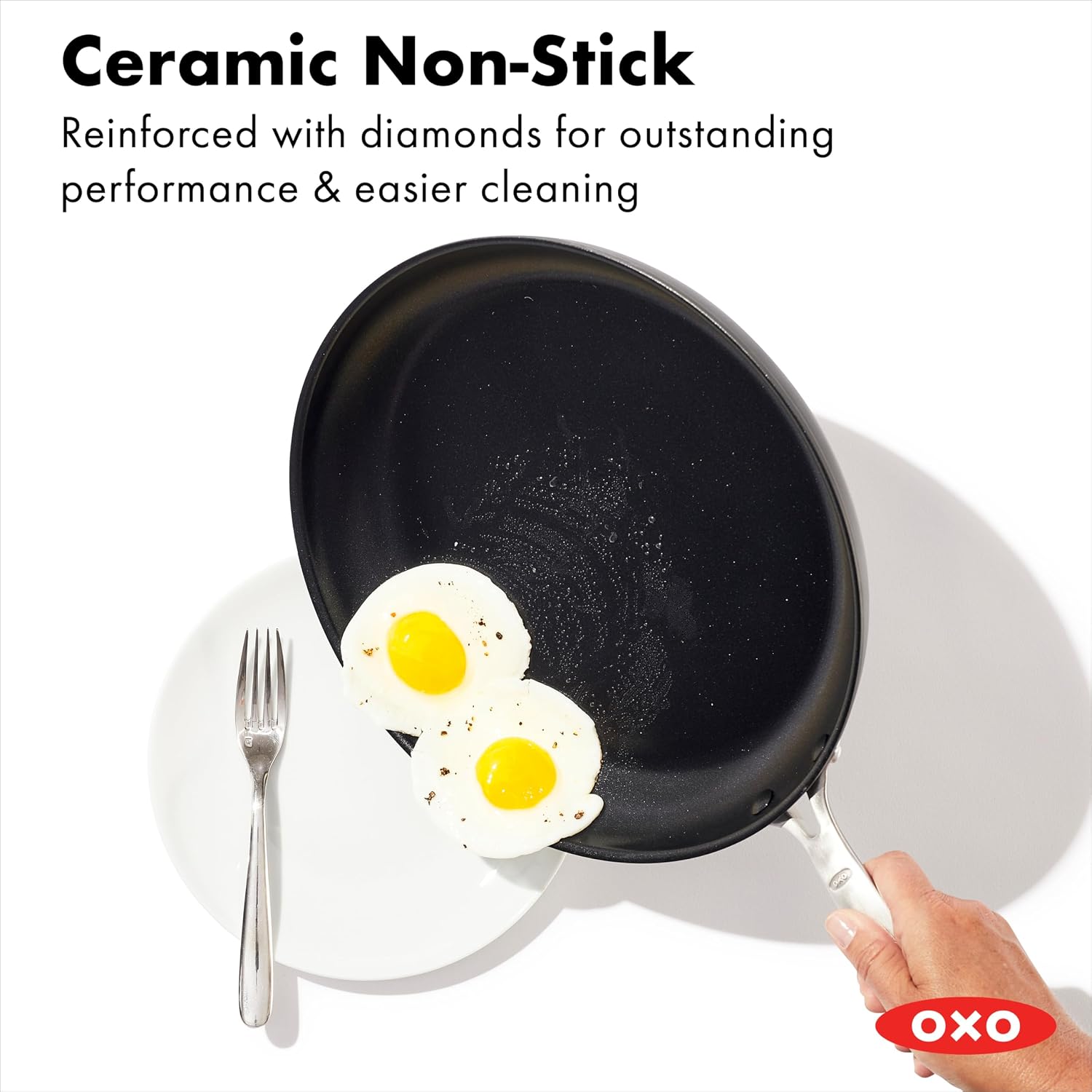
You bought a ceramic nonstick pan — or you’re seriously considering one — because something in the conventional nonstick story stopped sitting right. Maybe it was news coverage about PFAS (per- and polyfluoroalkyl substances, the synthetic chemicals used in traditional nonstick coatings like PTFE, also sold as Teflon). Maybe a friend mentioned it. Either way, you’re now evaluating a category of cookware that promises a clean, slick cooking surface without those compounds. Ceramic nonstick pans achieve that surface not through fluoropolymer chemistry but through a silica-based (essentially sand-derived) sol-gel coating applied and cured at high heat. The sales pitch is compelling: nonstick performance, no PFAS, and a color palette that makes Caraway the most Instagrammed pan of the last four years.
What the marketing doesn’t front-load is the durability curve. After six-plus months of real daily use, owners of Caraway and OXO’s PFAS-free ceramic lines surface a consistent, nuanced picture — and it’s worth understanding before you commit. This guide breaks down what aggregated owner reviews actually show, what the specs mean for longevity, and how to frame the purchase decision in terms that matter: not months on a shelf, but uses per dollar.
Why People Buy Ceramic Nonstick (And Why That Matters for Longevity Expectations)
The pattern across aggregated Caraway and OXO ceramic reviews is striking: the purchase motivation is almost entirely health-driven. Reviewers aren’t primarily saying “I needed a better nonstick pan.” They’re saying “I needed to get off PTFE.” Serious Eats’ overview of the ceramic nonstick category notes this explicitly — buyers in this segment are opting out of something, not necessarily opting into superior cooking performance.
That distinction matters enormously for how you should evaluate longevity. A buyer who chose ceramic because she wanted the best possible nonstick performance will measure disappointment on an absolute scale. A buyer who chose it because she wanted no PFAS in her kitchen is evaluating a different tradeoff — and the reviews from that second group are substantially more forgiving of the durability limitations.
This is not a cynical observation. It’s a useful calibration. If your primary concern is PFAS elimination, ceramic nonstick delivers on that promise completely and permanently. The silica coating contains no fluoropolymers, period. Wirecutter’s nonstick pan review confirms that reputable ceramic-coated pans from brands like Caraway and OXO do not contain PTFE, PFOA, or PFAS compounds. That fact doesn’t degrade over time. The nonstick performance of the coating, however, absolutely does — and that’s the variable that determines whether you’re satisfied at 18 months or frustrated at nine.
The Durability Reality: Uses-Per-Dollar, Not Calendar Months
One of the most useful data points from aggregated OXO ceramic owner reviews is a single candid disclosure: a pan used two to three times daily lasted approximately one year before meaningful coating degradation. That reframes the entire durability conversation.
The question isn’t “how many months until this pan fails?” It’s “how many uses does this coating survive?” Do the arithmetic:
By the numbers
- Light use (once daily): ~300–365 uses per year
- Moderate use (2x daily): ~600–730 uses per year
- Heavy use (3x daily): ~900–1,095 uses per year
- OXO owner-reported coating life at 2–3x daily use: ~12 months ≈ 600–900 total uses
That one-year benchmark at heavy use translates to a much longer lifespan at normal home-cook frequency. The Spruce Eats’ ceramic cookware roundup notes that ceramic coatings generally perform best under the lower-intensity use patterns typical of home kitchens — and most home cooks are using a single pan once daily or less, not running a short-order line.
Caraway’s owner reviews tell a consistent secondary story: those who report coating degradation at under a year almost universally add a caveat involving a care error — metal utensils, high-heat searing, abrasive cleaning, or lid condensation dripping back onto a cold pan. Caraway reviewers who follow the brand’s stated care protocol (silicone or wood utensils, low-to-medium heat, hand washing) trend toward satisfaction at the 18-to-24-month mark. Consumer Reports’ cookware buying guide notes that ceramic coatings are structurally more vulnerable to thermal shock and surface abrasion than PTFE-based coatings — which is chemistry, not a quality-control failure.
The practical implication: if you cook nonstick eggs twice a day and can’t commit to silicone utensils, you’re looking at a one-year replacement cycle. If you use the pan for eggs and delicate fish three to four times a week, with care, 24 months is a reasonable working expectation.
Caraway vs. OXO: Where They Differ on the Spec Sheet
Both Caraway and OXO Softworks PFAS-free ceramic pans occupy the mid-to-upper tier of the ceramic nonstick market, but they’re engineered with meaningfully different priorities.
Caraway leads with aesthetics and the complete-set value story. The cookware is constructed with an aluminum core and a hard-anodized exterior, and the ceramic coating is applied across the full interior surface. Published specs confirm induction compatibility across the full lineup — the magnetized stainless steel base handles induction contact. The brand’s cooking recommendations explicitly cap safe temperatures at 550°F in the oven and advise against stovetop use above medium heat. Good Housekeeping Institute testing of Caraway notes that the coating performs predictably at those temperature ranges, with degradation accelerating when users push into high-heat territory.
OXO Softworks ceramic pans prioritize ergonomics and a more utilitarian aesthetic. The PFAS-free line uses a similar sol-gel ceramic coating on an aluminum body, with the same structural vulnerabilities to abrasion and thermal stress. OXO’s published care guidance mirrors Caraway’s almost exactly — no metal utensils, no dishwasher, medium heat or below. The OXO pans tend to be priced slightly more accessibly and have a broader size range, making them popular for buyers who want the PFAS-free surface without the design premium.
Neither brand’s ceramic coating is structurally superior to the other in a way that changes the durability calculus significantly. Across aggregated review data, both lines show the same degradation triggers: abrasion, heat abuse, and dishwasher cycles. The choice between them usually comes down to whether the Caraway design premium — and the organizational system it’s built around — is worth it to you as a kitchen investment.
The Caraway Mini: A Narrow Use Case That Earns Its Keep
One product in the Caraway ecosystem earns disproportionate enthusiasm relative to its size: the mini pan. Reviewers who buy it specifically for scrambled eggs or steel-cut oats are intensely loyal in a way that full-set buyers often aren’t. The physics explain it — a smaller pan used for a single, low-temperature task runs directly into the coating’s sweet spot and almost never into its failure modes.
This is a useful purchase-decision heuristic. If you’re uncertain about the category and want to test ceramic nonstick behavior before committing to a full set, the Caraway mini is a lower-stakes entry point with a legitimate high-frequency use case. The coating on a pan used exclusively for gentle egg cookery at low heat will outlast the coating on a pan pressed into general service — and the mini’s format makes high-heat misuse structurally less likely.
Serious Eats’ ceramic nonstick overview makes a similar point about matching pan selection to task: ceramic coatings deliver their best longevity when they’re not competing with tasks better suited to carbon steel or stainless.
One Care Detail Owners Don’t Anticipate: Lid Condensation
A detail that surfaces consistently in Caraway owner reviews — flagged as an unexpected management issue — is moisture retention under the lid. When cooking with the lid on, condensation collects and can drip onto the interior surface. If that surface is significantly hotter than the condensation, the rapid thermal differential can stress the coating over hundreds of cycles.
This isn’t a flaw unique to Caraway. It’s a physics reality of any ceramic-coated surface used with a tight-fitting lid. The practical mitigation is simple: tilt the lid slightly when possible, or remove it toward the end of cooking rather than leaving it in place while the pan cools. It’s the kind of nuanced care detail that gets glossed over in the purchase experience and only surfaces in the 6-to-12-month owner reviews — which is why it’s worth flagging now.
The Price-Resistance-to-Enthusiasm Arc
Multiple Caraway reviewers describe a recognizable psychological pattern: initial sticker shock at the set price, followed by strong post-purchase enthusiasm. This is worth acknowledging directly, because it cuts both ways.
The enthusiasm is real — Caraway’s design cohesion, the modular storage system, and the genuine PFAS-free surface deliver meaningful value that reviewers articulate specifically. But the post-purchase enthusiasm is also a well-documented cognitive phenomenon (what behavioral economists call “post-purchase rationalization”), and it tends to be most intense in the 0-to-6-month window before coating performance starts to tell its own story.
The most useful review data comes from owners reporting at the 12-to-18-month mark, because it post-dates both the honeymoon period and the point where care patterns — good or bad — have had time to express themselves in coating performance. At that horizon, satisfied Caraway owners are people who made the care commitment. Dissatisfied ones almost always identify a specific care break as the inflection point.
Frequently Asked Questions
How long should a Caraway ceramic pan realistically last with daily use? With daily use and disciplined care — silicone utensils, medium heat or below, hand washing — Caraway owners in long-run reviews report 18 to 24 months of solid nonstick performance. With heavier or less careful use, 12 months is a more realistic benchmark. The coating is finite by design; the question is how many uses you extract from it.
Can I use metal utensils with the OXO PFAS-free ceramic pan? No. OXO’s published care guidance for the ceramic line explicitly prohibits metal utensils, and aggregated owner reviews consistently identify metal utensil use as the most common cause of early coating degradation. Stick with silicone, wood, or nylon.
What’s the difference between PTFE-free and truly non-toxic ceramic coatings? “PTFE-free” means the coating contains no polytetrafluoroethylene — the fluoropolymer used in conventional nonstick surfaces. Ceramic coatings from Caraway and OXO go further: they contain no PFAS compounds at all, which includes PTFE, PFOA, and related fluorochemicals. The silica-based ceramic coating is considered non-toxic at any cooking temperature within the rated range. Wirecutter’s nonstick pan review confirms both brands meet this standard.
Does Caraway work on induction cooktops? Yes. Caraway’s full cookware lineup includes a magnetized stainless steel base that is compatible with induction cooktops. This is confirmed in Caraway’s published product specifications and noted in Good Housekeeping Institute’s testing of the line.
What temperature is safe for ceramic nonstick pans? Both Caraway and OXO recommend a maximum stovetop temperature of medium heat. For oven use, Caraway is rated to 550°F. The critical issue isn’t toxicity — unlike overheated PTFE, ceramic coatings don’t off-gas harmful compounds at high temperatures — but physical degradation. High heat breaks down the silica coating structure and dramatically shortens the coating’s useful life.
Is the Caraway mini set worth buying as a standalone piece? For a narrow, specific use case — scrambled eggs, small portions, steel-cut oats — yes, emphatically. The Caraway mini earns its most loyal reviews from buyers who deploy it for exactly that task and nothing else. If you’re evaluating the ceramic category cautiously, the mini is a lower-commitment entry point that plays to the coating’s strengths. If you need general-purpose nonstick coverage, the full skillet is the workhorse purchase.
The Decision Frame
If your primary driver is PFAS elimination and you’re willing to make the care commitment — silicone utensils, medium heat, hand washing, lid management — Caraway or OXO ceramic nonstick will deliver meaningful longevity and genuine satisfaction. Budget mentally for replacement at the 18-to-24-month mark under normal home use, and treat the coating as a consumable with a known lifespan rather than a permanent surface.
If your primary driver is maximum nonstick durability or high-heat versatility, ceramic nonstick isn’t the right tool. A well-seasoned carbon-steel pan from Matfer Bourgeat or Lodge will outlast any ceramic coating by years and handle heat that would wreck the silica surface in weeks. The two categories solve different problems.
If you want to test ceramic nonstick without the full set commitment, the Caraway mini is the most sensible entry point: low cost, high loyalty, narrow use case that maps directly to the coating’s performance window.
The real return on a ceramic nonstick purchase isn’t measured in months. It’s measured in the confidence that what’s transferring from the pan to your food doesn’t include compounds you’ve decided you’re done cooking with.