You’ve decided on carbon steel — the material serious wok cooks default to because it heats fast, handles high-flame stir-frying without complaint, and builds a natural nonstick surface over time through a process called seasoning (essentially baked-on layers of polymerized oil that protect the metal and keep food from sticking). Now you’re staring at a product page trying to decode whether round-bottom or flat-bottom matters more than gauge, whether the handle setup is going to burn your wrist, and why half the one-star reviews read like user error rather than product failure. This guide cuts through that noise. It’s built from aggregated owner feedback, published specs, and the specific lessons experienced cooks document only after they’ve already bought wrong once. If you’re a few months into serious cooking and you have a wok purchase pending, this is the research pass you’d want before you commit.
| EDITOR'S PICKMade In Cookware - 13" Seasoned… | Mid-tierYOSUKATA 13.5" Carbon Steel Wok… | Budget pick[Craft Wok Traditional Hand Hamm](https://www.amazon.com/dp/B0922Y11HX?tag=greenflower20-20)… | |
|---|---|---|---|
| Diameter | 13" | 13.5" | 14" |
| Bottom Shape | — | Flat | Round |
| Pre-Seasoned | ✓ | ✓ | — |
| Induction Compatible | ✓ | ✓ | — |
| Handle Type | — | — | Wooden + Steel |
| Price | $149.00 | $62.99 | $57.75 |
| See on Amazon → | See on Amazon → | See on Amazon → |
The Real Differentiation: Gauge, Handle Geometry, and Heat Path
Round-bottom versus flat-bottom is the question everyone leads with, and it’s actually one of the last decisions that matters. The more consequential variables — the ones that drive long-term regret or satisfaction in aggregated owner reviews — are steel gauge (thickness), handle angle and material, and how the pan transitions heat from rim to center.
Gauge is measured in millimeters or as a weight proxy. A 14-inch carbon steel wok in the 1.5mm to 2mm range (roughly 3 to 4.5 lbs for that diameter) is the functional sweet spot cited repeatedly in Cook’s Illustrated’s equipment review coverage. Too thin (under 1.2mm) and the wok scorches unevenly and warps; too thick and it loses the thermal agility that makes a wok a wok — that quick-response, high-heat mobility that a cast-iron skillet can’t replicate.
Handle angle and weight distribution turn out to matter more than raw weight. Owners of the Babish carbon steel wok consistently report that a 5-pound pan feels lighter in use than a 3-pound competitor — not a typo, and not marketing. The reason is handle angle: a handle pitched at the right angle relative to the pan’s center of gravity dramatically reduces wrist strain during the toss-and-stir motion. Wirecutter’s wok coverage flags handle ergonomics as one of the top sources of long-term owner satisfaction variation, particularly for cooks doing extended sessions. If you’re running a supper club or doing serious family meal prep, forty-five minutes of stir-fry with a poorly balanced pan is a different experience than twenty minutes with a well-balanced one.
Heat path is the less-discussed variable: how efficiently does energy travel from the contact zone (the bottom) to the sloped walls where a lot of actual cooking happens in tossed stir-fry? Hammered surfaces — either hand-hammered in the Cantonese tradition or machine-hammered — create micro-irregularities that some owners and the Serious Eats wok review suggest improve seasoning adhesion on the walls, which matters for how food actually behaves once it climbs the slope. A perfectly smooth-walled wok can be harder to season evenly.
The Preparation Problem: Why Most Negative Reviews Are Actually User Error
This is the most actionable finding in the entire owner-review dataset, and it’s blunt: nearly every negative carbon steel wok review that attributes sticking, rust spots, or uneven performance to the product is actually describing a skipped or botched initial preparation sequence.
Carbon steel woks ship with a factory coating — usually a thin layer of oil or an anti-rust lacquer — that must be fully removed before the pan can accept seasoning. The removal step is typically done by heating the bare steel to high temperature (bluing) until the metal changes color, indicating the coating has burned off and the steel’s surface structure has opened up to bond with oil.
Craft Wok owners have documented a specific tip that doesn’t appear in the product instructions: remove the wooden handle before bluing. The handle attachment point blocks even heat coverage on that section of the steel, leaving a patch that won’t blue properly and subsequently won’t season properly. That under-seasoned zone becomes the pan’s weak point — the place where food sticks and rust initiates. It’s a ten-second fix (the handle usually unscrews) that changes the outcome of the entire preparation.
The seasoning sequence itself — multiple thin oil layers baked in, each allowed to fully polymerize before the next — is where patience determines results. Saveur’s wok seasoning coverage emphasizes that the common failure mode is applying too much oil at once, which produces a sticky, gummy surface rather than a hard, slick one. A proper season feels almost like a matte ceramic coating, not oily to the touch.
By the numbers:
- Optimal gauge range: 1.5mm – 2.0mm for 14-inch carbon steel
- Seasoning layers for a durable baseline: 3–5 thin coats minimum
- Handle removal before bluing: documented by Craft Wok community reviewers as the single most-cited “wish I had known” preparation tip
The Aesthetic Variable No One Budgets For
Here’s a signal that tells you something real about premium wok purchasing psychology. Among owners who have bought both a standard carbon steel wok and the Yosukata Blue carbon steel wok, a recurring review pattern emerges: buyers report that the Yosukata Blue’s pre-blued finish is visually striking enough that they hesitated to cook in it. One reviewer who owns both the Craft Wok and the Yosukata Blue specifically documented this — they didn’t want to cook in the Yosukata because it was, in their words, too beautiful.
That’s a luxury-goods signal worth naming explicitly. The Yosukata Blue arrives with its bluing already done at the factory, giving it an indigo-to-steel gradient that’s genuinely unusual in the category. For a prosumer buyer or supper-club host who cares about what’s on the stovetop aesthetically — and that’s a legitimate consideration, not a vanity one — this matters to the purchase decision. The functional tradeoff is that the factory blue may or may not match the quality of a careful owner-applied blue, and some experienced owners prefer to control that process themselves.
The flip side: if you bought a $180 aged balsamic because the bottle belongs on a table, you already understand that aesthetic value is real value. The Yosukata Blue is priced and positioned accordingly.
Where the High-End Context Lands: Nitrided Steel and the Procasa Standard
For buyers coming from a serious carbon steel background — Matfer Bourgeat skillets, ZhenSanHuan hand-hammered woks — the nitrided carbon steel category represents the most meaningful material upgrade available in a wok today.
Nitriding is an industrial heat-treatment process that diffuses nitrogen into the steel surface, creating a hardened zone that is more corrosion-resistant than standard carbon steel and requires less aggressive initial seasoning to become functional. The Procasa nitrided wok has drawn the most calibrated high-end reviews in the category: one owner who also owns ZhenSanHuan hand-hammered woks (a benchmark in the serious wok world) describes the Procasa as the most technically accomplished mass-market wok they’ve encountered.
The practical implications: a nitrided surface doesn’t rust as readily if you dry it imperfectly, which matters for cooks who use their wok daily and don’t always have time for the full post-cook dry-and-oil sequence. The seasoning still applies and still builds, but the substrate is more forgiving. Cook’s Illustrated’s equipment coverage notes that nitrided pans typically show more consistent out-of-box performance for users who are not experienced with carbon steel preparation — the margin for error is wider.
The Made In wok occupies an interesting position in this landscape. Its most notable review in the aggregated dataset comes from someone with forty years of wok cooking experience who also owns Matfer carbon steel pans — the Matfer reference is itself a credibility signal for this audience, since Matfer Bourgeat is the professional kitchen standard for carbon steel. That reviewer calls the Made In wok genuinely impressive, which from that calibration baseline carries real weight.
Frequently Asked Questions
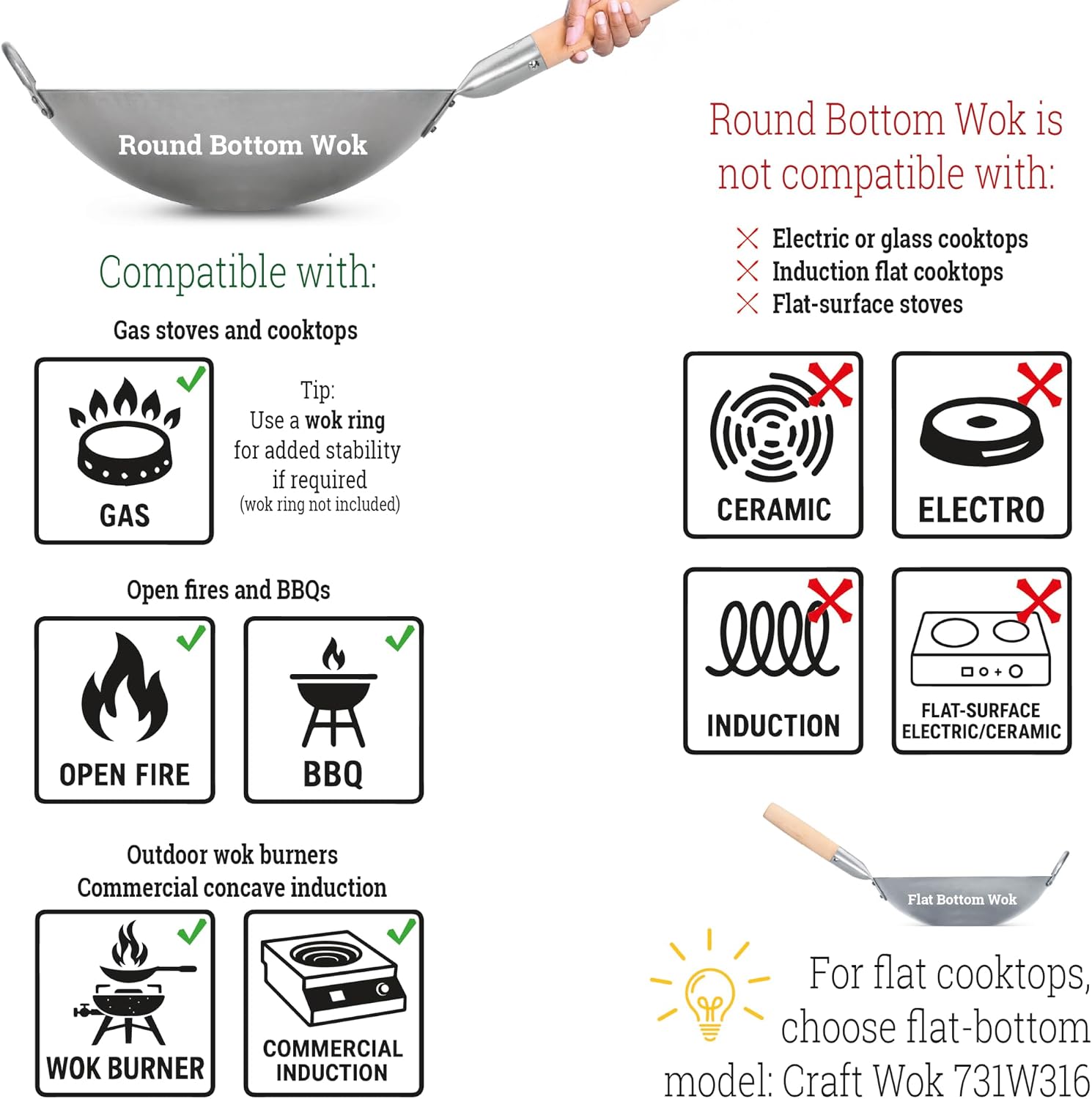
Can I use a round-bottom wok on a standard Western gas range without a wok ring? It depends on your grate geometry. Most Western residential gas ranges have flat or slightly contoured grates that won’t cradle a round-bottom wok safely — the pan rocks and creates a hazard. A wok ring stabilizes it, but also raises the pan further from the flame and reduces heat transfer. Serious Eats’ wok coverage recommends flat-bottom woks for most Western home ranges specifically because they sit directly on the grate and receive maximum flame contact without additional hardware.
What is bluing and do I have to do it before seasoning a new carbon steel wok? Bluing is the process of heating bare carbon steel to high temperature until the factory coating burns off and the metal surface oxidizes to a blue-gray color. You don’t skip it if your wok arrives with a factory anti-rust coating — skipping it means seasoning over a barrier layer that will eventually delaminate and take your seasoning with it. Some woks (like the Yosukata Blue) arrive pre-blued from the factory and can proceed directly to seasoning. Check the manufacturer’s documentation.
Why does the metal collar on the Yosukata handle get so hot? The metal collar connecting the wooden handle to the wok body is continuous with the pan’s steel, which means it conducts heat directly. During high-heat cooking, this collar can reach temperatures that make it uncomfortable or dangerous to touch without protection. This is a design characteristic rather than a defect — owners report it consistently. Keep a folded kitchen towel or silicone grip nearby for any contact near that collar during cooking.
What size wok is best for a family of four doing serious stir fry? 14 inches is the consensus recommendation for a household of three to four for stir-fry. A 12-inch wok undercrowds the heat zone when you’re cooking a full pound of protein plus vegetables — food steams rather than sears. A 16-inch wok exceeds the capacity of most home burners to heat evenly and becomes unwieldy for toss cooking. Wirecutter’s wok guide lands on 14 inches as the practical optimum for this use case.
How does a nitrided carbon steel wok differ from a standard carbon steel wok for seasoning? The nitrided surface is harder and more corrosion-resistant at the microscopic level, so it’s less prone to rust during the initial seasoning period when the protective oil layer is still thin. The seasoning process — thin coats of oil, polymerized at high heat — works the same way on both surfaces. The practical difference is that a nitrided wok is more forgiving if you miss a seasoning layer or dry it imperfectly. For experienced carbon steel cooks, the difference is modest. For cooks newer to the material, it’s meaningful.
Can a carbon steel wok replace a skillet for everyday non-Asian cooking? Partly. A well-seasoned carbon steel wok is excellent for eggs, sautéed vegetables, and quick sears on proteins — the same high-heat responsiveness that makes it great for stir-fry also makes it useful for pan sauces and fast weeknight cooking. Where it doesn’t substitute well: braising (the sloped walls make liquid-to-ingredient ratios awkward), and anything requiring a flat sear across a large protein surface where a skillet’s flat bottom is genuinely superior. Think of the wok as expanding your range, not replacing the skillet.
The Decision Frame
If you’re building intuition and want a reliable performer with a lower preparation learning curve, a hand-hammered carbon steel wok in the 14-inch, 1.5–2mm gauge range — Craft Wok being the most frequently cited entry point — is the purchase that experienced owners most consistently validate. Remove the handle before bluing. Season in thin layers. Expect three to five sessions before performance stabilizes.
If you’re coming from a serious carbon steel background and want a material step up in corrosion resistance and out-of-box consistency, the nitrided category — with the Procasa as the current high-water mark in aggregated experienced-owner reviews — is worth the premium.
If aesthetic continuity with the cooking environment matters to you, the Yosukata Blue’s factory finish is genuinely distinctive. Just go in knowing the handle collar runs hot, and that the pan is beautiful enough that some owners report hesitating to use it. That’s a feature and a warning simultaneously.
The Made In wok earns a specific recommendation for the cook who wants one thoughtfully engineered, American-marketed pan that a forty-year wok veteran finds genuinely impressive. It’s the crossover pick for the buyer whose carbon steel reference point is a Matfer skillet.
The round-bottom versus flat-bottom question? Flat-bottom for Western ranges, full stop, unless you have a commercial-grade wok burner or a dedicated outdoor setup. That decision takes thirty seconds. The gauge, the handle, and the preparation sequence take thirty minutes to get right — and that’s where the actual outcome is determined.