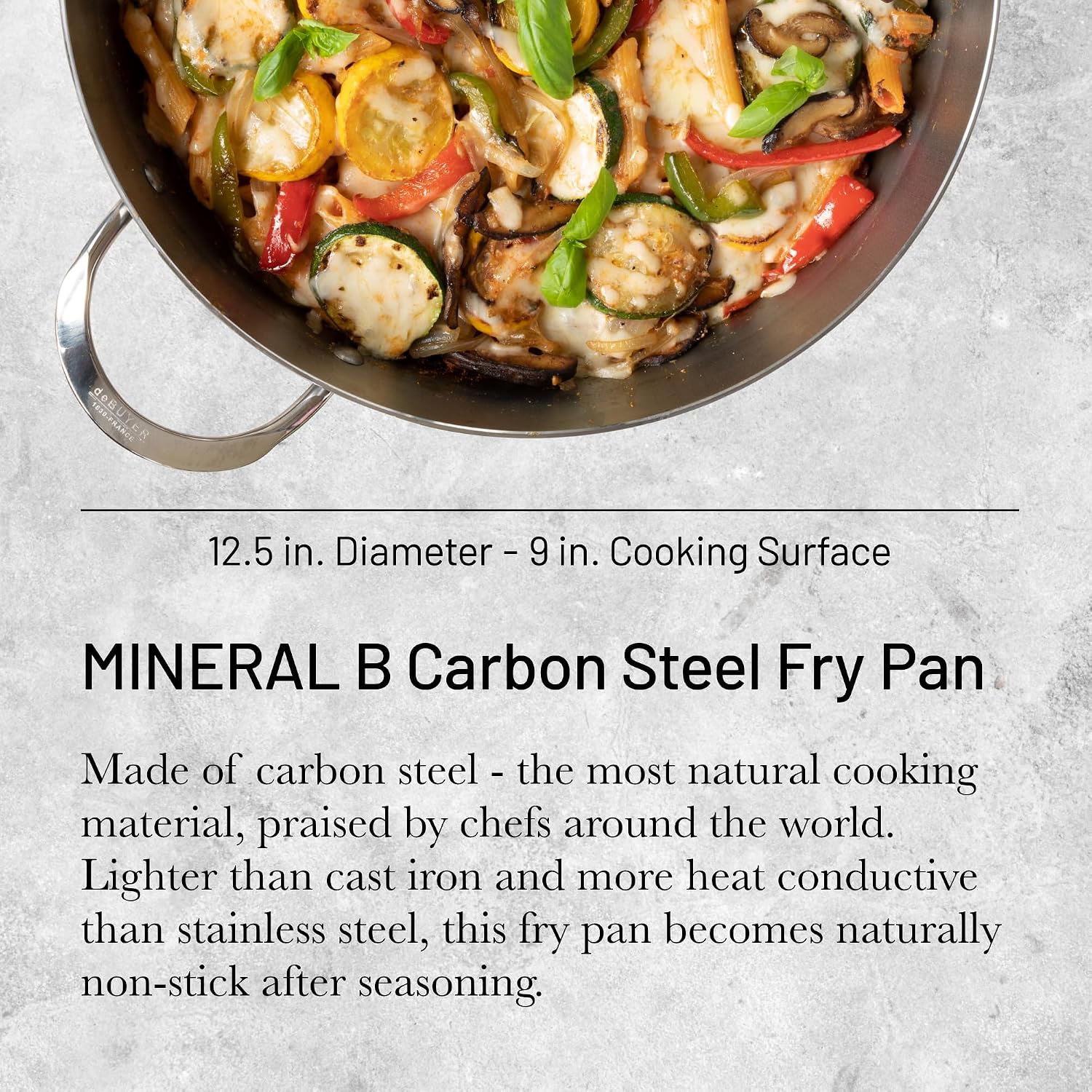
You bought the carbon steel pan — or you’re about to. Maybe you’ve seen it glide through pro-kitchen line-ups on every cooking show, or you’ve heard a culinary-school grad insist it’s the only pan worth owning. Carbon steel (a metal alloy of iron and roughly 1% carbon, lighter and more responsive than cast iron) sits in an interesting middle ground: it can develop a nonstick-like surface over time through seasoning — the process of baking thin layers of polymerized oil onto the metal until they bond and build a slick, protective patina. It heats faster than cast iron, tolerates higher temperatures than stainless, and handles everything from a sear to a crepe. The pitch is compelling. But there’s a cost the marketing never fully names: the seasoning curve — the weeks or months of careful cooking, maintenance, and occasional frustration before that pan behaves the way you were promised. This guide names that cost precisely, compares the major pans on the market based on published specs and aggregated owner feedback, and gives you a clear decision framework before you commit.
What “The Seasoning Curve” Actually Means — In Time, Effort, and Opportunity Cost
Seasoning isn’t a single event. It’s a cumulative process. The first three to five uses of a carbon steel pan are genuinely unpredictable — eggs stick, fond builds unevenly, and you’ll probably reach for your stainless out of frustration at least once. Wirecutter’s 2025 carbon steel review notes that “most pans require at least a month of regular cooking — primarily with fats — before the surface becomes reliably nonstick.” Cook’s Illustrated echoes this in their 2024 skillet review, describing a “break-in window” of four to eight weeks for home cooks who use the pan three to four times per week.
That’s real time. If you’re a supper-club host with a Saturday dinner in three weeks, buying an unseasoned carbon steel pan today and expecting frictionless crepes by service is optimistic. The curve punishes impatience and rewards repetition.
Here’s what the curve actually demands, operationally:
- Initial seasoning session: 30–60 minutes of oven cycling at 450–500°F with a neutral high-smoke-point oil, repeated 2–4 times. This is the foundation layer.
- First three to five cooks: High-fat, forgiving foods only — bacon, sautéed mushrooms, fried potatoes. No eggs. No acidic ingredients. No deglazing with wine or citrus, which strips young seasoning.
- Maintenance after each use: Hand-wash only (no soap on young seasoning, ever), dry immediately on a burner, apply a paper-towel-thin layer of oil before storage. This adds roughly four to six minutes per cook session.
- Recovery after a strip event: If you accidentally steam-clean or leave moisture on the pan, you may see rust within 24 hours on an unseasoned surface. That means re-seasoning from scratch — back to the oven for 90 minutes.
For a practitioner who’s already running a tight kitchen workflow, that maintenance overhead compounds. The question isn’t whether carbon steel performs once seasoned — virtually every serious review confirms it does. The question is whether your current usage patterns support the seasoning curve without disrupting your kitchen rhythm.
The Pan Specs That Actually Determine Your Timeline
Not all carbon steel behaves identically. The seasoning curve’s length and difficulty are materially affected by three published specifications: gauge (thickness), surface texture, and pan weight.
Gauge (thickness) is measured in millimeters and determines both heat retention and seasoning adhesion. Thinner pans (1.5–2mm) heat faster and respond to burner adjustments more immediately — useful for crepes and eggs once seasoned — but they also warp more easily during early high-heat seasoning cycles. Thicker pans (2.5–3mm) are more forgiving but slower to season evenly. Serious Eats’ 2025 carbon steel review identifies 2–2.5mm as “the practical sweet spot for most home cooks.”
Surface texture matters more than most buyers realize. Some pans arrive with a smooth, machine-pressed surface (de Buyer’s Mineral B line, for example, ships with a beeswax coating you melt off before first use). Others have a slightly textured, sand-blasted finish (Matfer Bourgeat’s Black Steel line) that some owners report accepts early seasoning layers more evenly. Saveur’s carbon steel guide notes that the Matfer surface “builds seasoning visibly faster” in early use, though the long-term end-state is comparable across both styles.
Weight affects practical usability during the curve window. A 10-inch carbon steel pan weighs roughly 3.5–4.5 lbs depending on gauge — heavier than a comparable stainless tri-ply but significantly lighter than cast iron. For cooks doing repeated sauté motions, this matters over a four-hour service.
By the Numbers: Key Spec Comparison
| Pan | Gauge | Weight (10”) | Surface Prep | Est. Street Price (2026) |
|---|---|---|---|---|
| de Buyer Mineral B | ~2.5–3mm | ~4.0 lbs | Beeswax-coated | $65–$80 |
| Matfer Bourgeat Black Steel | ~2mm | ~3.5 lbs | Sand-blasted | $70–$90 |
| Lodge Carbon Steel | ~3mm | ~4.5 lbs | Pre-seasoned | $45–$60 |
| Blu Skillet Ironware | ~2–2.5mm | ~3.8 lbs | Hand-seasoned | $175–$210 |
Prices sourced from aggregated retail listings as of May 2026; street prices fluctuate by ±10–15% seasonally.
Where the Real Cost Hides: Opportunity Cost and the First-Mover Penalty
Here’s the tradeoff most buying guides skip: the seasoning curve extracts its cost in opportunity cost as much as in effort.
A fully seasoned carbon steel pan — after two to three months of consistent use — outperforms nonstick on high-heat tasks, is oven-safe to temperatures that would warp most nonstick (typically 500°F+), and can last decades. The cost-per-use math, as Wirecutter’s 2025 review frames it, “strongly favors carbon steel over any PTFE-coated nonstick if you keep the pan five or more years.” A $75 de Buyer Mineral B replacing a $50 nonstick every two years crosses the break-even point around year three.
But during the curve window, you’re cooking on a pan that is actively worse than what you could have bought instead. That’s the first-mover penalty — you’re paying today for a payoff that arrives in month three. If your cooking volume is low (say, twice a week), that month-three target slides to month six or later.
The Lodge Carbon Steel, notably, ships pre-seasoned from the factory — which compresses the initial curve. Across aggregated owner reviews on retail platforms and in Wirecutter’s assessment, owners report the Lodge pre-seasoning as “functional but thin,” meaning it provides a head start but still requires four to six additional cook cycles before it’s reliable for eggs. It’s a shorter curve, not an eliminated one. For a beginner-practitioner who needs faster results, the Lodge’s lower price point and pre-seasoned head start make it a sensible entry. For someone who’s already comfortable with cast iron maintenance and wants a lighter, more responsive pan, the Matfer Bourgeat or de Buyer Mineral B represent the professional-grade upgrade that most culinary-school curricula default to.
The Maintenance Tax: What You’re Signing Up For Long-Term
Assuming you get through the seasoning curve — congratulations, you have one of the most capable pans a home cook can own. What does ownership look like from month four onward?
The honest answer is: lower than most buyers fear, but non-zero.
What you cannot do (ever):
- Soak in water or run through a dishwasher
- Cook highly acidic foods (tomato sauce, wine reductions) for extended periods — short deglazes are fine on a mature seasoning, but 20-minute braises with citrus will strip it
- Store without a thin oil layer if you’re in a humid climate
What you can do:
- Use metal utensils freely — carbon steel is not a nonstick coating, it’s a bonded polymer layer over metal, and it handles spatulas and tongs without concern
- Re-season spot repairs on the stovetop in under five minutes if you nick a section
- Restore a fully stripped pan in one 90-minute oven session
Serious Eats’ 2025 review summarizes it well: “A well-seasoned carbon steel pan is essentially self-maintaining as long as you cook with fat regularly. The ongoing care requirement is modest — it’s the initial investment that separates committed users from people who let the pan sit in a cabinet.”
That last clause is real. The carbon steel graveyard — the cabinet above the refrigerator where well-intentioned pans go to rust — is populated by buyers who underestimated the curve and overestimated their weekly cooking frequency.
The Decision Framework: If X, Then Y
You’re at the decision point. Here’s the explicit tradeoff map:
If you cook four or more times per week and currently own cast iron → You already have the maintenance habits. Carbon steel’s lighter weight and faster heat response are a genuine upgrade. Start with the Matfer Bourgeat Black Steel or de Buyer Mineral B. Budget $70–$90 and three to four weeks of intentional break-in cooking.
If you cook two to three times per week and want faster results → The Lodge Carbon Steel’s pre-seasoned surface and $45–$60 price point lower your barrier to entry. You’ll still need four to six additional break-in cooks, but you’re starting ahead of the curve.
If you’re a supper-club host or private chef who needs reliable performance in under two weeks → Consider seasoning the pan aggressively over four to five consecutive oven sessions before using it on service. This front-loads the curve into a single weekend. Alternatively, defer the carbon steel purchase until you have a lower-stakes window for break-in, and use your existing stainless for the next event.
If you want near-nonstick performance without the curve → Carbon steel is the wrong answer right now. A well-rated ceramic-coated stainless like the Always Pan or a PTFE nonstick gives you that surface immediately, with the understanding that it carries its own lifespan tradeoffs (most quality nonstick coatings degrade meaningfully by year two to three under regular high-heat use).
If you’re buying as a gift → Carbon steel is a meaningful, high-craft gift — but it requires the recipient to be both informed and committed. Pairing a de Buyer Mineral B with a clear printed care card and a bottle of quality flaxseed oil is thoughtful. Giving it cold with no context is how pans end up rusting in that cabinet.
The pan’s performance ceiling is genuinely high. The cost is real, measurable, and front-loaded. If your current cooking frequency and patience horizon match the curve, it’s one of the best long-term investments in your kitchen — and the cost-per-use math confirms it. If they don’t match yet, that’s not a failure. It’s just a timeline question, and carbon steel will still be worth buying when your workflow is ready for it.