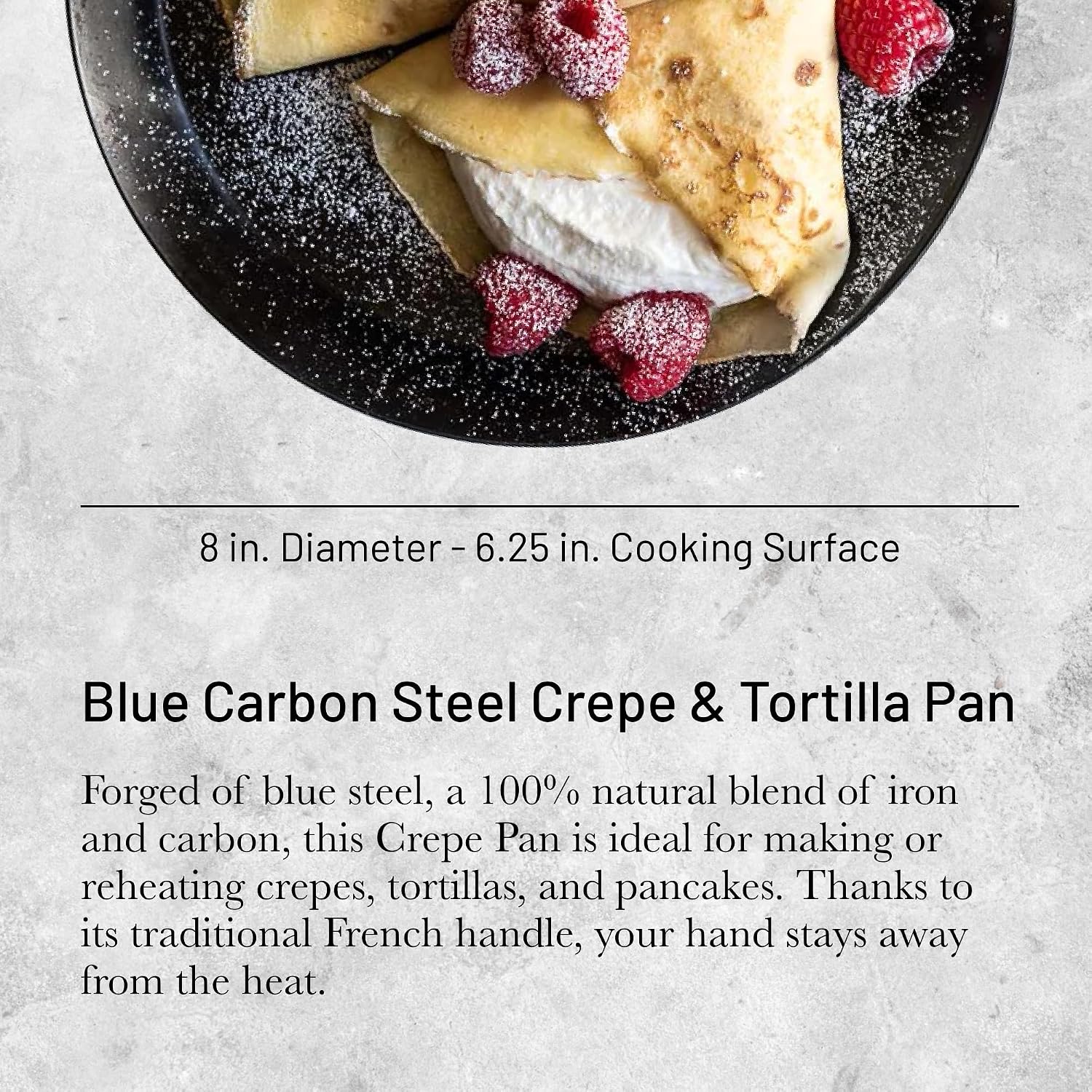
You’ve got a crêpe recipe — or a dosa, or a perfect fried egg — and someone in a cooking forum told you to skip the nonstick and get a blue carbon steel pan. Now you’re staring at product pages and trying to figure out what “blue” even means, whether de Buyer’s blue line is different from their Mineral B, and why some Strata owners are evangelical about a step called “bluing” while other buyers returned the pan in frustration. Carbon steel (an alloy of iron and a small percentage of carbon, thinner and lighter than cast iron but with similar heat retention and seasoning behavior) has earned a serious following among home cooks who want a pan that builds a natural nonstick surface over time — no coatings, no PFAS concerns, no expiration date on performance. The “blue” designation adds one more wrinkle worth understanding before you spend $60 to $120. This guide breaks down exactly what you’re buying, what the bluing step does, and which pan earns its place in your rotation.
| EDITOR'S PICKSTRATA Carbon Steel Clad 10.5"… | Mid-tierde Buyer Blue Carbon Steel Crep… | Budget pickde Buyer Blue Carbon Steel Crep… | |
|---|---|---|---|
| Diameter | 10.5" | 8" | 7" |
| Cooking surface | — | 6.25" | 5.25" |
| Weight | 2.4 lbs | — | — |
| Construction | 3-ply, aluminum core | — | — |
| Blue finish | — | ✓ | ✓ |
| Pan type | Frying pan | Crepe/tortilla | Crepe/tortilla |
| Price | $119.00 | $35.00 | $30.00 |
| See on Amazon → | See on Amazon → | See on Amazon → |
What “Blue Carbon Steel” Actually Means — and Why It Matters for Seasoning
Standard carbon steel pans are milled bright silver. Blue carbon steel pans go through a heat-treatment process — typically a controlled oxidation in a factory furnace — that creates a thin layer of ferrous oxide (black iron oxide, or magnetite) on the surface. This layer turns the steel a characteristic blue-gray-black color, which is where the name comes from. It is not a coating in the conventional sense; it’s a transformation of the metal’s surface chemistry.
Here’s why that matters practically: that blued surface is slightly more reactive and porous than raw bright steel, which means it bonds with polymerized oil — the foundation of seasoning — more readily. Owners consistently report that blued pans develop an initial seasoning layer faster and more evenly than unblued carbon steel, and that the seasoning anchors more durably once established. Serious Eats’ carbon steel skillet guide notes that blue steel’s pre-oxidized surface gives it a head start on the seasoning process that new cooks especially appreciate.
What bluing is not: it is not a permanent nonstick finish by itself. The ferrous oxide layer is microscopically thin and will not protect the pan from rust or provide nonstick performance on its own. You still need to season — the bluing just makes that seasoning step more effective. This distinction is the single most important thing to understand before you fire up the stove.
By the numbers:
- Blue carbon steel gauge at de Buyer: 2mm (blue crêpe pan, 11-inch frying pan)
- Strata 3-ply carbon steel: manufacturer-rated at approximately 2.8mm overall construction
- Typical nonstick coating lifespan: 2–5 years under regular use
- Owner-reported carbon steel lifespan when maintained: 20+ years (multiple long-run reviews)
de Buyer Blue vs. Mineral B: The Practical Differences
De Buyer makes two primary carbon steel lines that create real confusion at the purchase decision: the Mineral B and the Blue (also called Carbone Plus in some markets). Here’s how they actually differ.
The Mineral B has a beeswax factory coating applied before shipment — it protects the pan during transit and gives it an initial burnished look. The beeswax needs to be burned off or washed off before you season. The Blue line, by contrast, ships with the blued ferrous oxide surface and no wax coating. This means the Blue goes straight to seasoning with no prep step needed beyond a basic wash.
In terms of gauge, de Buyer’s Blue frying pan and crêpe pan run at 2mm. Reviewers who’ve handled both lines describe the 2mm as the ideal calibration point: heavy enough to signal genuine quality and provide meaningful heat retention, light enough to maneuver comfortably over a long cooking session. One frequently cited review of the 11-inch Blue frying pan puts it precisely: the 2mm gauge is “heavy enough where I don’t doubt I bought a cheap product, but light enough to maneuver” — a description that holds up across multiple independent accounts.
Does the Blue season faster than the Mineral B? Based on owner reports aggregated across major retail reviews, the answer is yes — marginally. The pre-blued surface does appear to take the first several seasoning rounds more readily. However, the long-run difference largely disappears after three to five seasoning cycles; both pans reach equivalent performance if maintained consistently. Cook’s Illustrated’s carbon steel equipment review notes that any carbon steel pan — regardless of surface prep — requires patience during the break-in phase, and that outcome differences between pan treatments narrow significantly after the first month of regular use.
The de Buyer Blue Crêpe Pan: Not Just for Crêpes
Here’s the use-case question that comes up constantly: is the de Buyer blue crêpe pan a specialty tool, or can it function as a daily skillet?
The honest answer is that it depends on what you cook. The crêpe pan’s design — very low, gently sloped sides, wide flat cooking surface — makes it exceptional for anything that benefits from easy access and low edges: crêpes, dosas, omelettes, fried eggs, pancakes, flatbreads of any kind. A dosa-maker’s account that surfaces repeatedly in owner reviews is worth noting directly: initial hesitation about weight and maintenance gave way to complete conversion once the technique clicked, with the low sides specifically credited for making the spreading and flipping motion intuitive.
What it is not optimized for: deep sautéing, searing proteins that generate significant splatter, or cooking with large volumes of liquid. The low walls that make crêpe work elegant become a liability when you’re browning sausage or reducing a sauce. For those tasks, the Blue frying pan (with its standard skillet profile) is the better instrument.
The longevity data here is striking. Multiple owner reviews document using the same de Buyer blue crêpe pan multiple times per week for over 20 years with zero performance degradation — no warping, no seasoning failure, no structural issues. The Fine Cooking overview of carbon steel pans describes this kind of lifespan as the core value proposition of the category: the cost-per-year math on a $70 pan used for two decades is genuinely difficult to argue against.
Strata 3-Ply Carbon Steel: What the Bluing Step Does for This Pan
Strata’s carbon steel line occupies a different position in the market. Where de Buyer Blue is single-layer carbon steel with a blued surface, Strata’s 3-ply construction sandwiches the carbon steel between layers (similar in concept to tri-ply stainless, where a conductive core is clad with working surface layers). This construction aims to reduce the hot-spot behavior that single-layer carbon steel can exhibit on gas burners with uneven flame patterns, and to improve induction compatibility and even heat distribution.
The bluing step matters more for Strata than for almost any other pan in the category — and the review pattern here is unusually clear. The Spruce Eats’ carbon steel pan round-up and aggregated owner reviews both surface the same pattern: owners who love the Strata uniformly credit the bluing step as the key to their success and describe the process in detail, while negative reviewers appear to have skipped it. This is the single most actionable insight from the owner data: with Strata’s 3-ply construction, the bluing and seasoning sequence is not optional maintenance — it is the activation step that determines whether the pan works.
How to season a Strata 3-ply carbon steel pan (and how it differs from plain carbon steel):
The process is conceptually the same as single-layer carbon steel but requires slightly more attention to even heating, because the 3-ply construction holds heat differently across the surface. The sequence that owners report most consistently:
- Wash the pan with warm water and a small amount of dish soap to remove any factory residue. Dry completely.
- Apply a very thin layer of high-smoke-point oil (flaxseed, grapeseed, or refined avocado oil are most commonly cited) across the entire surface — cooking surface, sides, and exterior.
- Wipe off nearly all the oil until the surface looks almost dry. Excess oil produces sticky, uneven seasoning.
- Place in an oven at 450–500°F (230–260°C), upside down, for one hour. Allow to cool in the oven.
- Repeat 3–4 times before first use.
The difference from plain carbon steel: because Strata’s construction responds more evenly to oven heat than stovetop heat during initial seasoning, reviewers specifically recommend oven seasoning over stovetop seasoning for the first several rounds. With plain single-layer carbon steel, stovetop seasoning is viable from the start.
If Your Seasoning Strips: The Recovery Process
Seasoning loss on blue carbon steel — whether from an acidic dish cooked too long, a cleaning mishap, or simply neglect — is recoverable. This is one of the category’s defining advantages over coated nonstick, where surface damage is typically permanent.
One reviewer makes the PFAS comparison explicitly, dismissing ceramic nonstick as “relabeled PFAS” — a strong sentiment that reflects real anxiety in the market, though it’s worth noting that the safety data on ceramic coatings is more nuanced than that framing suggests, and regulatory bodies including the EPA have not classified ceramic coatings as equivalent to PFAS compounds. What’s accurate and not contested: carbon steel has no synthetic coating to degrade, fail, or potentially flake into food. That’s a legitimate durability and longevity argument independent of specific safety claims.
When seasoning strips, the recovery process mirrors the initial seasoning sequence:
- If there’s rust, scrub with a stainless steel scrubber or fine steel wool until bare metal shows. Rinse and dry immediately — carbon steel rusts fast when wet.
- Apply the thin oil layer, wipe nearly dry, and run the oven cycle as described above.
- Cook fatty, forgiving foods (bacon, sausage, fried potatoes) for the first several sessions to rebuild the seasoning layer through use.
The ferrous oxide layer from the original bluing is not necessarily lost when seasoning strips — often it remains as the base layer. Owners report that re-seasoning a blued pan after stripping is typically faster than the initial seasoning process, because that base oxide layer still provides favorable surface chemistry.
Frequently Asked Questions
What exactly is bluing, and do you have to do it before seasoning a blue carbon steel pan? Bluing is a factory heat-treatment that creates a ferrous oxide layer on the steel surface. You do not have to re-blue the pan yourself — it arrives already blued. You simply wash, dry, and begin seasoning. The bluing is the substrate; seasoning goes on top of it.
How is de Buyer Blue different from the Mineral B, and does it season faster or differently? The Blue ships without the Mineral B’s beeswax factory coating, so there’s no prep step before seasoning. It does appear to season slightly faster in the first few cycles based on owner reports, because the blued surface bonds with oil more readily than bright steel. After several seasoning rounds, performance between the two lines converges.
Can a de Buyer blue crêpe pan be used as a daily skillet, or is it only for crêpes and omelettes? It functions well as a daily skillet for low-wall tasks — eggs, flatbreads, dosas, pancakes, quesadillas — but its shallow sides make it a poor choice for sautéing with significant liquid or searing proteins that generate splatter. If you want one pan to do both, the Blue frying pan is the better choice; if you cook crêpes and eggs daily, the crêpe pan is exceptional.
How do you season a Strata 3-ply carbon steel pan, and is the process different from plain carbon steel? The process is the same in principle, but Strata owners consistently recommend oven seasoning over stovetop for the initial rounds, because the 3-ply construction heats more evenly in an oven than over a burner flame during the critical bonding phase.
If seasoning strips on a blue steel pan, what is the correct recovery process? Remove any rust with fine steel wool, wash, dry completely, apply a nearly-dry thin oil layer, and run oven seasoning cycles. The underlying blued oxide surface typically remains even when top seasoning layers strip, which means recovery is usually faster than the original seasoning process. Cook fatty foods for the first several sessions to rebuild through use.
The decision rule: If you cook crêpes, dosas, eggs, or flatbreads multiple times a week and want a pan that will outlast every coated nonstick you’ve ever owned, the de Buyer Blue crêpe pan is one of the clearest value propositions in the entire cookware category. If you want a more versatile daily driver with improved heat evenness across different burner types, the Strata 3-ply is worth the premium — but only if you commit to the full bluing-and-seasoning sequence before your first cook. Skip that step and the reviews suggest you’ll join the wrong camp of owners.